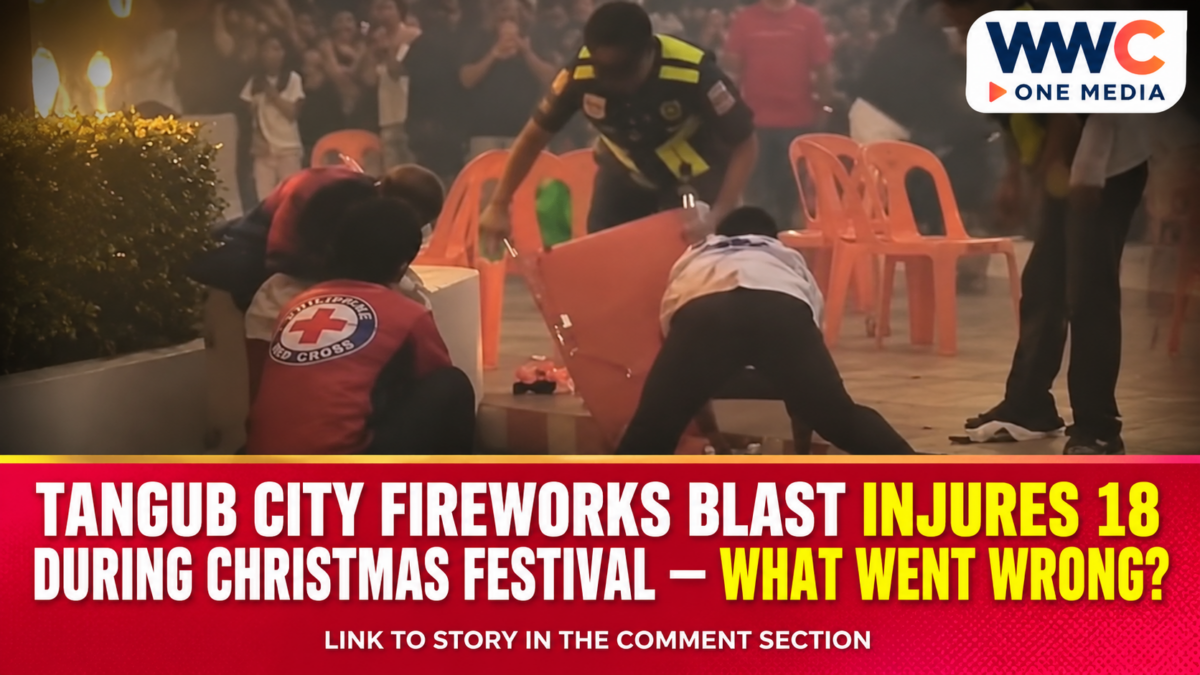
TANGUB CITY, MISAMIS OCCIDENTAL, Philippines — A Christmas celebration turned into a public safety emergency after a fireworks explosion injured 18 people during the opening of Tangub City’s Festival of Lights on November 21, 2026.
The city government confirmed the injury count in an official statement published on November 23, assuring residents and visitors that assistance had been provided to those affected and that an investigation was underway.
The Tangub City fireworks blast occurred during the opening of the Festival of Lights: Pasko sa Pamilya at Tangub City Plaza, raising questions about the safety measures surrounding large public celebrations as the Christmas season approaches.
While all victims were described as safe in the city’s statement, some continued to receive medical care.
The precise technical cause of the accident and whether any safety requirements were violated remain unresolved.
What Happened During the Tangub City Fireworks Blast?
The city’s preliminary account indicates that the fireworks display did not proceed as intended, resulting in an explosion that injured people attending the celebration.
The incident transformed an event intended to bring families and communities together into an emergency requiring assistance for multiple victims.
The local government subsequently launched an investigation to establish the circumstances surrounding the accident.
An important distinction must be made between describing what happened during the display and determining why it happened.
The initial account does not establish whether the incident resulted from a defective product, an operational problem or another contributing factor. Those possibilities should not be treated as confirmed findings without supporting evidence.
For the affected families, however, the immediate priority remains recovery and access to appropriate medical treatment.
Tangub City Government Confirms Assistance for 18 Victims
The local government extended assistance following the incident and committed to monitoring the condition of those affected.
Its November 23 statement confirmed that some victims were still receiving medical attention, although it did not provide an individual breakdown of their injuries or specify how many remained under treatment.
The city also reaffirmed its commitment to supporting those affected.
The financial and medical implications of an accident at a public gathering can extend beyond the initial emergency response.
Depending on the severity of an injury, affected individuals may require continuing treatment, rehabilitation or time away from work. These are potential consequences rather than confirmed circumstances involving the Tangub victims.
A comprehensive update on their recovery would help establish the longer-term impact of the incident.
Why Fireworks Safety Is Under Renewed Scrutiny
The Tangub incident comes at a particularly relevant point in the festive calendar, when communities are preparing for Christmas and New Year celebrations.
The central concern is not whether communities should celebrate with fireworks, but how organisers can ensure that entertainment does not compromise public safety.
Questions surrounding licensing, event preparation and regulatory compliance are especially relevant to organised displays involving large gatherings.
Related concerns are explored in WWC ONE MEDIA’s coverage of firecracker permit requirements and holiday-season enforcement in Davao.
Although the Tangub accident remains under investigation, the incident provides a compelling reason to examine whether existing protections are being implemented effectively.
What Philippine Regulations Require for Fireworks Displays
The Philippines has an established regulatory framework covering fireworks and firecrackers.
Republic Act No. 7183 provides the legislative foundation for controlling their production, distribution, sale and use.
Executive Order No. 28, signed on June 20, 2017, established additional safeguards intended to reduce fireworks-related injuries.
For a community fireworks display covered by the order, the requirements include an appropriate event venue, supervision by a qualified individual licensed by the Philippine National Police and permission from the relevant local government.
The permit must identify when and where the display is authorised to take place.
The regulatory framework also prohibits devices classified as illegal, including their use in otherwise authorised community displays.
These requirements make documentation and compliance important components of any investigation involving a public fireworks accident.
However, the occurrence of an accident does not automatically establish that an organiser or operator violated the law.
Any determination of responsibility must depend on evidence and the applicable legal requirements.
Public Celebrations Across Southeast Asia Face Similar Safety Questions
The Tangub incident also has relevance beyond Misamis Occidental.
Organisers of public festivals throughout Southeast Asia must balance entertainment, cultural traditions and community participation with appropriate safety preparations.
Previous regional incidents have brought attention to the consequences of fireworks being used in public areas. WWC ONE MEDIA has examined these concerns in its coverage of the Skudai Deepavali fireworks incident and subsequent court proceedings in Malaysia.
The Malaysian incident and the Tangub accident involve different circumstances and should not be treated as equivalent cases.
Nevertheless, both subjects illustrate why public safety deserves particular attention whenever pyrotechnics form part of community celebrations.
Festival preparedness involves more than selecting an entertainment programme. It also requires consideration of emergency response, communication, medical assistance and the welfare of spectators.
Similar event-management concerns are discussed in WWC ONE MEDIA’s coverage of security and public safety preparations for Cebu’s Sinulog 2027 festival.
What Happens Next in the Tangub City Investigation?
The city government has committed to investigating the accident while continuing its assistance to those injured.
Several questions remain relevant as the investigation progresses:
- What caused the fireworks display to fail?
- Were all applicable licences and permits secured?
- Were the required safety procedures followed?
- Will additional assistance be necessary for the victims?
- Will the incident result in changes to future festival safety arrangements?
These are matters requiring evidence, not assumptions about wrongdoing.
The findings could help determine whether additional precautions or regulatory measures are necessary for future celebrations.
The local government has reaffirmed its commitment to keeping the Festival of Lights meaningful and safe for residents and visitors.
For now, the confirmed facts are that 18 people were injured, assistance has been extended, some victims continued to receive medical treatment as of November 23, and an investigation is underway.
What remains unanswered is whether the accident could have been prevented — and what measures may be necessary to reduce the risk of a similar incident.