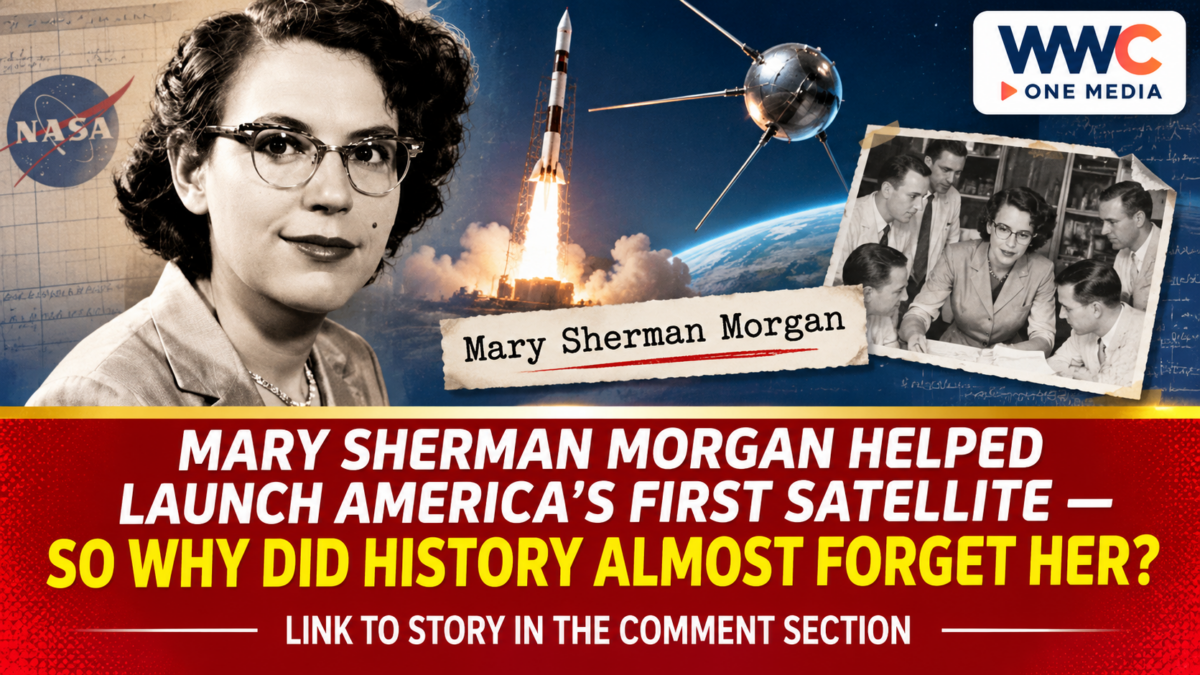
Long before astronauts became international celebrities and space exploration transformed into a global industry, an American woman from rural North Dakota helped overcome one of the engineering challenges standing between the United States and its ambitions in space.
Her name was Mary Sherman Morgan.
Working at North American Aviation, Morgan developed Hydyne, the rocket fuel used in the first stage of the launch vehicle that carried Explorer 1, America’s first successful satellite, into orbit on Jan. 31, 1958.
The achievement marked a turning point in American space exploration and contributed to one of the most important scientific discoveries of the early Space Age.
Yet Morgan’s contribution remained largely unrecognised during her lifetime.
Her extraordinary story raises a question that remains relevant nearly seven decades later: how many scientific breakthroughs owe their success to people whose names rarely appear in history books?
Mary Sherman Morgan: From Rural North Dakota to Rocket Science
Morgan’s journey into aerospace engineering began far from the laboratories and research centres associated with America’s space programme.
She grew up in rural North Dakota and attended high school in Ray, where she developed an ambition to pursue chemistry.
Her career eventually brought her to North American Aviation, placing her scientific abilities within an industry confronting increasingly demanding technological challenges.
During the early years of the Space Age, developing a successful launch vehicle required more than designing a powerful engine.
Scientists and engineers also needed reliable propulsion systems, suitable materials, accurate calculations and carefully coordinated equipment.
Rocket fuel was one particularly important part of that challenge.
Morgan’s expertise in chemistry helped address this problem, resulting in the development of Hydyne.
Her career illustrates how contributions made inside laboratories can become just as consequential as the highly visible achievements that follow.
Hydyne: The Rocket Fuel That Helped America Reach Space
The development of Hydyne came during a period of intense technological competition between the United States and the Soviet Union.
The Soviet Union successfully launched Sputnik 1 in October 1957, establishing itself as the first nation to place an artificial satellite into Earth orbit.
The achievement intensified American efforts to develop a successful satellite-launching capability.
Morgan’s work on Hydyne became part of that effort.
The fuel was used in the first stage of the Juno I rocket, a modified version of the Jupiter-C launch vehicle.
The distinction is important because Morgan did not independently design the entire rocket or build the Explorer 1 satellite. Her contribution addressed the propulsion requirements of a much larger scientific and engineering programme.
Her achievement demonstrates why individual advances in chemistry, engineering and materials science can have consequences extending well beyond their original technical objectives.
The importance of launch technology remains evident in contemporary space development, including Mitsubishi’s investment in European launch capabilities and Japan’s satellite ambitions.
Although modern commercial space programmes operate under different technological and economic conditions, dependable launch systems remain fundamental to reaching orbit.
January 31, 1958: The Launch That Changed American Space History
Explorer 1 lifted off from Cape Canaveral, Florida, on Jan. 31, 1958.
The mission brought together the work of the United States Army Ballistic Missile Agency and the Jet Propulsion Laboratory, with scientific instrumentation developed under the direction of physicist James Van Allen of the University of Iowa.
The satellite weighed approximately 14 kilograms and carried scientific equipment intended to collect information about the environment surrounding Earth.
Its successful deployment established a historic milestone: the United States had placed its first satellite into orbit.
The accomplishment was not solely the achievement of one scientist, institution or engineering team.
It depended on the combined efforts of specialists working across propulsion, spacecraft design, mathematics, instrumentation and communications.
Morgan’s fuel development was an important component of that collective achievement.
The multidisciplinary nature of space engineering continues to shape scientific research today, as demonstrated by student-led CubeSat research exploring satellite communications and antenna performance.
Explorer 1 Uncovered an Invisible Feature of Earth
The significance of Explorer 1 extended far beyond establishing America’s presence in space.
Its cosmic-ray detector produced unexpected measurements that prompted Van Allen to investigate whether intense radiation was interfering with the instrument.
The observations contributed to the discovery of regions containing energetic charged particles confined by Earth’s magnetic field.
These regions became known as the Van Allen radiation belts.
Additional measurements from Explorer 3, launched in March 1958, helped confirm the discovery.
The findings demonstrated how satellites could provide scientific information that could not be obtained through conventional ground-based observations alone.
Explorer 1 transformed a major engineering achievement into an important scientific mission.
The ability to collect and transmit information from spacecraft remains essential to modern exploration, a challenge reflected in NASA’s continuing efforts to maintain communication with the historic Voyager 1 spacecraft.
Why Mary Sherman Morgan’s Contribution Was Nearly Forgotten
Despite her role in developing Hydyne, Morgan did not achieve the widespread public recognition associated with several prominent figures of the American space programme.
She died in 2004.
Her son, George D. Morgan, subsequently undertook research to reconstruct her professional history and document her contributions.
His efforts resulted in a stage production titled Rocket Girl, which premiered at the California Institute of Technology in 2008.
The production was developed using historical research and interviews with engineers who had worked with his mother.
In July 2013, George published a book examining her life, career and involvement in the American space programme.
The project helped introduce Mary Sherman Morgan’s achievements to a wider audience.
It also highlighted a broader problem in the history of scientific innovation: significant technical contributions can be difficult to establish when institutional records and individual achievements are not adequately preserved.
Recognising Morgan does not diminish the accomplishments of other engineers and scientists. Instead, it helps provide a more complete understanding of how scientific progress occurs.
Why Her Legacy Still Matters Across the Asia-Pacific
Morgan’s story remains relevant to an international audience because scientific innovation extends beyond the people who receive the greatest public attention.
Space exploration requires chemists, mathematicians, software developers, technicians, engineers and researchers whose work may never attract international headlines.
As governments and businesses pursue new opportunities in satellite technology, space research and commercial exploration, recognising the importance of these specialised professions remains essential.
The diversity of careers supporting space exploration is also examined in WWC ONE MEDIA’s coverage of NASA’s astronaut recruitment requirements and the technical capabilities needed for future missions.
Morgan’s legacy is not simply a story about overcoming professional barriers. It is also a reminder that history should recognise the people responsible for the underlying science that makes extraordinary achievements possible.
America’s first successful satellite entered orbit in 1958. But the full story of the people who helped put it there took decades longer to emerge.
Frequently Asked Questions
Who was Mary Sherman Morgan?
Mary Sherman Morgan was an American rocket fuel scientist who worked at North American Aviation and is credited with developing Hydyne, the fuel used in the first stage of the rocket that launched Explorer 1.
What did Mary Sherman Morgan invent?
Morgan developed Hydyne, a liquid rocket fuel that contributed to America’s early satellite-launching capabilities.
When was America’s first satellite launched?
Explorer 1 was successfully launched from Cape Canaveral, Florida, on Jan. 31, 1958.
Did Mary Sherman Morgan work for NASA?
Her historic rocket fuel development was undertaken at North American Aviation. Explorer 1 was launched before NASA began operations later in 1958.
What did Explorer 1 discover?
Explorer 1 provided measurements that led to the discovery of the Van Allen radiation belts, regions of energetic charged particles trapped by Earth’s magnetic field.