HONG KONG — A fatal Tsim Sha Tsui hit-and-run on November 22, 2026, has left one pedestrian dead and three others injured after a private vehicle entered a pavement along Prat Avenue. Hong Kong Police subsequently arrested the 38-year-old driver in connection with suspected drink-driving and dangerous driving causing death.
The deadly Sunday afternoon collision has raised questions about pedestrian protection, driver accountability and road safety in Hong Kong.
The arrest marked a significant development in the investigation after the motorist fled the location of the collision. However, the precise circumstances that caused the vehicle to leave the roadway remain unresolved in the verified police account.
Tsim Sha Tsui hit-and-run: What happened on Prat Avenue?
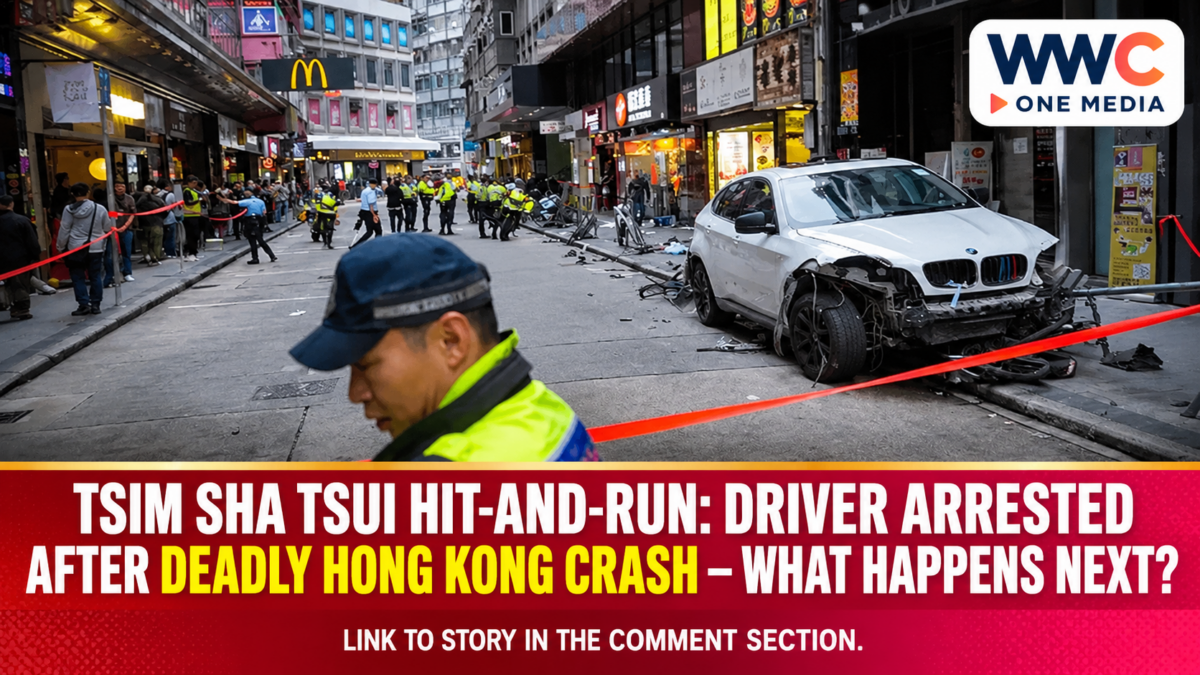
The collision occurred at approximately 2:30 p.m. near 6 Prat Avenue in Tsim Sha Tsui.
A private car heading east was suspected of losing control before entering the pedestrian pavement and striking four people. The motorist left the scene following the collision.
The incident transformed an ordinary pedestrian area into the site of a fatal traffic investigation.
One of the central questions is what caused the vehicle to depart from its intended path. Establishing the circumstances surrounding that movement will be important in determining responsibility.
The crash also illustrates the potential consequences when vehicles enter spaces intended for pedestrians, a concern relevant to other densely developed Asia-Pacific cities.
Similar road-safety questions have emerged in incidents such as the Pasir Ris van crash involving a pedestrian walkway in Singapore.
One pedestrian dead, three others injured
The four casualties were transported to Queen Elizabeth Hospital.
The deceased was a 53-year-old man who suffered severe injuries to his head. He was unconscious when transported to hospital and was pronounced dead at 3:23 p.m.
The surviving victims included a 62-year-old man with head injuries and two women, aged 31 and 70, who sustained injuries to their limbs.
All three surviving pedestrians were conscious during their transfer to hospital.
Their subsequent medical conditions have not been established in the primary record reviewed for this report.
The human consequences of the collision remain central to the investigation. Beyond the criminal allegations surrounding the driver, the incident has resulted in a death and injuries affecting three other individuals.
Pedestrian protection deserves particular attention because people travelling on foot have considerably less physical protection than occupants of motor vehicles.
Driver arrested after leaving the crash scene
Following police enquiries, the 38-year-old motorist was arrested in connection with suspected drink-driving and dangerous driving causing death.
The driver was being held for questioning when police announced the arrest on November 22.
An arrest, however, is not equivalent to a conviction. The allegations must be assessed through the appropriate investigative and judicial procedures before criminal responsibility can be established.
It would also be premature to conclude that alcohol consumption was the definitive cause of the collision without verified evidence establishing that connection.
The case presents questions about both the circumstances preceding the impact and the driver’s conduct afterwards.
The distinction between suspicion, formal charges and established guilt is similarly important in other traffic investigations, including the criminal proceedings involving former Hong Kong lawmaker William Wong following a university campus crash.
Hong Kong’s dangerous driving problem in numbers
The Tsim Sha Tsui collision comes against the backdrop of continuing traffic enforcement efforts across Hong Kong.
Provisional enforcement figures covering January to September 2026 recorded 425 drink-driving offences across the territory, compared with 447 during the corresponding period in 2025.
Dangerous driving offences, including those involving death or grievous bodily harm, totalled 801 during the first nine months of 2026, compared with 823 a year earlier.
Within Kowloon West, the enforcement figures included 143 drink-driving offences and 251 dangerous driving offences.
These statistics describe recorded enforcement activity rather than the total prevalence of dangerous behaviour or the number of convictions.
Hong Kong also recorded 17,320 traffic accidents involving casualties in 2025. Of those incidents, 92 involved fatalities and 467 involved serious injuries.
Reducing these numbers requires continued attention to both driver conduct and the design of public roads.
The fatal Prat Avenue incident cannot independently establish a worsening territory-wide road safety trend. Nevertheless, it demonstrates why declining enforcement figures should not be interpreted as evidence that serious traffic risks have disappeared.
Why pedestrian protection remains an urban priority
Road safety involves more than preventing collisions between vehicles.
The separation of moving traffic from pedestrian spaces, the effectiveness of roadside barriers and responsible driving practices are important considerations when assessing urban transport safety.
A vehicle entering a pavement can expose several people to danger within seconds.
The potential effectiveness of protective infrastructure depends on the circumstances of a collision, including the vehicle’s movement and the characteristics of the surrounding road.
Similar concerns have surfaced in regional incidents involving a vehicle entering a pedestrian island in Singapore and a fatal bus collision involving a pedestrian in Taiwan.
Hong Kong’s road safety programme includes measures addressing impaired driving, excessive speed and the protection of older pedestrians.
The Prat Avenue crash provides a compelling reason to examine whether additional precautions could reduce the consequences of vehicles entering pedestrian areas. Such an assessment should follow the evidence rather than presume that a particular infrastructure deficiency caused this incident.
What happens next in the Tsim Sha Tsui investigation?
The investigation was assigned to Special Investigation Team 1 of Traffic, Kowloon West.
People who witnessed the collision or possess relevant information have been asked to contact investigators at 3661 9188.
The principal outstanding questions concern the vehicle’s loss of control, the evidence supporting the suspected driving offences and the driver’s actions following the collision.
Further verified police or judicial developments may provide a clearer account of the incident.
The case also underscores the importance of establishing an accurate sequence of events in fatal road collisions, particularly when the motorist leaves the scene, as illustrated by another fatal hit-and-run investigation that resulted in an arrest in Cebu City.
For the families affected by the Tsim Sha Tsui crash, accountability depends on a thorough investigation and a fair assessment of the evidence.
The confirmed toll remains one fatality and three injured pedestrians, while the driver’s legal responsibility must be determined through due process.