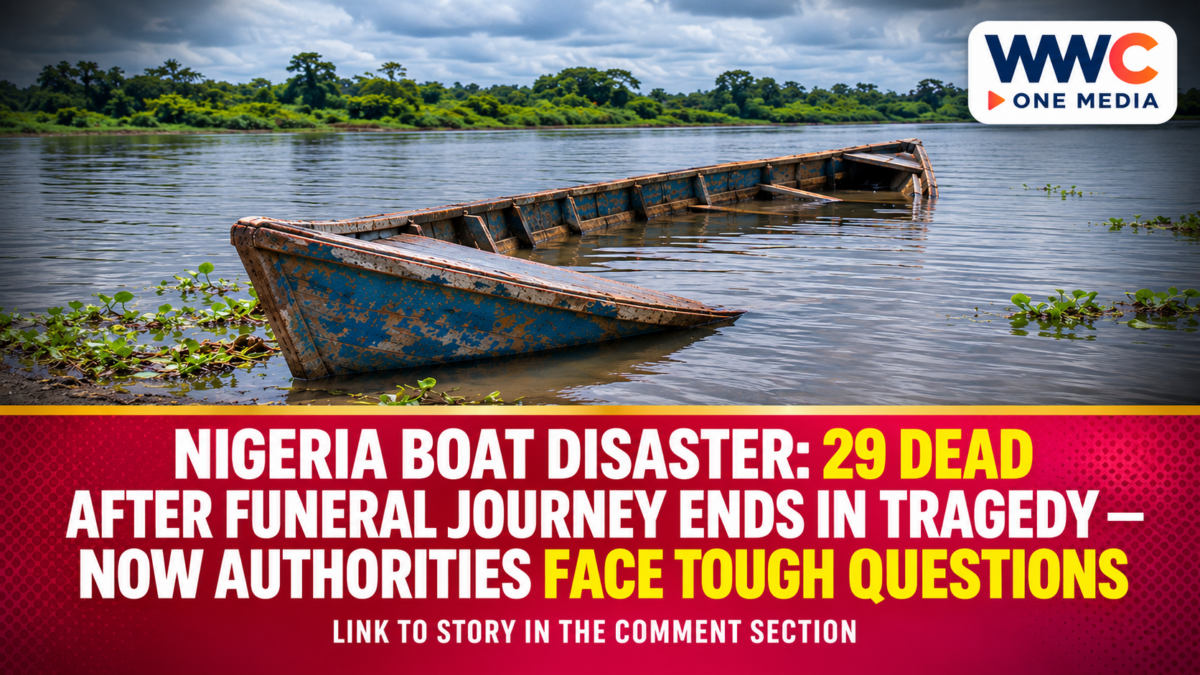
YENAGOA, NIGERIA — The Nigeria boat disaster in Bayelsa State has claimed at least 29 lives, with more than 50 passengers surviving after a vessel transporting mourners to a funeral capsized on Friday, Nov. 20, 2026.
President Bola Ahmed Tinubu has approved 250 million Nigerian naira (₦250 million) in financial assistance for bereaved families while calling for stronger enforcement of inland waterway safety standards and a comprehensive investigation into the tragedy.
What began as a journey to honour the dead has become a disaster that places Nigeria’s passenger boat safety, emergency response capabilities and regulatory enforcement under renewed scrutiny.
Nigeria Boat Disaster: What Happened in Bayelsa?
The passenger vessel was travelling from Ayama to Ukubie for a burial ceremony when it capsized near the river junction between the Oweikorogha and Otuan communities in Southern Ijaw Local Government Area, Bayelsa State.
The passengers were travelling to pay their respects to a deceased individual. Instead, the journey ended in a fatal emergency that mobilised government agencies, security personnel and community responders.
Bayelsa Governor Douye Diri subsequently disclosed that the number of confirmed fatalities had reached 29 by Sunday afternoon, Nov. 22, while more than 50 people had survived.
However, the complete passenger count and final number of people potentially unaccounted for remain important details requiring clarification.
Accurately accounting for everyone aboard is essential during maritime emergencies. As illustrated in the separate MV June Aster maritime disaster and passenger-accounting operation, rescue figures must be carefully reconciled before definitive conclusions can be reached.
Tinubu Approves ₦250 Million for Bereaved Families
Nigeria’s federal government has authorised a ₦250 million assistance package for families who lost relatives in the Bayelsa accident.
Vice President Kashim Shettima travelled to Bayelsa on Sunday at Tinubu’s direction to express the government’s condolences and meet people affected by the disaster.
Accompanied by National Emergency Management Agency Director-General Zubaida Abubakar Umar, Shettima visited survivors undergoing treatment at the Bayelsa Medical University Teaching Hospital.
He subsequently met affected families at Government House in Yenagoa.
The president has also instructed the National Emergency Management Agency to extend relief assistance to survivors.
The approved funding represents an important government commitment, although the precise allocation per family, distribution arrangements and completion of payments have yet to be established in the publicly available records reviewed for this report.
Nigeria Orders Stronger Waterway Safety Enforcement
The federal response extends beyond financial assistance.
Tinubu has called for stricter vessel inspections, greater compliance with maritime safety requirements and stronger cooperation between federal and state authorities.
A comprehensive investigation has also been demanded to establish the circumstances surrounding the fatal capsizing.
The distinction between introducing safety regulations and consistently enforcing them will be central to the government’s response.
A credible investigation should establish whether the vessel was suitable for passenger transportation, whether applicable capacity restrictions were observed and whether emergency equipment was adequate.
These are questions for investigators, not established findings of wrongdoing.
The importance of examining operational procedures before determining responsibility is also reflected in WWC ONE MEDIA’s coverage of the Occidental Mindoro passenger ferry grounding and subsequent safety investigation.
Emergency Responders Mobilised After the Capsizing
The disaster prompted a coordinated response involving emergency management personnel, security agencies, local divers and community volunteers.
Tinubu directed federal emergency response organisations to cooperate in rescue and recovery activities.
The involvement of local responders highlights the importance of community-level emergency preparedness, particularly when accidents occur in waterways where immediate access to specialised rescue equipment may be challenging.
Maritime emergencies require coordination between medical facilities, rescue personnel and transport authorities. Such cooperation is also central to the wider responsibilities examined in WWC ONE MEDIA’s coverage of Coast Guard operations, vessel inspections and maritime emergency preparedness.
Governor Siminalayi Fubara of neighbouring Rivers State separately expressed condolences to Bayelsa and acknowledged the efforts of personnel involved in the emergency response.
Why the Investigation Matters Beyond Bayelsa
Passenger transportation safety depends on several interconnected safeguards, including vessel maintenance, accurate passenger records, appropriate safety equipment and effective emergency procedures.
A breakdown in any of these areas can increase the risks associated with a maritime emergency.
However, identifying the specific failures that contributed to the Bayelsa disaster requires documented evidence.
Investigators must distinguish between the immediate circumstances of the capsizing and any underlying operational or regulatory shortcomings.
Determining those differences will be important not only for establishing accountability but also for designing measures capable of preventing similar accidents.
What Happens Next?
The immediate priorities include accounting for passengers, supporting survivors and assisting families who lost relatives.
Attention will also turn to the findings of the investigation and the implementation of the government’s promised safety enforcement measures.
The ₦250 million assistance package provides a commitment of financial support, but the broader effectiveness of the government’s response will depend on whether announced reforms translate into measurable improvements in passenger safety.
For the families affected by the Bayelsa boat disaster, the investigation carries a more personal significance.
They deserve clarity about what happened, appropriate assistance and an evidence-based explanation of whether the tragedy could have been prevented.