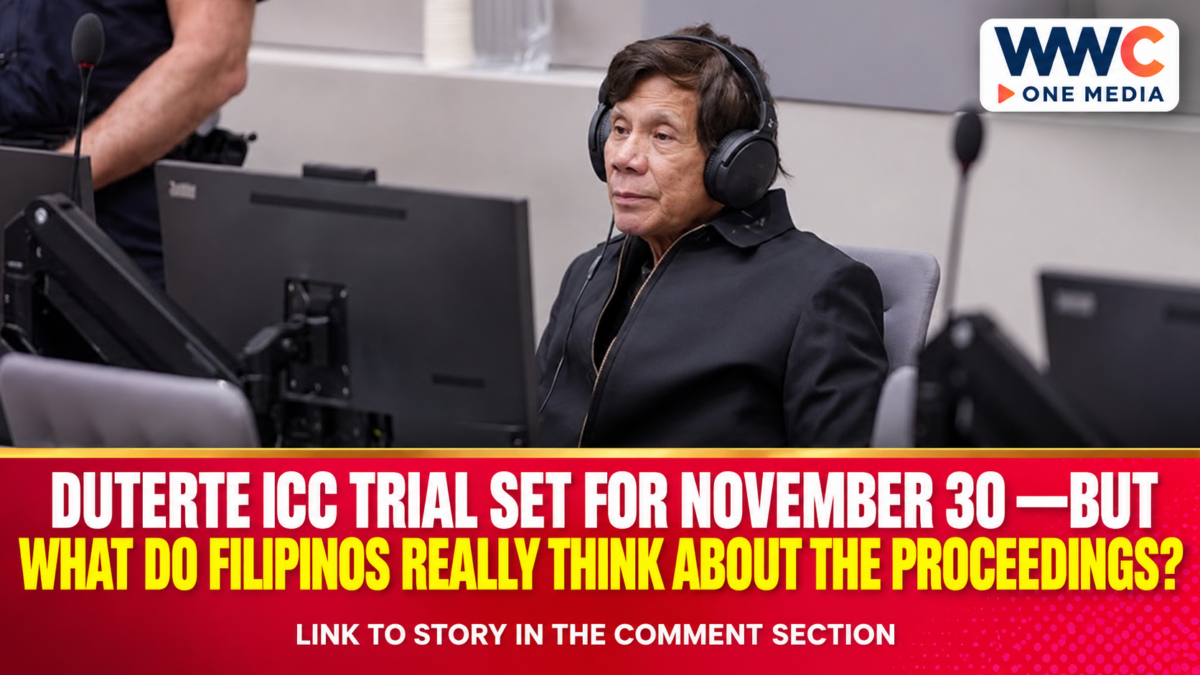
MANILA, Philippines — Former Philippine President Rodrigo Roa Duterte is scheduled to stand trial before the International Criminal Court (ICC) on November 30, 2026, following a judicial determination that he is capable of participating in the proceedings over alleged crimes against humanity.
With the opening of the Duterte ICC trial approaching, Philippine public opinion remains divided over the international tribunal and its handling of the former president’s case.
Preliminary information published by Momentum Research indicates that a majority of Filipino adults agree with the court’s fitness determination, with broader support for the former president personally facing the proceedings.
However, agreement with the court’s medical and legal assessment must not be confused with a belief that Duterte is guilty.
Duterte ICC Trial: What the Public Opinion Numbers Reveal
A separate national survey conducted by Social Weather Stations (SWS) in September 2026 found that 55 percent of Filipino adults followed reports concerning a development in Duterte’s ICC case.
Public attention to earlier developments had reached 80 percent in November 2025, 75 percent in March 2026 and 72 percent in June 2026.
The surveys examined different developments in the proceedings, meaning the figures should not be interpreted as directly comparable measures of political support.
The September findings also showed that 41 percent expressed confidence in the fairness of the proceedings, while 26 percent expressed little confidence. Another 33 percent remained undecided.
These findings illustrate an important distinction in the national conversation: Filipinos can hold different views about the former president, the international tribunal and the fairness of the judicial process.
Why Duterte Was Declared Fit to Stand Trial
The court’s fitness determination followed an assessment of Duterte’s ability to comprehend the proceedings and participate effectively in his defence.
The ICC has also provided for continued medical monitoring.
The determination addresses whether the accused can exercise his legal rights rather than whether the criminal allegations against him are true.
WWC ONE MEDIA previously examined Duterte’s appearance before the ICC during his fitness review, highlighting the significance of the health-related questions surrounding the proceedings.
Fitness to stand trial should not be interpreted as a declaration that an individual has no medical conditions.
What Criminal Charges Does Duterte Face?
The former president faces three counts involving murder and attempted murder as crimes against humanity in connection with the Philippines’ anti-drug campaign.
The case covers alleged criminal conduct associated with Duterte’s time as mayor of Davao City and his subsequent presidency.
These allegations remain subject to judicial examination.
The prosecution must establish criminal responsibility under the applicable legal standard, while the defence retains the opportunity to challenge evidence and present its arguments.
Previous procedural developments included Duterte’s challenge to the formulation of the ICC charges.
The existence of criminal charges does not establish guilt.
Why Public Opinion Cannot Decide Duterte’s Fate
The public debate surrounding Duterte’s case raises questions extending beyond his individual criminal proceedings.
Support for a trial does not necessarily mean support for a conviction. Similarly, questioning the ICC’s decisions does not automatically establish that the allegations are unfounded.
An individual may support accountability while also insisting that the accused receives fair treatment, adequate medical care and meaningful access to legal representation.
These principles are not mutually exclusive.
For families affected by alleged drug war killings, the proceedings represent an opportunity for their concerns to be heard through a judicial process.
For Duterte and his supporters, the proceedings also raise important questions about the treatment of the accused and the protection of defence rights.
The credibility of the trial will ultimately depend on how the court evaluates the case, not on which political faction attracts greater public support.
What Happens When Duterte’s Trial Opens?
The November 30 proceedings are scheduled to take place in The Hague, Netherlands.
The opening phase will address Duterte’s understanding of the accusations and his response to them before the presentation of the parties’ opening arguments.
Readers following the former president’s legal situation can also revisit WWC ONE MEDIA’s earlier coverage of Duterte’s continued detention ahead of the November trial.
The opening of proceedings does not mean that a final judgment will immediately follow.
International criminal cases involving extensive documentary evidence, numerous witnesses and disputed allegations can require lengthy judicial examination.
Both supporters and critics of the former president should therefore distinguish procedural developments from final judicial findings.
A Major Legal Development for the Philippines
The Duterte ICC trial brings together difficult questions concerning justice, human rights, political accountability and the protection of an accused person’s legal rights.
Public opinion will remain an important part of the national discussion. But surveys cannot determine whether the prosecution has established criminal responsibility.
As November 30 approaches, the most important question is not simply whether Filipinos believe Duterte should face trial.
It is whether the proceedings can establish the facts fairly while protecting the rights of everyone involved.
Until a judgment is rendered, Rodrigo Duterte remains presumed innocent.
Frequently Asked Questions
When will Rodrigo Duterte’s ICC trial begin?
The trial is scheduled to begin on November 30, 2026, before ICC Trial Chamber III in The Hague, Netherlands.
Is Rodrigo Duterte fit to stand trial?
The ICC has determined that Duterte is capable of participating in his trial, with measures addressing his participation and health monitoring.
What percentage of Filipinos are following Duterte’s ICC case?
A September 2026 SWS survey found that 55 percent of Filipino adults followed reports about a specific development in the case.
What charges does Rodrigo Duterte face?
He faces three counts involving murder and attempted murder as crimes against humanity connected to the Philippines’ anti-drug campaign.
Has Rodrigo Duterte been convicted?
No. The fitness determination and scheduled opening of his trial do not constitute a conviction.