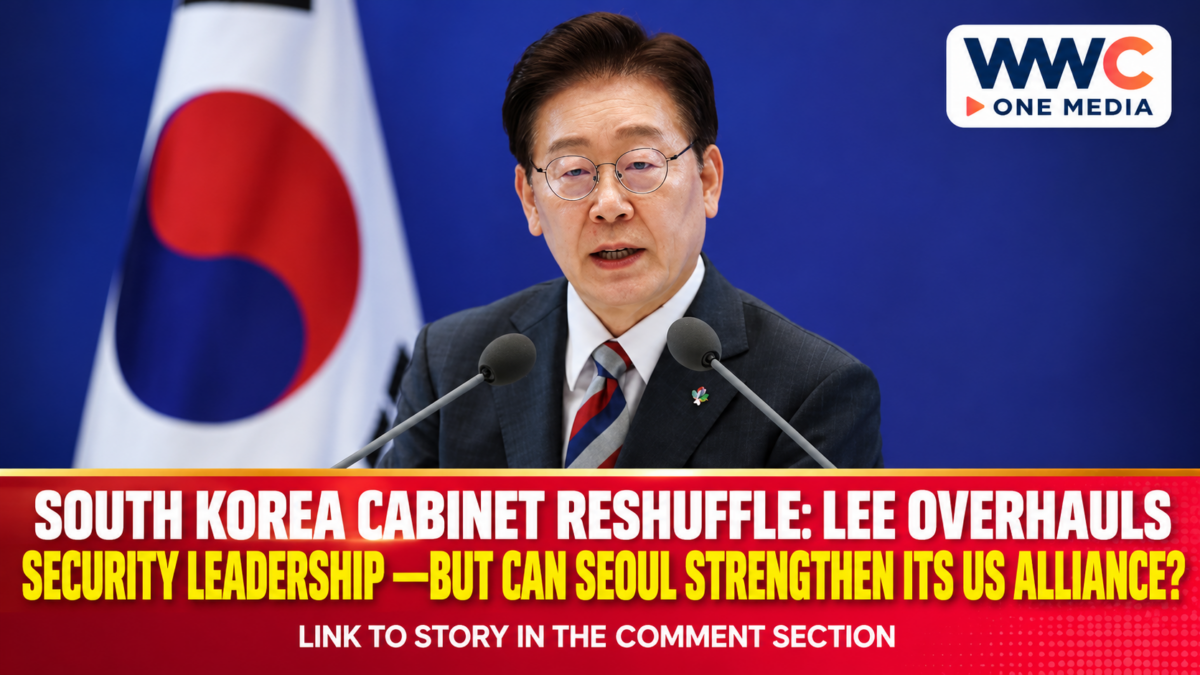
SEOUL, South Korea — President Lee Jae Myung has unveiled a major South Korea cabinet reshuffle, nominating five senior officials on Nov. 23, 2026, including new candidates to lead the country’s foreign affairs, intelligence and unification portfolios.
The leadership changes place South Korea’s relationship with the United States and its pursuit of peace on the Korean Peninsula at the centre of the administration’s next diplomatic phase.
However, changing the officials responsible for national security is one thing. Turning political commitments into stronger international cooperation is another.
The reshuffle presents Seoul with an opportunity to improve diplomatic coordination while navigating its relationships with Washington, Beijing and other major Asia-Pacific partners.
South Korea Cabinet Reshuffle Places US Alliance in Focus
Lee has nominated Lim Woong-soon, the second deputy director of the National Security Office, to become foreign minister.
Lim’s diplomatic experience includes service at South Korea’s embassy in Washington. His nomination reflects the administration’s intention to pursue closer American cooperation while advancing its broader international interests.
The government’s priorities extend across national security, trade, industrial development and advanced technology.
These objectives make the foreign ministry’s leadership particularly important for businesses and governments monitoring economic and security developments throughout the Asia-Pacific.
South Korea’s diplomatic challenge is not simply to maintain its American alliance. It must also determine how that partnership can support its economic competitiveness and national security objectives.
The country’s wider security discussions include South Korea’s efforts to regain wartime operational control, another issue involving the future management of its relationship with Washington.
The latest nominations do not, by themselves, establish a new military agreement or alter existing defence commitments.
Intelligence Leadership Faces an Institutional Test
Former Justice Minister Kang Kum-sil has been nominated to lead South Korea’s National Intelligence Service (NIS).
A former judge and South Korea’s first female justice minister, Kang brings a legal background to the proposed intelligence leadership position.
The selection raises important questions about institutional accountability and the relationship between intelligence gathering, democratic oversight and national security.
Cybersecurity and cooperation with international partners are among the administration’s stated priorities for the agency.
An intelligence organisation must balance effective security operations with public accountability. Its ability to maintain that balance will depend on leadership decisions, institutional safeguards and cooperation with other government agencies.
WWC ONE MEDIA previously examined how South Korea’s new intelligence chief nomination could reshape intelligence oversight.
Kang’s nomination provides an opportunity to examine those priorities, but it does not establish that existing intelligence arrangements have already changed.
North Korea Diplomacy Remains a Major Challenge
Lee has also selected former lawmaker Hong Ihk-pyo as his nominee for unification minister.
His background includes work in foreign policy, economic research and legislative affairs.
The proposed leadership change comes as Seoul continues pursuing peaceful coexistence and reduced tensions with North Korea.
In September 2026, Foreign Minister Cho Hyun outlined the government’s approach to inter-Korean relations, including efforts to restore communication and reduce the possibility of unintended military confrontations.
South Korea has also expressed support for renewed diplomatic engagement between Washington and Pyongyang.
The challenge is that diplomatic engagement requires participation from both sides. Changes within the South Korean government cannot independently determine North Korea’s response.
Recent discussions involving China have added another dimension to regional diplomacy, particularly amid continuing questions surrounding the possibility of renewed US–North Korea dialogue.
Hong’s nomination could provide renewed administrative momentum for Seoul’s peace agenda, although no breakthrough in inter-Korean negotiations has been established by the reshuffle.
Seoul Must Balance Security and Economic Interests
South Korea’s relationship with the United States extends beyond conventional military cooperation.
In September, the government identified artificial intelligence, semiconductors, shipbuilding and civilian nuclear activities as areas where it seeks to broaden its American partnership.
These sectors illustrate why foreign policy has become increasingly important to industrial competitiveness.
For companies operating across Asia-Pacific markets, diplomatic stability can influence investment planning, technology partnerships and long-term supply-chain decisions.
South Korea must also maintain productive relationships with other regional economies.
During his November diplomatic engagements, Lee met Chinese President Xi Jinping in Shenzhen and participated in regional meetings involving ASEAN and APEC economies.
Seoul and Beijing discussed economic cooperation alongside efforts to maintain stability on the Korean Peninsula.
These parallel diplomatic initiatives demonstrate that strengthening relations with Washington does not necessarily require abandoning engagement with other major economic partners.
The real challenge is managing these relationships without allowing political disagreements to undermine strategic or commercial cooperation.
Two Additional Ministries Get New Leadership Nominees
The reshuffle also extends beyond diplomacy and national security.
Lawmaker Han Jun-ho has been nominated as minister of the interior and safety, while presidential spokesperson Kang Yu-jung has been selected as the candidate for minister of culture, sports and tourism.
These nominations bring public administration, domestic safety and cultural policy into the broader leadership transition.
The administration is seeking faster implementation of government programmes and more tangible policy outcomes.
For Lee, the success of the reshuffle will therefore involve both international diplomacy and domestic governance.
What Happens Next?
South Korea’s National Assembly Act provides for parliamentary confirmation hearings involving Cabinet minister nominees and candidates for the leadership of the National Intelligence Service.
The hearings will provide an opportunity to examine the nominees’ qualifications, policy positions and suitability for their proposed responsibilities.
Beyond the parliamentary process, three developments deserve particular attention: future diplomatic coordination with Washington, the direction of inter-Korean engagement and the implementation of intelligence oversight priorities.
The November reshuffle establishes the leadership direction Lee wants to pursue. It does not guarantee that international partners will respond favourably or that diplomatic obstacles will disappear.
Ultimately, the significance of the appointments will be determined not by the announcement itself, but by the agreements, institutional reforms and diplomatic outcomes that follow.
Frequently Asked Questions
Why did South Korea announce a cabinet reshuffle?
President Lee Jae Myung announced five senior government nominations on Nov. 23, 2026, with objectives including improved government implementation, stronger international cooperation and peaceful coexistence on the Korean Peninsula.
Who is South Korea’s new foreign minister nominee?
Lim Woong-soon, the second deputy director of the National Security Office and a career diplomat, has been nominated for the position.
Who has been nominated as South Korea’s intelligence chief?
Former Justice Minister Kang Kum-sil has been nominated to lead the National Intelligence Service.
Will the reshuffle change South Korea’s relationship with the United States?
The administration intends to strengthen cooperation with Washington. However, the nominations themselves do not establish a new bilateral agreement or confirm that diplomatic differences have been resolved.
Does the cabinet reshuffle guarantee renewed talks with North Korea?
No. South Korea continues to pursue peaceful engagement, but renewed negotiations would require participation from North Korea and, where applicable, other diplomatic partners.