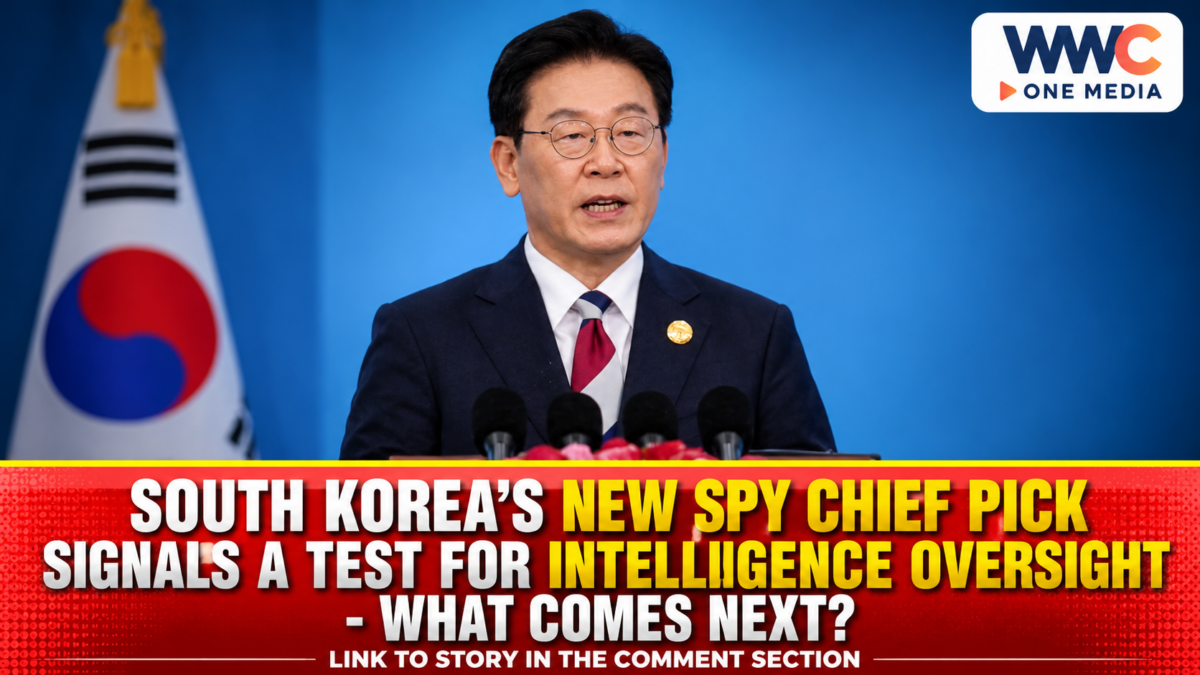
South Korean President Lee Jae Myung has nominated former Justice Minister Kang Kum-sil to lead the National Intelligence Service (NIS), while selecting four other candidates for senior Cabinet positions in a reshuffle announced on November 23, 2026.
The nominations place new leadership choices at the centre of South Korea’s intelligence, diplomacy, inter-Korean relations, domestic administration and cultural policy. They also create a parliamentary scrutiny process that will test the candidates’ qualifications and give lawmakers an opportunity to examine the administration’s priorities.
The most consequential appointment may be the proposed change at the intelligence agency. The NIS operates in a security environment shaped by North Korea, cyber threats and South Korea’s close relationship with the United States. Selecting a former justice minister to lead the agency puts questions of institutional independence, democratic oversight and national security administration in sharper focus.
Five nominations cover intelligence and four ministries
The presidential office announced five nominations through a briefing delivered by Chief of Staff Lim Kwang-hyun.
Kang Kum-sil, a former justice minister, was named as the candidate for director of the National Intelligence Service. Lim Woong-soon, the second deputy director of the National Security Office, was nominated as foreign minister.
The other candidates are Hong Ihk-pyo, a former lawmaker, for unification minister; Han Jun-ho, a sitting lawmaker, for interior and safety minister; and Kang Yu-jung, the presidential senior spokesperson, for culture, sports and tourism minister. 대한민국 청와대
The appointments are not simply a collection of vacancies. Together, the five positions touch several parts of the government that shape South Korea’s domestic and external direction.
The foreign and unification ministries deal with different but closely connected parts of the Korean Peninsula’s security environment. The intelligence service gathers and assesses information relevant to national security. The interior ministry has responsibilities tied to public administration and safety, while the culture ministry oversees a sector that has become increasingly visible in South Korea’s international profile.
The breadth of the reshuffle makes the candidates’ eventual performance more important than the announcement itself.
South Korea spy chief nomination puts oversight in focus
Kang’s nomination is the most prominent intelligence appointment in the announcement.
The presidential office described her as a former judge and the country’s first female justice minister. It also highlighted her previous work as an ambassador for women’s human rights and presented her legal background as relevant to strengthening democratic oversight of the intelligence agency.
The administration also identified cyber threats and international cooperation as areas requiring attention. 대한민국 청와대
Those priorities matter because intelligence agencies exercise powers and handle information that are not ordinarily visible to the public. Effective oversight must therefore operate alongside the need to protect sensitive national-security information.
A director with a legal background could bring experience in institutional accountability and the limits of state authority. That is a reasonable expectation based on Kang’s professional history, but it is not proof of how she would manage the agency. Her actual approach will become clearer through her public answers, policy decisions and eventual performance in office.
The nomination also comes against an existing debate about South Korea’s intelligence relationships. WWC previously examined questions surrounding the NIS and its participation in a security meeting involving the United States and Japan in its report on South Korea’s intelligence agency and the wider alliance relationship.
That earlier issue provides context, but it should not be treated as proof that Kang’s nomination is a direct response to the meeting. The presidential announcement did not identify it as the reason for the appointment.
A diplomat is nominated to lead foreign policy
Lim Woong-soon’s selection gives the Foreign Ministry a candidate with a career diplomatic background.
The presidential office identified him as a former minister at South Korea’s embassy in Washington and said he had served as second deputy director of the National Security Office. It framed his proposed role around strengthening cooperation with the United States while expanding diplomacy across security, trade, industry and advanced technology. 대한민국 청와대
That combination reflects the increasingly broad scope of modern diplomacy. Relations with Washington are not limited to military coordination. They also involve economic security, technology supply chains, industrial policy and trade arrangements.
The administration’s language places the alliance at the centre of its diplomatic approach. But the announcement does not provide a new agreement with Washington, a change in military commitments or a detailed policy timetable. Those would require separate decisions and official records.
South Korea’s debate over its security relationship with the United States also extends to wartime operational control. WWC has previously examined Seoul’s effort to regain wartime command authority in its coverage of the proposed OPCON transfer and the conditions surrounding it.
The new foreign minister nominee may have to navigate that wider policy environment, but the presidential briefing did not announce a change to the existing OPCON framework.
Unification policy remains a separate challenge
Hong Ihk-pyo was nominated to lead the Ministry of Unification.
The presidential office described him as a former lawmaker with experience at the Korea Institute for International Economic Policy, the National Assembly’s Foreign Affairs and Unification Committee, the ruling Democratic Party’s leadership and the presidential office.
It presented his proposed role as helping pursue practical steps toward easing tensions and building trust between the two Koreas. 대한민국 청와대
That objective faces structural difficulties. North Korea’s security posture, its relationship with other countries and the absence of sustained inter-Korean trust all affect the room available for negotiations.
The nomination itself does not establish that talks are imminent or that Pyongyang is prepared to change its position. It does, however, identify the administration’s stated intention to place renewed attention on coexistence and practical engagement.
South Korea’s intelligence assessments of North Korea remain another part of this wider policy picture. WWC has previously reported on the uncertainty surrounding North Korea’s potential succession planning, an example of the long-term questions that can shape Seoul’s security calculations.
Domestic administration and cultural policy also get new nominees
The reshuffle extends beyond foreign affairs and intelligence.
Han Jun-ho was nominated as minister of the interior and safety. The presidential office described him as a former journalist and a second-term lawmaker with legislative experience in areas including land, transportation and artificial intelligence.
Kang Yu-jung was nominated as minister of culture, sports and tourism. The presidential briefing highlighted her experience as a cultural and arts critic, university professor, member of the National Assembly’s culture, sports and tourism committee, and senior presidential spokesperson. 대한민국 청와대
The two appointments represent different administrative challenges.
The interior and safety portfolio involves government coordination and public safety, while the culture ministry has a role in supporting cultural activity and South Korea’s international cultural presence. The administration said it wanted to strengthen regional development and increase the public impact of cultural policy.
These are broad objectives rather than measurable commitments. Their significance will depend on the policies, budgets and implementation plans that follow the appointments.
What happens next
The five nominees must undergo the applicable National Assembly confirmation-hearing process.
South Korea’s National Assembly Act specifically includes candidates for Cabinet minister and National Intelligence Service director positions among those subject to parliamentary confirmation hearings. The law provides for hearings through the relevant standing committees. 조문정보
The hearings will give lawmakers an opportunity to examine the candidates’ professional records, policy positions and plans for their respective institutions.
For Kang Kum-sil, the most important questions are likely to concern intelligence oversight, agency independence, cyber threats and the limits of the NIS’s authority. Lim Woong-soon will face scrutiny over the administration’s diplomatic priorities and the practical direction of relations with Washington and regional partners.
Hong Ihk-pyo’s approach to North Korea policy will also matter, while Han Jun-ho and Kang Yu-jung will be assessed on their plans for their respective ministries.
The November 23 announcement is therefore the beginning of a transition process, not its conclusion. The administration has identified the people it wants to place in key positions. Parliamentary scrutiny and subsequent policy decisions will show whether those choices translate into a coherent programme of government.
Frequently asked questions
Who did South Korea nominate as its new intelligence chief?
President Lee Jae Myung nominated former Justice Minister Kang Kum-sil to become director of the National Intelligence Service on November 23, 2026.
Who was nominated as South Korea’s foreign minister?
Lim Woong-soon, the second deputy director of the National Security Office and a former diplomat, was nominated for the foreign minister position.
Who are the other ministerial nominees?
Hong Ihk-pyo was nominated for unification minister, Han Jun-ho for interior and safety minister, and Kang Yu-jung for culture, sports and tourism minister.
Are the nominees already confirmed?
No. The November 23 announcement identified them as nominees. They must undergo the applicable National Assembly confirmation-hearing process.
Does the reshuffle mean South Korea is changing its policy toward the United States or North Korea?
The presidential briefing described continued support for stronger South Korea-U.S. cooperation and peaceful coexistence on the Korean Peninsula. It did not announce a specific change to existing policy or a new agreement with either country.