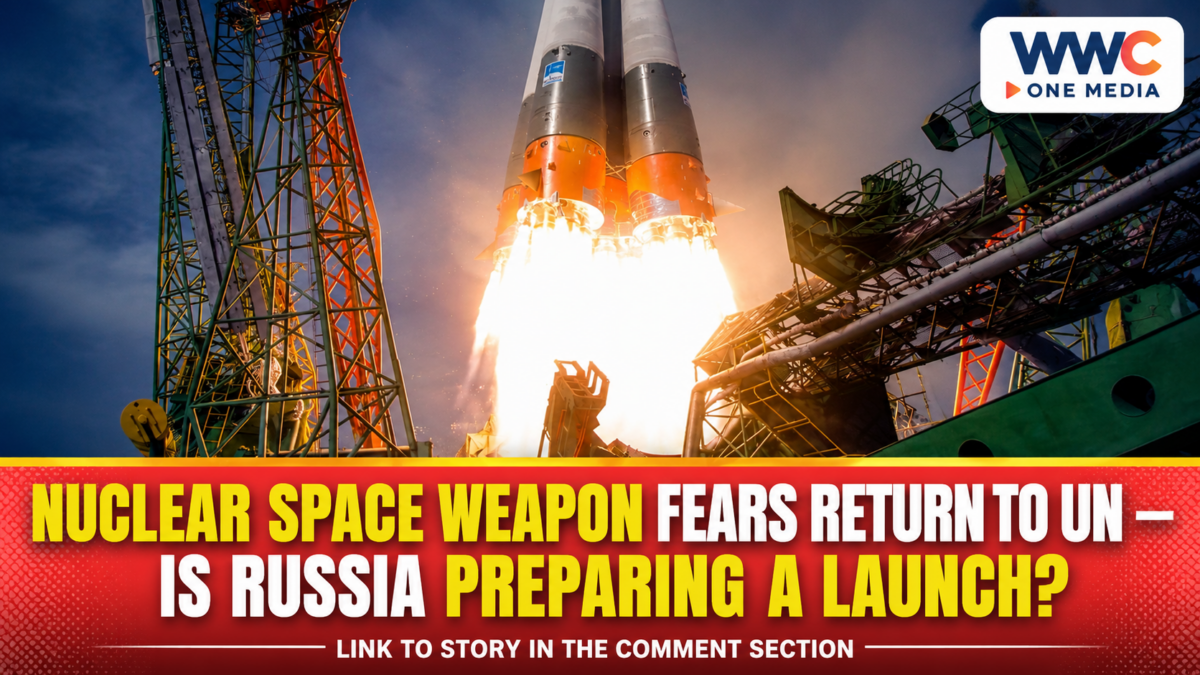
A dispute over a possible Russian nuclear space weapon resurfaced at the United Nations in October, with Washington warning that it had no indication Moscow had abandoned plans to develop such a capability and Russia rejecting the allegations as unfounded. The exchange has renewed attention on a treaty obligation that prohibits nuclear weapons in orbit, while exposing how little independently verifiable information governments have made public about the alleged system.
The latest claims about a possible launch before the end of 2026 have not been substantiated by a publicly available Russian, German or NATO primary document reviewed for this report. That distinction matters: an intelligence warning may be significant to governments, but it is not the same as a publicly verified launch order, an identified operational satellite or proof that a nuclear device has been placed in orbit.
The issue is bigger than a confrontation between Washington and Moscow. Satellites support communications, navigation, weather forecasting, agriculture, disaster response and financial infrastructure. A nuclear detonation in orbit could threaten systems used by countries that are not involved in the dispute.
Nuclear space weapon allegations have reached the UN
During the United Nations General Assembly’s First Committee debate on October 8, representatives of Russia and the United States addressed allegations involving a Russian anti-satellite system and a possible nuclear payload.
The Russian representative rejected claims that Moscow was deploying anti-satellite weapons or creating a satellite capable of carrying nuclear weapons to attack other objects in space. Russia said its space activities complied with international commitments and maintained that it supported keeping outer space free of weapons.
The US representative responded that Washington had no indication Russia had abandoned plans to develop and place a nuclear weapon in outer space. The US also warned that such a capability could threaten satellites operated by governments and private companies around the world.
These were opposing government positions, not an independent finding that a nuclear-armed satellite exists or is ready for launch.
The transcript available through the UN’s public preview is automatically generated and explicitly identified as neither an official record nor an official UN document. The statements should therefore be understood as the delegations’ reported positions in the meeting, not treated as certified verbatim quotations.
What international law actually prohibits
The central legal framework is the 1967 Outer Space Treaty. Article IV requires states parties not to place in orbit around Earth objects carrying nuclear weapons or other weapons of mass destruction. It also prohibits installing such weapons on celestial bodies or stationing them in outer space in any other manner.
That provision is narrower than a general ban on every military activity in orbit. The treaty does not prohibit all military satellites, military personnel in space or every type of conventional space-related capability. Its specific prohibition concerns nuclear weapons and other weapons of mass destruction in orbit or otherwise stationed in outer space, alongside separate restrictions governing military activities on the Moon and other celestial bodies.
This distinction is important when governments use the broad term “weaponisation.” A satellite used for military communications or surveillance is not automatically equivalent to an orbital nuclear weapon. Nor does the existence of anti-satellite capabilities by itself establish that a nuclear device has been deployed.
The treaty also makes states internationally responsible for national space activities, including those carried out by non-governmental entities. That means the rules are not limited to government-owned spacecraft.
The legal question is therefore not whether countries may use satellites for national security. It is whether a particular activity crosses the treaty’s specific prohibitions and other applicable rules of international law.
The military dispute extends beyond one alleged satellite
The disagreement is unfolding as governments openly debate military capabilities in orbit.
In a written statement delivered at the United Nations on October 21, 2026, the United States accused Russia’s Ministry of Defense satellite COSMOS 2612 of manoeuvring dangerously close to a commercial satellite. Washington described the activity as consistent with an on-orbit weapons operation and called on Russia to explain the satellite’s behaviour.
That was a US government allegation, not an independently established finding in the document. The statement nevertheless illustrates how satellite manoeuvres, proximity operations and uncertainty about a spacecraft’s purpose can become sources of strategic tension.
The United States has also publicly acknowledged having “on-orbit space control weapons” intended to defend its forces against hostile action. The systems’ technical details were not disclosed in the written statement reviewed here.
WWC has previously examined the US announcement of weapons deployed in orbit, including the unanswered questions about their capabilities and intended use.
This matters because the same manoeuvre or technology can be interpreted differently by competing governments. One country may describe a system as defensive, while another may regard it as a potential threat. Without transparency, that gap can increase the risk of miscalculation.
Why a nuclear detonation in orbit would affect civilian life
A nuclear weapon in space would not be a conventional anti-satellite missile. Its potential effects would extend beyond a single spacecraft or military target.
The US Department of Defense’s written testimony to Congress in May 2025 warned that a nuclear detonation in orbit could damage or destroy space systems used for communications, scientific research, meteorology, agriculture, commerce, public safety and national security.
Those services are deeply connected to daily economic activity. Satellite communications support emergency coordination and remote connectivity. Navigation signals help transport networks, shipping and aviation. Weather satellites contribute to forecasting and disaster preparedness. Earth-observation systems help monitor crops, forests, coastlines and changing environmental conditions.
For the Philippines, these are not abstract concerns. The country relies on satellite-enabled services for communications, weather monitoring, maritime awareness and disaster response across an archipelago exposed to typhoons, earthquakes and other hazards.
The regional position is already on record. In its October 20 statement to the UN First Committee, ASEAN said it remained seriously concerned about the possible weaponisation of outer space. It backed dialogue, transparency and confidence-building measures, while supporting work toward a legally binding instrument to prevent an arms race in space.
WWC has also examined US-China discussions about nuclear-site visits, illustrating why transparency can matter when governments are trying to reduce uncertainty over strategic capabilities.
The diplomatic disagreement is also about how to prevent an arms race
Washington and Moscow differ not only over the allegations but also over the preferred approach to space security.
The US statement at the October 2026 UN debate argued for voluntary norms, rules and principles of responsible behaviour, saying these could reduce misunderstandings and miscalculations. Russia has continued to advocate a legally binding international instrument to prevent an arms race in outer space.
ASEAN’s position attempts to connect the two approaches. Its October statement supported practical transparency and confidence-building measures, but said those steps should not replace or delay negotiations on a legally binding and multilaterally verifiable instrument.
That debate reflects a real difficulty in arms control: states may agree that a risk exists while disagreeing on which activities should be prohibited, how compliance should be verified and what military capabilities should remain permissible.
The Philippines has a direct interest in those negotiations. Space-based services are important to civilian resilience and economic activity, while smaller and developing countries have limited ability to protect themselves from disruptions caused by major-power competition in orbit.
WWC’s coverage of Russia’s nuclear warnings and wider security tensions provides additional context on why nuclear-risk management remains a concern beyond the immediate space debate.
What happens next
The next important test is whether governments provide verifiable information and whether diplomatic discussions produce practical safeguards.
The United Nations’ ongoing work on preventing an arms race in outer space offers a forum for discussing transparency, responsible behaviour and possible legal measures. The US and Russia will also face pressure to explain how their respective space activities comply with existing international obligations.
For now, the public record reviewed does not establish that Russia has scheduled a December launch of a nuclear-armed satellite, that a spacecraft called Sputnik-S is operational, or that a nuclear weapon has been placed in orbit.
The confirmed development is the continuing dispute between Washington and Moscow over space capabilities, alongside a shared treaty framework that prohibits nuclear weapons in orbit. Until verifiable evidence emerges, the distinction between a warning, an allegation and a confirmed deployment must remain clear.
Frequently Asked Questions
Does the Outer Space Treaty ban nuclear weapons in space?
Yes. Article IV prohibits states parties from placing objects carrying nuclear weapons or other weapons of mass destruction in orbit around Earth, installing them on celestial bodies or stationing them in outer space in any other manner.
Has Russia launched a nuclear weapon into orbit?
The public primary records reviewed for this article do not establish that Russia has placed a nuclear weapon in orbit.
What is Russia’s alleged nuclear anti-satellite weapon?
The allegation concerns a possible Russian space-based system intended to carry a nuclear device and threaten satellites. The specific satellite and reported launch timetable have not been confirmed by a publicly available primary record reviewed for this article.
Why would a nuclear explosion in space affect countries outside the conflict?
A detonation could damage satellite systems used for communications, navigation, weather forecasting, agriculture, commerce and public safety. Those services are used globally, including by countries that are not parties to the dispute.
What is ASEAN’s position on weapons in space?
ASEAN has expressed concern about the weaponisation of outer space and supports peaceful use, transparency and confidence-building measures. It also supports work toward a legally binding instrument to prevent an arms race in space.