
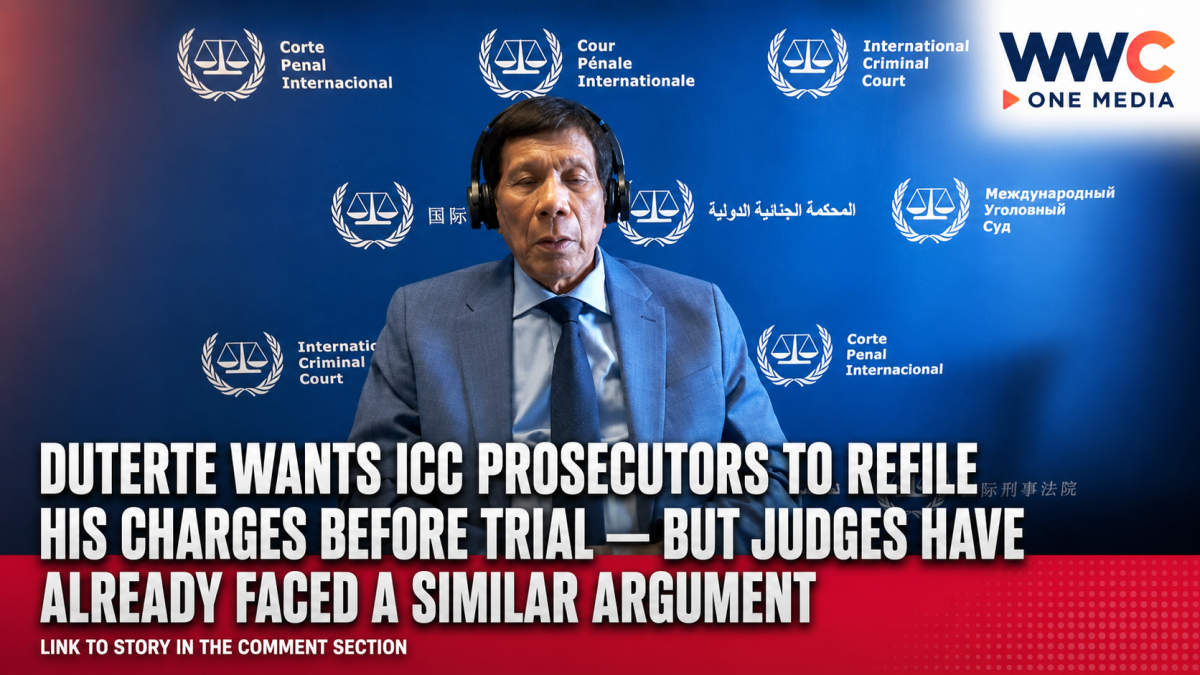
THE HAGUE/MANILA — With his crimes against humanity trial only months away, former Philippine President Rodrigo Duterte has launched another major procedural challenge before the International Criminal Court, this time targeting not whether the ICC can prosecute him, but whether prosecutors have told him precisely enough what he must defend himself against.
Duterte’s defense team has asked ICC Trial Chamber III to order prosecutors to resubmit or refile the charges, arguing that the current formulation fails to give the former president sufficiently detailed notice of the accusations he will face when trial opens on November 30, 2026.
The request, dated August 31, was filed by Duterte’s defense under lead counsel Peter Haynes KC, according to reports from GMA News and the Philippine Daily Inquirer.
At the heart of the motion is a phrase that could become crucial as the case moves toward trial: the prosecution has described some of the alleged killings as “illustrative” and “non-exhaustive” incidents.
Duterte’s lawyers argue that such an approach potentially leaves the accused confronting a case whose factual limits are not clearly fixed.
The defense is invoking Article 67(1)(a) of the Rome Statute, which guarantees an accused the right to be informed promptly and in detail of the nature, cause and content of the charges against him.
Why Duterte’s Lawyers Want the Charges Rewritten
The dispute goes beyond wording.
If prosecutors are allowed to rely on specific killings merely as examples of a broader alleged campaign, Duterte’s lawyers contend that the defense could be forced to prepare against allegations extending beyond a clearly identified list of incidents and victims.
That, according to the defense, could affect its ability to investigate individual allegations, challenge witnesses, prepare counter-evidence and determine exactly which alleged acts prosecutors will try to prove at trial.
The prosecution’s case originated from a Document Containing the Charges that identified 49 incidents involving 78 alleged victims of murder or attempted murder in connection with Duterte’s anti-drug campaign.
But the broader prosecution theory alleges that the killings formed part of a widespread and systematic attack against civilians linked to the so-called war on drugs during periods when Duterte served as Davao City mayor and later Philippine president.
That distinction—between the specific incidents listed in the case and the broader alleged attack—is now becoming one of the legal pressure points ahead of trial.
But the ICC Has Already Dealt With a Similar Argument
The latest motion does not emerge from nowhere.
During the confirmation-of-charges stage, Duterte’s previous defense team had already argued that prosecutors should not be permitted to use the listed incidents merely as examples while leaving the factual scope of the accusations open-ended.
The defense argued that the ICC needed to assess the individual incidents and clearly define the factual boundaries of the case so Duterte would know what allegations he had to answer.
However, in its April 23, 2026 decision confirming the charges, Pre-Trial Chamber I said the defense appeared to conflate the accused’s right to sufficient notice with the separate question of the factual scope of the confirmed charges.
The chamber ultimately confirmed all three counts and committed Duterte to trial.
That history makes the August 31 filing especially significant.
Duterte’s new defense team is effectively bringing the issue back before a different set of judges—Trial Chamber III—at the stage when prosecutors must translate the confirmed case into the evidence and witnesses they intend to present at trial.
Whether Trial Chamber III sees the new request as a legitimate fair-trial issue or an argument substantially addressed during the pre-trial phase will be one of the key questions surrounding the motion.
What Exactly Is Duterte Charged With?
On April 23, ICC Pre-Trial Chamber I unanimously found “substantial grounds to believe” Duterte was criminally responsible for three counts involving murder and attempted murder as crimes against humanity.
The first count covers the alleged murder of at least 19 victims in Davao City between 2013 and around June 2016 during Duterte’s mayoral period.
The second involves the alleged murder of at least 14 so-called “high-value targets” in different parts of the Philippines between approximately July 2016 and July 2017.
The third covers alleged barangay clearance operations involving at least 45 victims—43 killings and two attempted killings—between approximately July 2016 and September 2018.
The ICC said the alleged acts were part of a broader widespread and systematic attack against a civilian population associated with the anti-drug campaign.
Confirmation of charges is not a conviction.
The prosecution will still have to prove Duterte’s guilt beyond reasonable doubt at trial, while Duterte remains presumed innocent unless and until the ICC finds otherwise.
Thousands of Pieces of Evidence Now in Play
The procedural battle is unfolding just as the volume of evidence in the case becomes much clearer.
GMA News reported in August that prosecutors had disclosed 6,909 items of evidence to Duterte’s defense between January 7 and July 31.
Of those, prosecutors classified 2,279 items as incriminating, while thousands of others were disclosed under ICC rules giving the defense access to material relevant to preparing its case.
Prosecutors also identified 57 potentially exonerating items, including material that could undermine witness credibility or support possible defense arguments.
Separately, prosecutors have estimated they could present roughly 60 to 70 witnesses, including about 31 insider witnesses, during the trial.
The prosecution previously estimated that direct examination alone could require around 175 to 200 hours.
Those numbers help explain why the exact boundaries of the charges matter so much to both sides.
The broader the factual case prosecutors are allowed to present, the more extensive the preparation required from Duterte’s lawyers.
August 31 Was Already a Critical Deadline
The timing of Duterte’s new motion is also notable.
Trial Chamber III had ordered prosecutors to submit by August 31 their detailed trial brief, final witness list and evidence list.
That trial brief is expected to identify the principal facts prosecutors plan to prove, which witnesses will establish those facts, the exhibits they intend to use and their legal arguments.
Duterte’s defense has until October 30 to identify the principal factual and legal issues it disputes and outline the general nature of its defense.
The Philippine Daily Inquirer reported on September 1 that the ICC prosecution had submitted its witness list and evidence in accordance with the court’s timetable.
The convergence of those filings could make the next several weeks decisive in defining exactly what the November trial will look like.
Trial Is Still Scheduled for November 30
For now, Duterte’s new motion has not canceled, suspended or postponed the trial.
The ICC’s official case page continues to list November 30, 2026 as the scheduled opening date.
Trial Chamber III is composed of Presiding Judge Joanna Korner, Judge Keebong Paek and Judge Nicolas Guillou. Duterte’s current lead counsel is Peter Haynes KC, with Kate Gibson serving as associate counsel.
The former president has remained in ICC custody in The Hague since his surrender to the court in March 2025.
His lawyers have repeatedly challenged different aspects of the proceedings, including the ICC’s jurisdiction, his detention, his fitness to participate and the formulation of the case against him.
Some of those challenges have been rejected, including a bid to obtain permission to appeal the April decision confirming the charges.
The latest filing therefore should not be read as evidence that Duterte has defeated—or is about to defeat—the prosecution.
Instead, it opens another potentially important legal battle over a fundamental question that must be settled before the courtroom confrontation begins:
When Duterte finally goes on trial, how narrowly—or how broadly—will prosecutors be allowed to define the crimes they say he must answer for?
WWC ONE MEDIA MJE
Leave a Reply