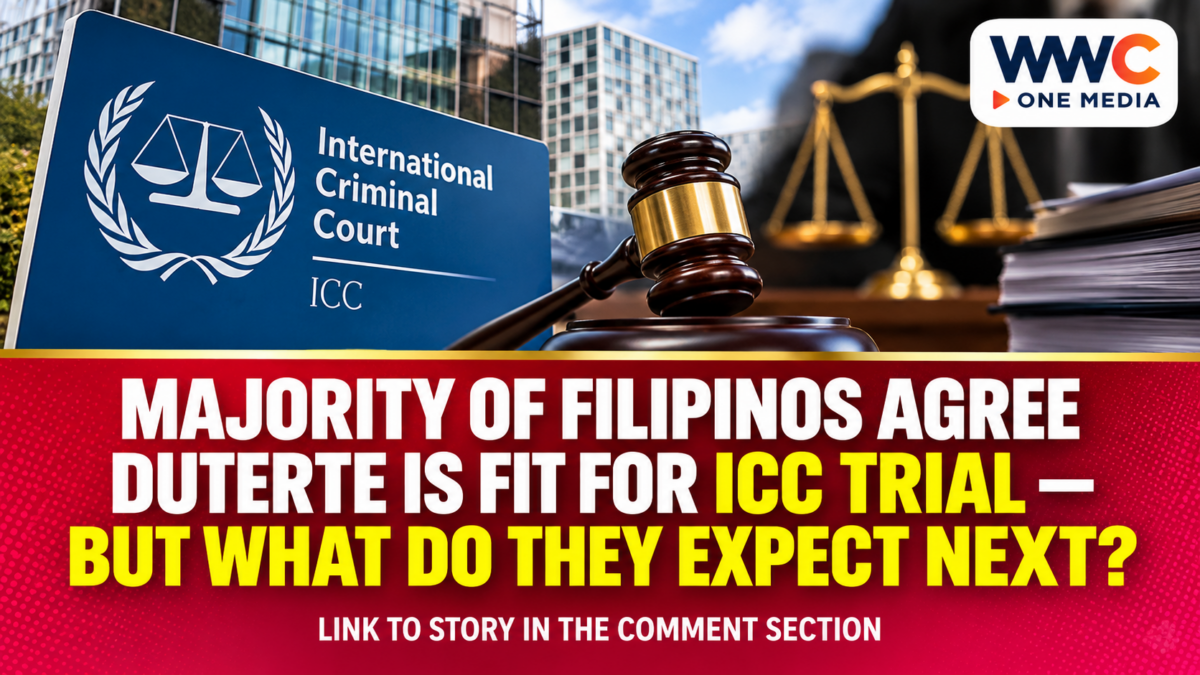
MANILA, Philippines — A majority of Filipino adults agree that former Philippine President Rodrigo Duterte is fit to stand trial before the International Criminal Court (ICC), while even broader public support exists for him to personally face the proceedings.
The findings of the October 2026 National Momentum Survey come ahead of the scheduled opening of the Duterte ICC trial on November 30, placing questions of accountability, judicial fairness and the former president’s participation back at the centre of national discussion.
However, agreement with the court’s assessment of Duterte’s fitness should not be interpreted as a declaration of guilt.
The international proceedings will determine whether prosecutors can establish criminal responsibility for alleged crimes against humanity connected to the Philippines’ anti-drug campaign.
Duterte ICC Trial: What Filipinos Really Think
Momentum Research conducted its October nationwide survey from October 16 to 19, 2026, covering 1,401 respondents, with a national sampling margin of error of 2.6 percentage points at a 95% confidence level.
Its findings reveal an important distinction between public acceptance of the ICC’s fitness ruling and expectations surrounding Duterte’s personal participation.
While Filipinos hold differing opinions about the former president’s condition, a larger proportion considers his personal appearance before international judges important.
The distinction matters because fitness to stand trial concerns an accused person’s ability to participate meaningfully in legal proceedings, rather than whether the criminal allegations are true.
The survey provides a snapshot of public sentiment, but the responsibility for determining Duterte’s legal and medical capacity remains with the court.
Why the ICC Declared Duterte Fit to Stand Trial
The ICC publicly announced its determination on October 8, 2026, after considering assessments from independent medical experts.
The evaluation examined Duterte’s ability to comprehend the accusations, engage with his lawyers and participate in the judicial process.
The court also established arrangements intended to accommodate his condition, including continued medical supervision.
These measures recognise that an accused person may require additional support without necessarily being incapable of standing trial.
Duterte’s capacity to participate has been an important issue throughout preparations for the proceedings, including his September appearance before ICC judges.
The fitness determination does not mean that every concern surrounding his health has disappeared. Rather, it establishes that the court considers him capable of participating under the arrangements it has adopted.
Public Confidence Remains Divided
A separate nationwide survey conducted by Social Weather Stations from September 21 to 27, 2026, provides additional context on public attitudes towards the international proceedings.
The survey found that 41% expressed substantial confidence that Duterte would receive a fair trial, compared with 26% who expressed little confidence and 33% who remained undecided.
Meanwhile, 55% had followed reports concerning a legal challenge filed by Duterte’s defence.
These findings suggest that public interest in the case does not necessarily translate into unconditional confidence in the international tribunal.
Some Filipinos may support the continuation of the proceedings while maintaining reservations about the court. Others may regard the trial as an essential opportunity to address longstanding allegations.
Neither position determines the legal outcome.
What Charges Will Duterte Face?
Duterte faces three counts involving alleged murder and attempted murder classified as crimes against humanity.
The allegations concern conduct during his time as Davao City mayor and Philippine president.
The prosecution’s case centres on alleged crimes associated with the anti-drug campaign between November 2011 and March 2019.
The proceedings have also generated legal disputes regarding the precision and scope of the accusations, including Duterte’s defence challenge seeking a revised presentation of the charges.
The distinction between confirmed charges and a criminal conviction remains fundamental.
Duterte retains the presumption of innocence, and prosecutors must establish his guilt beyond reasonable doubt before the court can convict him.
Victims’ Families Also Await the Proceedings
Beyond the political debate, the trial represents an opportunity for participating victims to have their interests considered within an international judicial process.
Their involvement highlights a dimension of the case that public opinion surveys cannot fully capture: the experiences of individuals and families affected by the alleged crimes.
WWC ONE MEDIA has previously examined the continuing search for answers among families affected by the anti-drug campaign.
The proceedings must balance the interests of participating victims with Duterte’s entitlement to a fair trial.
Accountability and procedural fairness are not mutually exclusive. Both are essential to a credible judicial outcome.
What Happens on November 30?
The opening of the trial is scheduled for November 30, 2026, before ICC Trial Chamber III in The Hague, Netherlands.
The proceedings will begin with judicial formalities, followed by presentations from the parties and participating victims’ legal representatives before witness testimony proceeds.
The trial is not expected to produce an immediate verdict.
Its significance extends beyond the Philippines, particularly for international discussions about criminal accountability, human rights and the legal protections afforded to former government leaders facing prosecution.
For now, the latest public opinion findings reveal stronger expectations surrounding Duterte’s personal participation than agreement with the fitness ruling itself.
But the ultimate question will not be answered by a survey.
It will be determined through evidence, legal arguments and the judgment of the court.
Frequently Asked Questions
When will Rodrigo Duterte’s ICC trial begin?
The trial is scheduled to open on November 30, 2026, in The Hague, Netherlands.
Has Duterte been declared fit to stand trial?
Yes. The ICC publicly announced its fitness determination on October 8, 2026, and adopted measures to support his participation.
Do most Filipinos agree with the ICC’s fitness ruling?
Yes. The October 2026 National Momentum Survey found majority agreement with the ruling and even greater support for Duterte personally facing the proceedings.
What charges does Rodrigo Duterte face?
He faces three counts involving alleged murder and attempted murder as crimes against humanity in connection with the anti-drug campaign.
Has Rodrigo Duterte already been convicted?
No. Confirmation of charges and a determination of fitness to stand trial do not constitute a criminal conviction. Duterte remains presumed innocent.