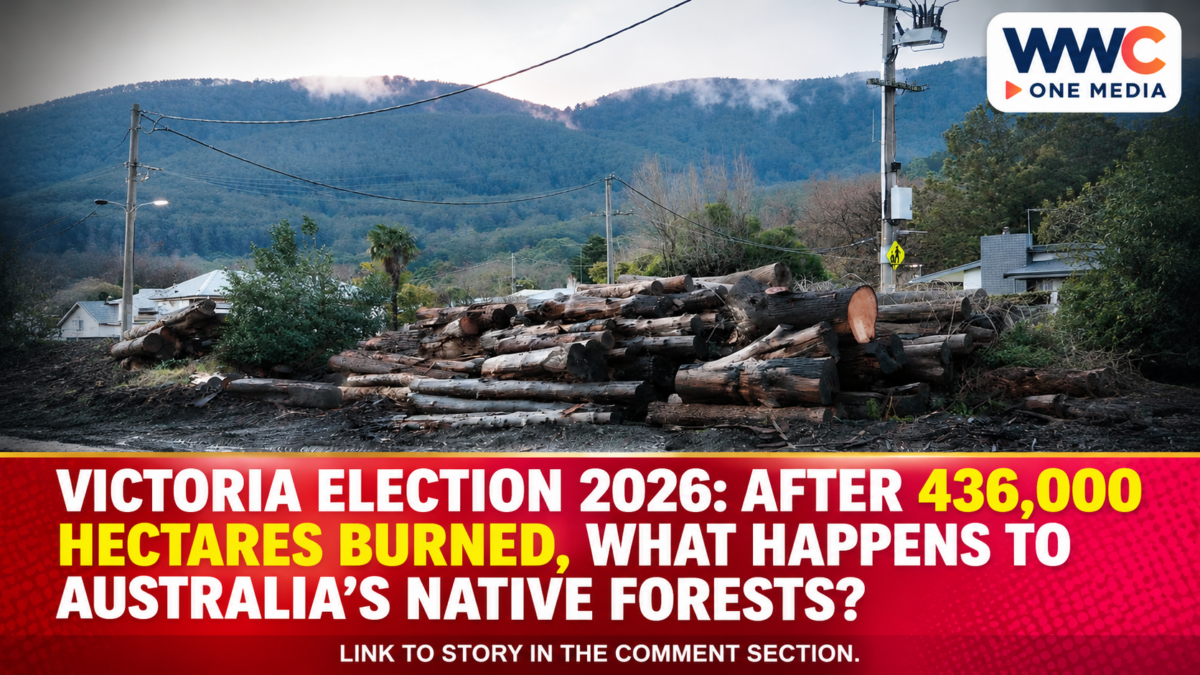
MELBOURNE, AUSTRALIA — November 24, 2026. The Victoria Election 2026 is approaching amid mounting environmental challenges, with voters heading to the polls on November 28 following a bushfire season that burned more than 436,000 hectares of land and affected over 1,590 structures.
Nearly three years after Victoria ended commercial native timber harvesting in state forests, competing political proposals have reopened questions about how Australia’s native forests should be managed, protected and restored.
The Liberal-National Coalition is proposing a programme covering 5,000 hectares of degraded public forest annually, including selective tree removal and fuel management. Meanwhile, the Victorian Greens are seeking stronger legal restrictions on native forest logging and permanent protection for additional forest areas.
The policy divide comes as Victoria confronts the difficult task of protecting communities from bushfires while preserving wildlife habitats and supporting regional economies.
Victoria Election 2026: Bushfires expose environmental challenges
Victoria’s 2025–2026 summer fire season began in October 2025 before intensifying in January 2026, when four weather districts experienced catastrophic fire danger conditions.
Among the largest fires were the Berry Lane–Longwood fire, which burned 132,150 hectares, and the Walwa River Road fire, which affected 120,914 hectares.
The Dargo–Wonnangatta Complex fire covered another 48,970 hectares.
These incidents placed considerable pressure on emergency personnel, volunteer firefighters and regional communities.
The environmental consequences extend beyond the immediate destruction. Forest recovery, damaged wildlife habitats, agricultural rehabilitation and community preparedness will require continuing attention after the election.
Extreme weather and climate preparedness are also receiving attention elsewhere in the Asia-Pacific region, including Canada’s experience with record-breaking November temperatures.
For Victoria, an important policy question is how to reduce future disaster risks without compromising the ecological systems that governments are seeking to protect.
Australia’s native forest logging debate returns
Victoria ceased commercial harvesting of native timber in state forests on January 1, 2024.
The closure represented a significant restructuring of regional forestry activity, rather than the disappearance of the state’s entire timber industry.
VicForests, the former government-owned native timber harvesting business, subsequently closed on June 30, 2024.
The Victorian Government continues to support plantation forestry, which provides materials for construction, manufacturing and paper production.
Victoria has a plantation estate covering approximately 382,600 hectares, consisting primarily of radiata pine and southern blue gum.
However, the transition away from native forest harvesting presented economic challenges for communities dependent on the industry.
An independent public audit identified approximately 1,000 workers and 200 businesses directly affected by the decision.
The debate ahead of the election therefore involves both environmental protection and the economic future of communities historically dependent on forestry.
The challenge is whether regional employment opportunities can be maintained without reversing environmental protections or creating additional pressure on native ecosystems.
Coalition proposes forest restoration and timber recovery
The Liberal-National Coalition has outlined a public land management programme that would treat 5,000 hectares of degraded public forest annually.
The proposal combines forest thinning with measures intended to reduce combustible vegetation and improve forest conditions.
Recovered timber would be processed within Victoria for products including sawlogs, firewood, biochar and mulch.
The Coalition has also committed to protecting old-growth trees and trees containing natural hollows, which provide important habitat for native wildlife.
Its broader policy includes rebuilding strategic fuel breaks, expanding cultural burning in partnership with Indigenous communities and increasing planned burning.
A separate commitment would provide A$2.52 million over four years towards an expanded A$4.41 million bushfire detection camera network across 18 locations, with additional industry investment.
These are election commitments rather than programmes that have already been implemented.
Their effectiveness would depend on forest selection, operational standards, ecological assessments, funding and regulatory oversight.
The recovery and commercial use of timber also raise an important question: how should authorities distinguish legitimate forest restoration and fire prevention from commercial extraction?
Victoria’s biodiversity crisis demands attention
A November 2026 assessment of Victoria’s natural environment identified several areas requiring urgent policy reform.
The assessment highlighted weaknesses in conservation funding, forest protection, biodiversity compensation arrangements, wildlife legislation, access to protected natural areas and climate adaptation planning.
It called for stronger safeguards against damaging forest clearing and greater accountability for environmental outcomes.
The assessment also identified inadequate access to protected natural spaces in Melbourne, raising questions about whether urban development is keeping pace with environmental and recreational needs.
The Victorian Greens have proposed an A$2 billion nature fund alongside additional legal protections for forests and wildlife.
Their platform includes new protected areas in the Central Highlands and East Gippsland, stronger involvement of Traditional Owners and tighter restrictions on timber extraction.
The Greens also propose prohibiting Victorian mills from processing timber originating from native forests elsewhere in Australia.
These commitments would require legislative and administrative changes before becoming enforceable.
Victoria’s existing approach, established under Labor, ended large-scale commercial native timber harvesting in state forests while retaining government responsibilities for forest management, biodiversity and bushfire risk reduction.
The competing approaches illustrate how environmental protection can involve different policy priorities, including habitat conservation, commercial activity, public safety and regional employment.
Environmental protection is also an economic issue
Forest policy has consequences beyond conservation.
For businesses and regional communities, decisions about timber production, land management and disaster preparedness can affect investment, operating costs and employment prospects.
For governments, the central challenge is allocating public resources between immediate emergency preparedness and longer-term ecological restoration.
Similar implementation questions have emerged internationally through COP31 climate negotiations and unresolved adaptation commitments.
Environmental policy can also influence private investment, as illustrated by the continuing development of Indonesia’s carbon market and climate-related investment opportunities.
However, financial commitments alone cannot establish whether a conservation programme is successful.
Effective environmental management requires measurable targets, transparent expenditure and regular assessments of ecological outcomes.
For Victoria, the next government’s ability to balance those requirements could shape the state’s environmental and regional economic direction.
What happens after the Victorian election?
Victoria’s state election will take place on Saturday, November 28, 2026.
Early voting began on November 18. The election will determine representation in the 88-member Legislative Assembly and the 40-member Legislative Council.
Once a government is formed, attention will turn to budget commitments, proposed legislation and the implementation of environmental policies.
Among the important developments to watch will be whether existing forestry restrictions remain in place, how future bushfire management programmes are designed and whether biodiversity restoration receives additional funding.
The election result will determine Victoria’s political leadership.
But the longer-term environmental outcome will depend on what the next government actually delivers in its forests, communities and protected natural areas.