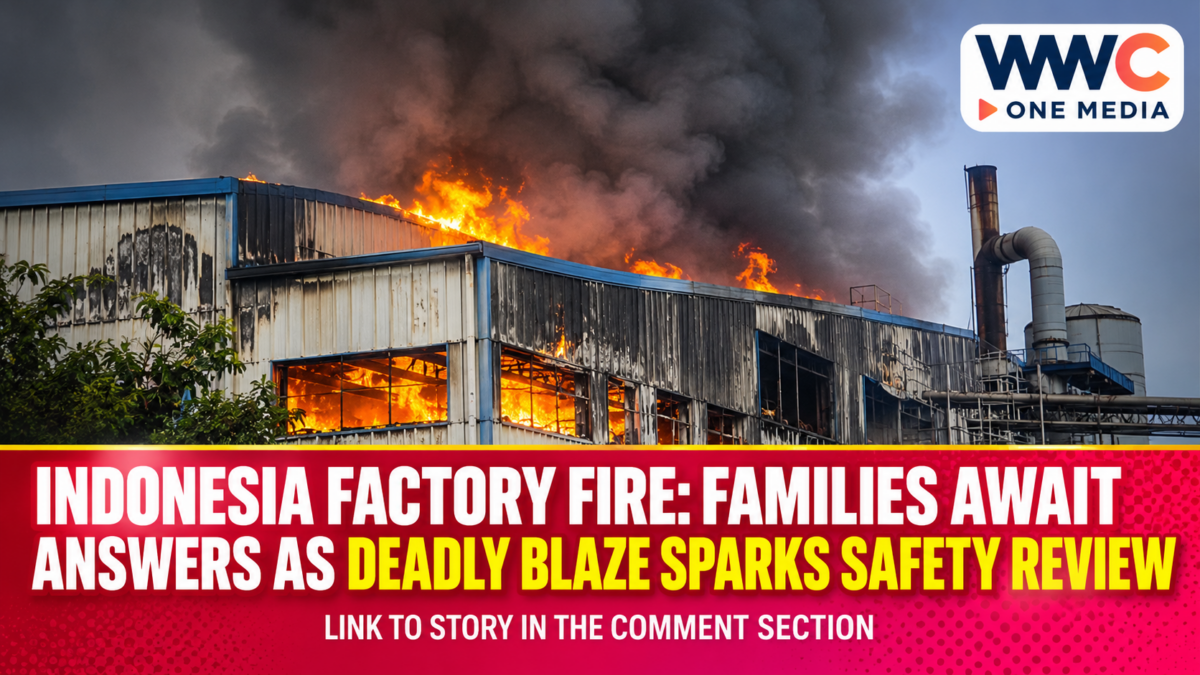
SERANG, INDONESIA — A deadly factory fire at Indonesian confectionery manufacturer PT Fonusa Agung Mulia has triggered a forensic identification operation, an investigation into workplace safety and demands for stronger protection of affected employees and their families.
The fire broke out on Saturday, Nov. 21, 2026, at the Pancatama Industrial Estate in Cikande, Serang Regency, Banten province.
Three days after the disaster, the emergency response has expanded beyond firefighting into a complex operation involving victim identification, employee tracing and industrial accountability.
For affected families, determining the whereabouts of their loved ones remains an urgent priority. For Indonesia’s manufacturing sector, the tragedy has raised questions about whether workplace emergency systems can provide adequate protection during a major industrial fire.
Indonesia Factory Fire Triggers Forensic Identification Operation
Police forensic specialists are using DNA analysis to establish the identities of victims recovered from the factory.
A police update released on Nov. 23 documented the following developments:
- 33 individuals provided information for victim identification.
- 28 DNA samples were collected from relatives.
- 24 body bags had been received at Bhayangkara Hospital in Banten.
- Ten body bags had undergone examination, each containing one deceased individual.
These figures represent the progress of the identification operation at the time of the update and should not be interpreted as a final casualty count.
The distinction is important because recovered remains must undergo forensic examination before authorities can establish individual identities and reconcile employee records.
Families Face Uncertainty as Identification Continues
Victim identification facilities have been established in Cikande and at Bhayangkara Hospital.
The process involves comparing information collected from relatives before identification with forensic evidence obtained during examinations.
Indonesia’s recent refinery explosion in Cepu also highlighted the importance of distinguishing preliminary emergency information from completed technical investigations.
In Cikande, the immediate challenge is establishing accurate information about affected employees while ensuring families receive reliable updates.
Forensic identification can provide the certainty necessary for families to pursue employment-related benefits and other administrative arrangements.
Industrial Safety Comes Under Scrutiny
The Indonesian Ombudsman has called for a comprehensive examination of the factory’s occupational health and safety arrangements.
The proposed review covers critical areas such as emergency exits, evacuation procedures, fire detection equipment, emergency lighting and firefighting systems.
Whether these safeguards were adequate, properly maintained and operational during the incident remains an important question.
However, the call for an examination does not establish that any particular safety system failed.
The precise cause of the factory fire has not been established in the official records examined.
Police investigators have begun examining the incident and interviewing witnesses as part of efforts to determine its origin and identify possible workplace safety violations.
The importance of establishing the actual cause of a fire before assigning responsibility also emerged following the deadly Sorsogon public market fire.
Workers’ Compensation and Employment Rights Become a Priority
The consequences of the Cikande factory fire extend beyond physical damage to industrial facilities.
On Nov. 23, Indonesia’s Ombudsman called for affected workers and their families to receive clarity regarding employment entitlements, outstanding wages, social security coverage and occupational accident benefits.
The intervention places employee welfare alongside the continuing investigation.
For affected households, delays in establishing employment status or identifying eligible benefits could compound the uncertainty caused by the disaster.
The Ombudsman’s position also highlights the need for transparent coordination between employers and public institutions responsible for worker protection.
The amounts of compensation that individual families may receive have not been established in the official material examined.
A Wider Challenge for Industrial Workplace Safety
The Cikande tragedy has renewed attention on how industrial facilities manage emergency preparedness.
A meaningful safety assessment must examine not only whether emergency systems exist but whether those systems can perform effectively when workers need them.
From a business perspective, workplace safety should form part of operational risk management rather than being treated solely as a regulatory requirement.
Emergency preparedness, equipment maintenance, employee training and evacuation planning are areas that businesses can evaluate without waiting for an accident.
The importance of preventive measures has also been examined in WWC ONE MEDIA’s coverage of fire prevention and persistent safety risks in Cebu.
Across Asia-Pacific manufacturing economies, the Cikande disaster provides a reason for renewed scrutiny of industrial emergency preparedness without prejudging the findings of Indonesia’s investigation.
What Happens Next?
Indonesian Labour Minister Yassierli visited the affected factory on Nov. 23 alongside Banten Governor Andra Soni as authorities continued coordinating the emergency response.
The next significant developments will involve updated casualty information, completed forensic identification, findings concerning the origin of the fire and clarification of workers’ entitlements.
Investigators will also need to establish whether any corrective measures or enforcement actions are warranted.
Until those findings become available, claims concerning negligence, defective equipment or specific regulatory violations should not be treated as established facts.
For the families affected by the Cikande factory fire, the immediate priority remains certainty.
For the industrial sector, the longer-term question is whether the investigation will produce meaningful improvements in workplace safety and emergency preparedness.
This is a developing story. Information may change as Indonesian authorities complete their investigations and victim identification procedures.