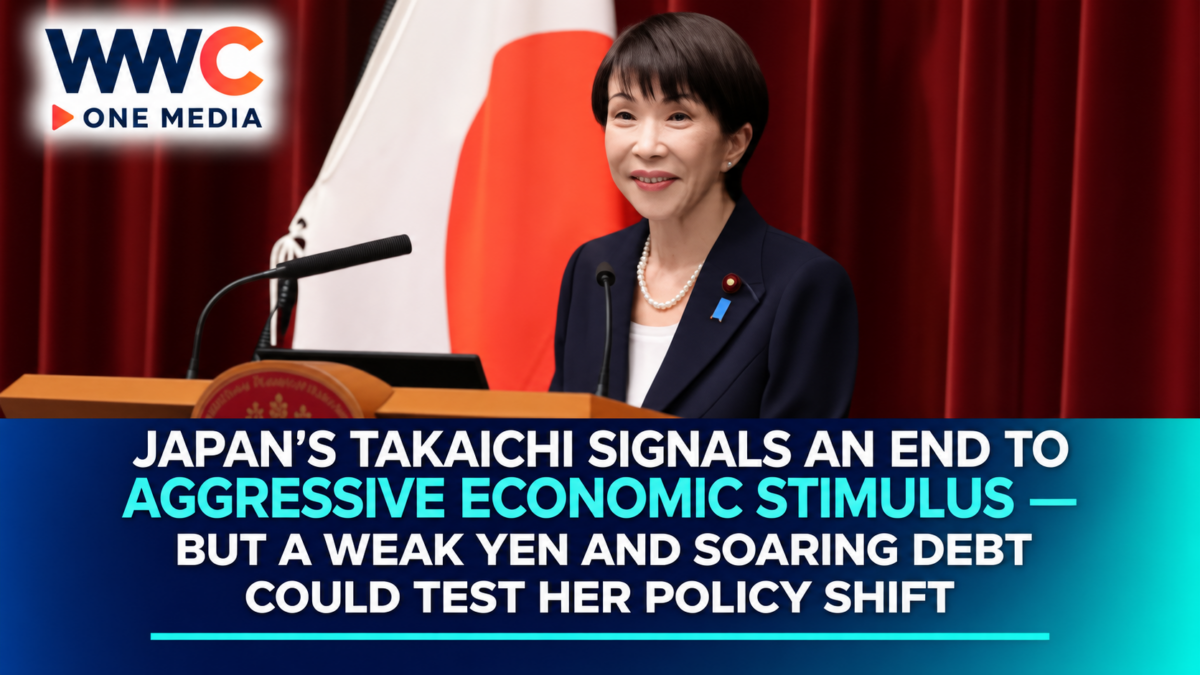
TOKYO, JAPAN — Japanese Prime Minister Sanae Takaichi has declared that Japan no longer needs aggressive reflationary economic policies under current conditions, signaling a potentially significant shift away from the ultra-loose monetary and fiscal stimulus that shaped the country’s economy for more than a decade.
Speaking during a parliamentary session on Thursday, October 8, Takaichi said Japan is no longer experiencing the kind of deflationary conditions that once justified extraordinary efforts to raise prices and stimulate demand.
Her remarks, reported by Bloomberg and FXStreet, come as her administration attempts to convince international investors that it can manage rising inflation, protect the yen and maintain fiscal discipline without interfering with the independence of the Bank of Japan.
Takaichi also emphasized that her government’s policies should not automatically be classified as reflationary and pledged transparent communication with financial markets.
The statement marks an important change in tone for a prime minister long associated with the economic philosophy of former leader Shinzo Abe.
But markets are unlikely to judge her government on words alone.
Japan is trying to move beyond an era of ultra-cheap money just as rising borrowing costs, a fragile yen and enormous government spending commitments create a new economic challenge.
Japan’s economic policy is entering a new era
For much of the past three decades, Japan struggled with weak inflation, sluggish wage growth and periods of falling consumer prices.
To combat those conditions, policymakers adopted unusually aggressive stimulus measures, including near-zero or negative interest rates, large-scale bond purchases and government spending programs.
These policies became central to Abenomics, the strategy introduced by former Prime Minister Shinzo Abe in 2013.
Reflationary policies are intended to revive economic activity and push inflation toward a sustainable level, particularly when an economy faces deflation or persistently weak demand.
But Japan’s economic circumstances have changed.
Consumer prices are now rising, wages have begun adjusting more frequently and businesses face higher costs for labor, imported materials and energy.
The government is therefore increasingly arguing that Japan no longer needs the same type of broad stimulus used during its deflationary years.
Economy Minister Minoru Kiuchi reinforced this position on October 2, explaining that Japan no longer required exceptionally loose monetary policy simply to generate higher inflation.
Reuters reported that Kiuchi also distinguished Takaichi’s economic strategy from the stimulus measures introduced under Abe.
Bank of Japan interest rates reach a 31-year high
Bank of Japan policy rate
1.25%
Highest in roughly 31 years
Core Tokyo inflation, September
2.4%
Year-on-year estimate
The policy transition is already underway at the Bank of Japan.
Japan’s central bank has raised its benchmark interest rate to 1.25%, the highest level in approximately 31 years, as inflation pressures become more widespread.
Reuters reported that the central bank has become increasingly concerned about the risk of persistent price increases, driven by higher import costs, rising wages and businesses passing more expenses on to consumers.
The BOJ has also shifted toward a more proactive approach to monetary policy after years of exceptionally low borrowing costs.
That shift matters because higher rates affect mortgages, business loans, government debt financing and international currency markets.
The government faces a delicate balancing act.
Keeping interest rates too low could allow inflationary pressures and yen weakness to continue.
But raising rates too quickly could slow economic growth and make government borrowing substantially more expensive.
A weak yen is complicating Japan’s economic transition
The yen remains a major concern for Japanese policymakers.
On October 8, the dollar was trading around ¥158.22, according to FXStreet market reporting.
USD/JPY exchange-rate context
¥158.22
per US$1, reported October 8
A higher USD/JPY figure indicates a weaker yen against the dollar. This is a reported market snapshot, not a live quote.
A weaker yen can benefit Japanese exporters by making their products more competitively priced abroad and boosting the yen-denominated value of overseas earnings.
However, it also raises the local-currency cost of imported products, especially oil, gas, food and industrial raw materials.
For Japanese households, the consequences can be particularly painful when wages fail to keep up with rising living expenses.
The currency issue has also become a diplomatic concern.
Bloomberg reported on October 2 that Takaichi had discussed the weak yen with US President Donald Trump, who raised concerns about its effects on American trade.
Takaichi acknowledged that an undervalued currency can create economic problems, while maintaining that exchange-rate movements should be addressed appropriately.
The continuing weakness of the yen therefore creates a difficult political and economic challenge.
Japan wants to support growth and maintain export competitiveness, but it also needs to contain imported inflation and restore confidence in its currency.
Japan’s ¥143 trillion budget requests raise questions about fiscal discipline
While Takaichi is trying to distance her administration from aggressive reflationary policies, investors remain concerned about the government’s ambitious spending plans.
Reuters reported that budget requests for Japan’s next fiscal year have reached approximately ¥143.1 trillion, close to pandemic-era levels.
At the same time, the government aims to limit new bond issuance to roughly ¥40 trillion.
The finance ministry has also requested a record ¥36.64 trillion for debt-servicing costs, reflecting the growing expense of financing Japan’s substantial public debt.
Japan’s fiscal balancing act
| FY2027 ministry budget requests | ¥143.1 trillion |
| Target ceiling for new bond issuance | ~¥40 trillion |
| Requested debt-servicing allocation | ¥36.64 trillion |
| Estimated annual cost of proposed food-tax cut | ~¥4 trillion |
These figures represent different fiscal categories and are not directly additive. Budget requests are not the final approved budget.
The numbers illustrate the fundamental challenge facing Takaichi.
Her government wants to invest in strategic industries, strengthen national security and provide relief to households affected by rising prices.
But financial markets are increasingly sensitive to the possibility that those commitments could require additional borrowing.
Reuters reported on October 8 that economists remain skeptical of the government’s changing language unless it is accompanied by concrete spending decisions.
A food-tax reduction could complicate the government’s message
One of Takaichi’s signature proposals is a temporary reduction in the consumption tax on food and non-alcoholic beverages from 8% to 1% for two years.
The measure, planned to begin in April 2027, is designed to help households cope with higher living costs.
However, it could reduce annual government revenue by approximately ¥4 trillion.
The government has suggested using stronger tax receipts and existing public funds to help cover the shortfall, but analysts have questioned whether those sources will provide a sustainable solution.
That creates an apparent contradiction between Japan’s new economic messaging and its proposed fiscal measures.
While the government is declaring that aggressive reflationary stimulus is no longer necessary, it is still considering tax relief and substantial investments that could support demand.
Officials argue that their spending priorities focus on improving the economy’s productive capacity rather than simply stimulating consumption.
The distinction matters, but investors will want evidence that projects deliver measurable economic benefits.
Bank of Japan independence becomes a major test
Takaichi’s remarks also seek to address concerns that political pressure could prevent the Bank of Japan from raising rates when inflation requires it.
The prime minister has emphasized respect for the central bank’s monetary policy decisions.
Finance Minister Satsuki Katayama made a similar point in a September Bloomberg television interview, saying that Takaichi wanted international investors to understand that she was not pursuing traditional reflationary policies.
The market significance is substantial.
An independent central bank can adjust interest rates in response to inflation and economic conditions without being required to accommodate government spending priorities.
However, rising rates create a dilemma for Japan because higher bond yields increase financing costs for the government.
On October 7, Bloomberg reported that Takaichi was prepared to review spending and revenue measures if bond yields moved unexpectedly.
That statement suggests her government is increasingly aware of how quickly bond-market pressure could complicate fiscal policy.
Bond markets are demanding proof, not promises
The Financial Times reported that Japan’s 30-year government bond yield reached a record 4.23% amid concerns about spending plans and fiscal sustainability.
The same report noted that shorter-maturity bond yields were also trading near multidecade highs.
Bond yields rise when prices fall, meaning that investor selling can push up the government’s cost of raising new funds.
A prolonged increase in yields would make debt servicing more expensive as Japan refinances maturing obligations.
The government’s position is that stronger growth and carefully targeted investment can eventually improve the debt-to-GDP ratio.
Skeptics argue that this outcome depends on whether economic growth and government revenues increase sufficiently to offset higher interest costs.
In its October 8 analysis, Reuters said Takaichi’s shift away from reflationary language could backfire if investors conclude that her administration’s spending plans remain largely unchanged.
This is why the coming budget negotiations matter more than the terminology used to describe Japan’s economic policy.
What does the policy shift mean for the Philippines and Asia?
Japan’s economic transition could have consequences throughout Asia, particularly for countries with significant trade, investment and financial ties to Tokyo.
For the Philippines, Japan remains an important source of development financing, infrastructure investment, manufacturing activity and tourism.
A sustained strengthening of the yen could increase the peso value of income earned by Filipinos working in Japan, although the final effect would depend on exchange rates and living costs.
Higher Japanese interest rates could also influence financing costs for yen-denominated loans and investment flows across Asian markets.
Meanwhile, Japanese companies may reassess overseas investments if domestic borrowing costs increase or the global economic outlook weakens.
These are potential effects rather than confirmed consequences of Takaichi’s October 8 statement.
Japan’s monetary and fiscal decisions will continue to interact with broader developments, including US interest rates, energy prices and global investor sentiment.
The bigger picture: Is Japan finally leaving Abenomics behind?
Takaichi’s latest declaration represents a significant rhetorical departure from the policies historically associated with Japan’s battle against deflation.
The economy is no longer operating in the same environment that gave rise to Abenomics.
Prices are rising, wages are adjusting and the Bank of Japan is gradually returning interest rates toward more conventional levels.
But the transition carries risks.
Japan must control inflation without undermining growth, strengthen the yen without destabilizing exporters, and manage government spending without triggering another major bond-market selloff.
At the same time, Takaichi faces pressure to protect households from higher living costs while funding defense, technology and economic security priorities.
Her administration argues that growth-oriented investment and greater fiscal responsibility can coexist.
The question is whether the upcoming budget will demonstrate that commitment.
Japan may no longer need aggressive stimulus to escape deflation—but Takaichi’s bigger challenge is proving that the country can sustain growth without relying on the cheap money and heavy spending that defined its economy for more than a decade.