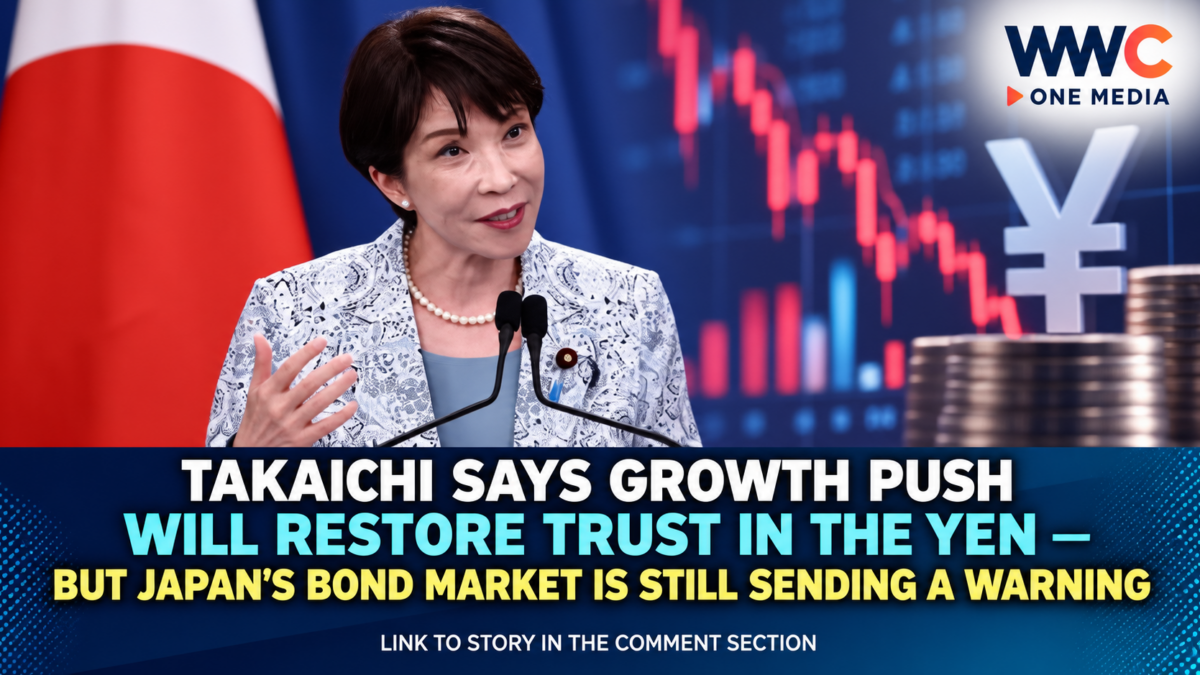
TOKYO — Japanese Prime Minister Sanae Takaichi is trying to reassure increasingly nervous currency and bond markets that her growth-first economic strategy will strengthen confidence in the yen rather than weaken it.
Speaking in parliament on Friday, Takaichi said her government would continue watching exchange-rate and price movements carefully and respond appropriately as conditions change.
She also argued that fiscal policy should take into account movements in:
the yen;
interest rates;
inflation;
and the broader economy.
Her underlying message is becoming clearer:
Japan cannot build confidence in the yen simply by defending a specific exchange rate. It has to convince investors that the economy can grow without allowing public finances to spin out of control.
That is a much more complicated challenge.
The yen remains weak.
Bond yields have risen sharply.
Japan’s public debt remains enormous.
And Takaichi is simultaneously pushing expensive policies designed to boost growth and help households deal with inflation.
The question facing markets is whether those policies strengthen Japan’s economy—
or simply create more debt.
Takaichi says growth itself can support confidence in the yen
Bloomberg’s latest report focuses on Takaichi’s argument that sustained economic growth can help restore confidence in Japan’s currency.
That is economically plausible.
Currencies are influenced by:
interest-rate differentials;
economic growth;
inflation;
capital flows;
trade;
government finances;
and investor confidence.
If Japan raises productivity and attracts private investment, investors may become more willing to hold Japanese assets.
That can indirectly support the yen.
But economic growth does not automatically create a stronger currency.
If that growth is financed by excessive borrowing, markets can instead worry about inflation and debt sustainability.
That is the tension at the center of “Takaichinomics.”
The yen is still close to levels that worry Tokyo
The Japanese currency has remained around the high ¥150s against the dollar.
Earlier this week, the yen was near ¥157.7 per dollar, despite previous intervention efforts aimed at supporting it.
A weak yen has mixed effects.
It helps exporters because overseas earnings become worth more when translated into yen.
It can support tourism.
But it also makes imported goods more expensive.
That matters enormously for Japan because the country imports large quantities of:
energy;
food;
raw materials;
and industrial inputs.
With global energy prices elevated, the combination of expensive oil and a weak yen can become especially painful for households.
Takaichi says the government is watching inflation as closely as the currency
That connection explains why Takaichi linked exchange rates and prices in her parliamentary remarks.
The Bank of Japan has said inflationary pressure is broadening across the economy, driven partly by:
higher raw-material costs;
a weaker yen;
energy prices;
and rising wages.
The BOJ says more companies are raising prices and that labor costs are increasingly contributing to inflation.
This is a completely different Japan from the one policymakers were dealing with a decade ago.
For years, Tokyo struggled to create inflation.
Now officials are trying to stop inflation from becoming too persistent.
Takaichi has now declared the reflation era effectively over
That may be the most important policy shift.
On Thursday, Takaichi told parliament that Japan is no longer in a position where it needs aggressive “reflationary” policies combining monetary easing and fiscal expansion.
She said the economy is no longer experiencing deflation and stressed that her current strategy should not be confused with traditional reflation.
That is a remarkable change for a politician historically associated with aggressive stimulus.
Takaichi was long viewed as an heir to parts of Shinzo Abe’s economic philosophy.
But Japan in 2026 is facing very different conditions.
Inflation is higher.
Bond yields are higher.
The BOJ has raised rates.
And the yen remains under pressure.
The policy response therefore has to evolve.
She also signaled she will not fight the Bank of Japan
Takaichi said her government fully respects the Bank of Japan’s independence in setting monetary policy.
That is significant because investors had worried that a strongly reflationist government might resist further BOJ interest-rate increases.
The BOJ has already raised rates twice this year, and its policy rate is at the highest level in decades.
Markets are watching for another increase.
Former BOJ policymaker Asahi Noguchi has said Japan may need to move gradually away from extremely low rates and large-scale fiscal support now that inflation and wages are more entrenched.
Takaichi’s latest comments suggest she is increasingly accepting that reality.
That could help the yen
Higher Japanese interest rates can support the currency.
For decades, one of the main reasons the yen weakened was the enormous gap between Japanese rates and those in the U.S. and other economies.
Investors could borrow cheaply in yen and invest elsewhere.
That strategy—known as the yen carry trade—put persistent pressure on the currency.
If Japanese rates continue rising while foreign central banks eventually stop tightening, the interest-rate gap narrows.
That could make holding yen assets more attractive.
But rates cannot rise too quickly without creating other problems.
Higher rates are already hurting Japan’s bond market
Japan’s government bond market is sending a very clear warning.
Earlier this month, the yield on the 30-year Japanese government bond surged to a record 4.235%.
The latest October 8 auction cleared at a weighted-average yield of 4.109%, with the lowest accepted price corresponding to a yield of 4.121%.
The 10-year yield has also remained near levels not seen for roughly three decades.
That matters because Japan has one of the largest public-debt burdens in the developed world.
Higher yields eventually mean higher government interest payments.
Japan’s debt is nearly twice the size of its economy
Japan’s gross public debt remains enormous relative to GDP.
For decades, ultra-low interest rates made that burden manageable.
The government could borrow cheaply.
The BOJ also bought huge quantities of government bonds.
That environment is now changing.
If yields remain elevated, refinancing government debt becomes progressively more expensive.
That puts pressure on future budgets.
A policy that looks affordable when bond yields are near zero can look completely different when long-term borrowing costs are above 4%.
This is why markets are skeptical about aggressive fiscal expansion
Takaichi says she supports what she calls “responsible and proactive public finances.”
Her October 5 policy address said the government would use large, predictable, multi-year spending programs to encourage private investment in strategic industries.
At the same time, she pledged to keep the debt-to-GDP ratio on a downward trajectory and control annual bond issuance.
In theory, both goals can coexist.
Government spending can raise productivity.
Higher productivity can raise growth.
Higher growth increases tax revenue.
That can make debt more manageable.
But markets need evidence that the investments actually produce enough growth.
Otherwise, “growth spending” simply becomes more borrowing.
The food-tax cut is the biggest immediate credibility test
Takaichi’s government plans to reduce the consumption tax on food from 8% to 1% for two years beginning in April 2027.
The measure is designed to reduce the burden of rising food prices on households.
It is politically popular.
It is also extremely expensive.
Reuters estimates the policy will create a revenue shortfall of around ¥5 trillion a year, equivalent to more than $30 billion at current exchange rates.
That is exactly the kind of measure bond investors worry about.
Tax cuts reduce government revenue at the same time that interest costs and defense spending are rising.
Takaichi says she will not fund the tax cut with deficit bonds
This has become one of her most important promises.
The government says the food-tax reduction will not be financed through additional deficit-covering debt.
Instead, officials are looking for:
spending cuts;
unused government funds;
non-tax revenue;
and other sources of financing.
If they succeed, the policy could provide household relief without substantially increasing debt issuance.
If they fail, markets may conclude the government’s fiscal promises are unrealistic.
That would put renewed pressure on bonds—and potentially the yen.
Japan has restarted a DOGE-style spending review
The government is now searching aggressively for money.
Tokyo has revived a spending review modeled partly on the U.S. Department of Government Efficiency.
Officials are examining 201 special-purpose funds expected to contain roughly ¥7 trillion, or around $44 billion, by the end of the next fiscal year.
The goal is to identify idle funds, inefficient subsidies and tax breaks that can be cut or redirected.
That sounds straightforward.
In practice, it is politically difficult.
An earlier review examined about 120 tax breaks and proposed eliminating only three.
That illustrates how hard real spending reform can be.
Every tax break has beneficiaries.
Every subsidy has supporters.
Every fund has a bureaucracy defending it.
Japan’s budget requests are already at record levels
The fiscal pressure is not limited to the food-tax cut.
Budget requests for the coming year have reached roughly ¥143 trillion, according to Reuters.
The government also faces major spending requirements for:
defense;
economic security;
semiconductors;
AI;
energy;
infrastructure;
and regional revitalization.
At the same time, debt-servicing costs are rising.
That means Takaichi’s promise to support growth while maintaining market confidence will require unusually strict prioritization.
Everything cannot be funded.
Defense spending is another major long-term commitment
Japan is expanding defense spending rapidly amid growing security concerns involving China, North Korea and the wider Indo-Pacific.
That spending has broad political support.
But it adds another structural burden to the budget.
The government is also pursuing a public-private investment strategy worth hundreds of trillions of yen over the coming decade.
These programs may strengthen long-term growth and national security.
But they require money now.
That is why markets keep returning to the same question:
Where will the funding come from?
Takaichi’s argument is that growth can improve the denominator
There is an important economic logic behind her strategy.
Debt sustainability depends not only on the amount of debt.
It also depends on the size of the economy.
If nominal GDP rises faster than government debt, the debt-to-GDP ratio can fall even if the absolute debt stock remains large.
Takaichi explicitly says her government will focus on lowering the debt-to-GDP ratio over time rather than obsessing over a single-year primary-budget target.
That gives policymakers more flexibility to invest during periods when they believe spending can raise long-term growth.
The risk is obvious:
if growth disappoints, the debt remains.
Markets therefore need to believe the spending is productive
Not all fiscal spending is equal.
Money spent building infrastructure or improving productivity can generate future returns.
Money spent simply supporting consumption may have a shorter-lived impact.
Takaichi says her government will prioritize strategic investment capable of lifting Japan’s potential growth rate.
That includes areas such as:
AI;
semiconductors;
economic security;
energy;
advanced manufacturing;
and domestic investment.
Investors will judge whether those programs actually increase private investment.
If they do, Takaichi’s growth argument becomes stronger.
If not, fiscal skepticism will intensify.
Japan’s AI investment boom could help
The BOJ itself has highlighted AI-related demand as a growing source of investment.
Companies are spending more on:
electronics;
machinery;
telecommunications infrastructure;
and data centers.
That has helped support Japan’s economic outlook even while consumption remains under pressure.
AI investment could therefore fit perfectly with Takaichi’s strategy.
Government incentives attract private investment.
Private investment raises productivity.
Productivity improves growth.
Growth supports tax revenue and confidence in Japanese assets.
That is the positive scenario.
But AI could also push interest rates higher
There is another side.
BOJ officials have argued that stronger AI investment could increase demand and potentially raise Japan’s long-run neutral interest rate.
That means borrowing costs may settle permanently above the near-zero levels Japan became accustomed to.
For companies, that may be manageable.
For a government carrying enormous debt, it is much more consequential.
A stronger economy can handle higher rates.
But the transition can still be painful.
A stronger yen would not necessarily be universally welcomed
Japan’s exporters often benefit from a weaker yen.
Companies such as:
Toyota;
Sony;
Nintendo;
and major machinery manufacturers
earn large amounts of revenue overseas.
When the yen weakens, those foreign earnings translate into more yen.
That can boost profits and Japanese stock prices.
So the government does not necessarily want an extremely strong currency.
What it wants is stability.
Rapid depreciation is the bigger problem because it increases import costs and undermines household purchasing power.
“Trust in the yen” is therefore about stability more than a specific number
Takaichi’s language is important.
She is emphasizing confidence and trust rather than promising that the yen will return to ¥120 or ¥130 per dollar.
That is sensible.
Governments rarely have complete control over exchange rates.
The dollar side of the equation matters too.
U.S. interest rates.
Federal Reserve policy.
Energy prices.
Global risk sentiment.
All can move the yen regardless of what Tokyo does.
The realistic objective is to convince investors that Japanese policy is coherent enough that they do not need to flee the currency.
Tokyo has already intervened once this year
Japan and the United States carried out a rare coordinated intervention earlier this year when the yen weakened sharply.
The move briefly pushed the currency to around ¥155.2 per dollar, before it weakened again toward the upper ¥150s.
That demonstrated the limits of intervention.
Governments can move currencies temporarily.
But they struggle to reverse a trend if the underlying economic forces continue pointing the other way.
That is why Takaichi is now emphasizing fundamentals.
Growth.
Fiscal credibility.
Inflation.
Interest rates.
Those ultimately matter more than repeated intervention.
Rising oil prices make the yen problem harder
Global energy prices remain elevated because of Middle East instability.
Japan imports most of its fossil fuels.
That means expensive oil and gas increase the country’s import bill.
If the yen is simultaneously weak, those imports become even more expensive in local currency.
That can worsen Japan’s trade balance and inflation pressure.
It can also erode household spending power.
This creates another reason for Tokyo to prevent disorderly yen weakness.
The government is trying to fight inflation without crushing demand
That is a difficult balancing act.
Higher interest rates can support the yen and reduce inflation.
But they can also slow:
consumer spending;
housing;
business investment;
and overall growth.
Tax cuts can support households.
But they can worsen fiscal deficits.
A stronger yen reduces import inflation.
But it can hurt exporters.
There is no policy combination that improves every variable simultaneously.
Takaichi’s task is therefore one of balance, not simple stimulus.
That explains her rhetorical shift
Earlier in her political career, Takaichi strongly supported aggressive fiscal and monetary easing.
Today, she is emphasizing:
market confidence;
fiscal sustainability;
BOJ independence;
and the end of the reflation era.
That is not necessarily ideological inconsistency.
The economy changed.
Japan spent decades trying to escape deflation.
It has now largely succeeded.
The policy risk has shifted from too little inflation to too much inflation combined with an extremely high debt burden.
Scott Bessent has also pressured Tokyo to move beyond reflation
U.S. Treasury Secretary Scott Bessent recently argued that Japan should leave traditional reflation policy behind.
Takaichi’s statement that Japan no longer needs reflationary policy closely echoes that argument.
That may also reflect international concern over the yen.
A persistently weak Japanese currency can create trade tensions.
U.S. officials generally want major trading partners to avoid policies that appear deliberately designed to weaken their currencies.
Respecting BOJ independence and emphasizing fiscal responsibility helps Takaichi counter that perception.
Bond investors remain the hardest audience to convince
Politicians can announce plans.
Bond markets price them immediately.
Japan’s 30-year yield reaching above 4% is a signal that investors now demand much more compensation to lend the government money for decades.
That does not mean Japan faces an imminent debt crisis.
Most government debt is denominated in yen.
Japan has a large domestic savings base.
The BOJ remains a powerful market participant.
But the era when the government could assume almost-free borrowing is clearly ending.
That changes every fiscal calculation.
The yen and the bond market are sending related messages
A weaker currency says investors worry about the relative attractiveness of Japanese assets.
Higher bond yields say investors want more compensation for holding long-term government debt.
Both can reflect concerns about:
inflation;
fiscal expansion;
and policy credibility.
That is why Takaichi’s economic strategy cannot treat the currency and bond market as separate issues.
A fiscal policy that scares bond investors can also weaken the yen.
A weaker yen can worsen inflation.
Higher inflation can push yields even higher.
That creates a dangerous feedback loop.
The positive feedback loop is possible too
There is also a much better scenario.
Strategic spending raises investment.
Investment raises productivity.
Productivity raises wages.
Higher wages support consumption.
Stronger growth increases tax revenue.
Tax revenue helps stabilize debt.
Improved fiscal credibility supports bonds.
Higher confidence supports the yen.
That is essentially the economic story Takaichi is asking investors to believe.
It is not impossible.
Japan has significant strengths:
advanced manufacturing;
large household savings;
world-class companies;
strong institutions;
and growing investment in technology.
The question is execution.
Japan may finally be leaving the post-deflation era behind
For decades, Japanese policymakers operated under one assumption:
inflation was too low.
Interest rates were too low.
Demand was too weak.
That framework is increasingly obsolete.
Japan now has:
higher wages;
persistent inflation;
positive interest rates;
more expensive government borrowing;
and a weak currency that makes imports costly.
The economic regime has changed.
Takaichi’s political success may depend on how quickly her own economic philosophy changes with it.
Growth alone will not save the yen
That is perhaps the most important caveat to her argument.
Faster growth can increase confidence.
But investors will not ignore:
debt;
inflation;
interest rates;
or fiscal credibility.
A government cannot simply spend heavily, call it a growth strategy and assume the currency will strengthen.
Markets will want evidence.
Evidence that private investment is rising.
Evidence that productivity is improving.
Evidence that new spending is being prioritized.
Evidence that the ¥5 trillion food-tax hole can actually be financed without excessive new debt.
Without that, “growth” becomes a slogan rather than a currency strategy.
The next BOJ meetings will matter almost as much as Takaichi’s budget
The BOJ is due to publish updated growth and inflation forecasts at the end of October.
Markets will watch closely for signs of another rate increase.
If inflation stays high and the yen weak, the case for further tightening strengthens.
Takaichi’s promise to respect central-bank independence reduces the risk of an open political clash.
But tighter monetary policy could also make government debt more expensive.
That tension will remain.
The next budget may be the real test of “Takaichinomics”
Investors have heard the assurances.
They now want the numbers.
How much will strategic investment cost?
How much will the food-tax cut cost?
What spending will be eliminated?
How much new debt will be issued?
Will the government remain below its bond-issuance targets?
Those answers will determine whether markets believe Takaichi’s claim that Japan can pursue growth and fiscal sustainability simultaneously.
Words can stabilize sentiment.
Budgets determine credibility.
Takaichi is trying to redefine her economic brand
The shift is significant.
“Takaichinomics” once implied aggressive stimulus.
It is increasingly becoming something more complicated:
targeted strategic investment;
household relief;
higher private-sector investment;
less reliance on blanket monetary easing;
and an explicit promise to maintain fiscal discipline.
That may be more appropriate for Japan’s current economy.
But it is also harder to execute.
Stimulus is simple.
Selective growth policy requires choosing winners, cutting waste and resisting political pressure.
The yen may ultimately become the scorecard
Currencies compress thousands of judgments into one number.
Growth.
Inflation.
Interest rates.
Trade.
Fiscal policy.
Political credibility.
Global risk.
All appear in the exchange rate.
That is why Takaichi’s comment about restoring trust in the yen matters.
She is effectively saying her government wants markets to judge Japan differently.
Not as a country trapped in permanent deflation and zero interest rates.
But as a growing economy capable of sustaining higher rates without losing fiscal control.
That would be a historic transition.
But Japan still has to prove it can escape one problem without creating another
The country spent decades fighting deflation.
Now inflation is back.
It spent decades relying on cheap borrowing.
Now yields are rising.
It used a weak yen to support exports.
Now that same weak yen is squeezing consumers.
Takaichi believes stronger growth can make those trade-offs manageable.
Markets are not rejecting that argument.
They simply want proof.
Japan’s prime minister says a stronger economy will restore confidence in the yen.
But with the currency still weak, 30-year bond yields recently hitting record highs and a multitrillion-yen tax cut still needing credible funding, investors are confronting a much harder question:
Can Takaichi deliver enough growth to strengthen Japan before higher interest rates make its enormous debt burden much more expensive?