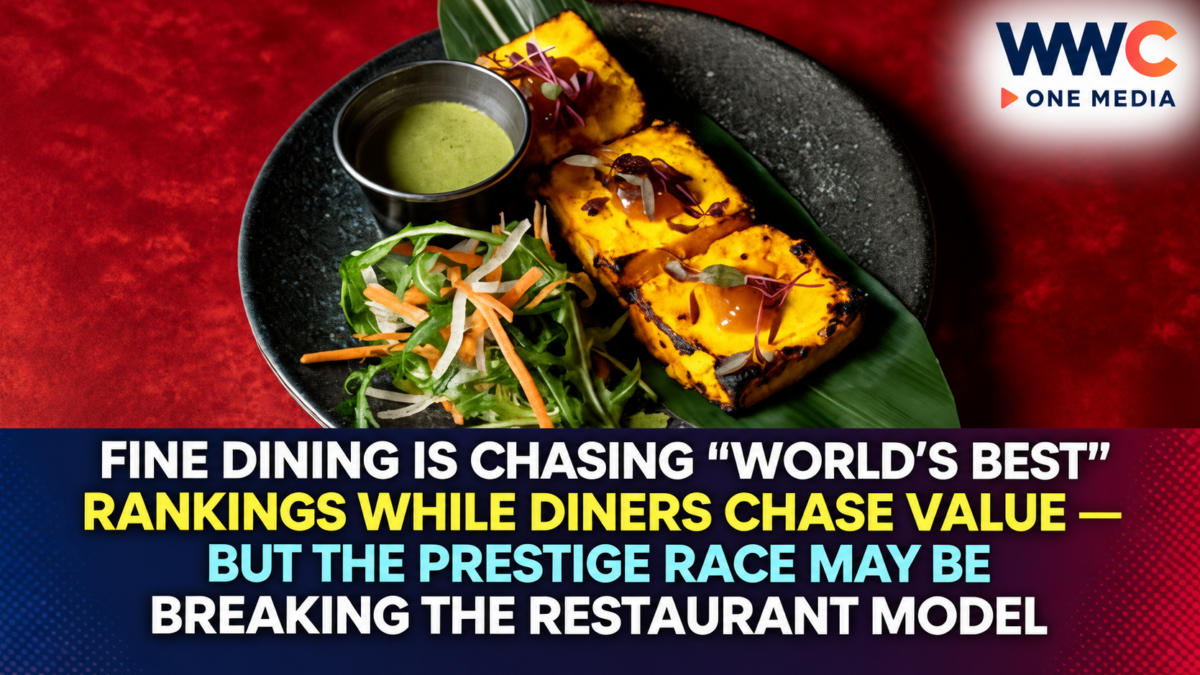
For years, ambitious chefs were told that reaching the top meant chasing Michelin stars, appearing on prestigious “best restaurant” rankings and creating the kind of elaborate tasting menus that could persuade diners to travel halfway around the world for dinner.
Now the economics of that model are starting to crack.
A new Bloomberg Opinion column argues that the relentless proliferation of best-restaurant lists may be contributing to fine dining’s difficulties by encouraging restaurants to compete for prestige, spectacle and international recognition at a time when many customers increasingly want something very different: affordability, flexibility and a reason to return regularly.
The argument is provocative, and restaurant rankings are certainly not the only — or even necessarily the biggest — reason high-end restaurants are struggling.
The harder numbers point to a much broader problem.
Labor is expensive.
Ingredients are expensive.
Rent, insurance, utilities and credit-card fees have climbed.
Consumers are watching their budgets.
And the extraordinary amount of staff and preparation required to deliver a multi-hour tasting menu leaves very little room for error.
In the United States, the National Restaurant Association estimates that the average restaurant’s total operating expenses have jumped 36% since 2019. Forty-two percent of operators said their restaurants were not profitable in 2025, while 33% reported being unprofitable during the first half of 2026.
That suggests the real crisis is not simply that customers have stopped appreciating extraordinary restaurants.
It is that extraordinary restaurants have become extraordinarily difficult to operate profitably.
THE FINE-DINING ECONOMICS ARE GETTING BRUTAL
Restaurants have always been notoriously low-margin businesses.
The National Restaurant Association estimates that food and labor each consume roughly one-third of a typical restaurant’s sales, while utilities, occupancy, supplies, administration and payment-processing expenses take another large share.
Under more normal conditions, that can leave a typical restaurant with a pretax profit margin of only around 5%.
Those economics have deteriorated dramatically.
Average hourly restaurant wages have increased approximately 41% since February 2020, while average wholesale food prices are around 35% higher.
For fine-dining restaurants, the pressure can be even more intense.
A chef-driven tasting-menu restaurant may employ large kitchen brigades, pastry teams, sommeliers, captains and other highly trained workers while serving relatively few customers per night.
Premium seafood, luxury proteins, specialty produce and imported wine add additional costs.
A restaurant may receive glowing reviews and still struggle to produce meaningful profits.
That is the uncomfortable contradiction sitting beneath the glamorous world of Michelin stars and global rankings.
Prestige can fill dining rooms.
It does not automatically fix the business model.
THE “WORLD’S BEST” RACE CHANGED WHAT RESTAURANTS ASPIRE TO BECOME
Restaurant rankings have enormous cultural influence.
A place appearing on a major international list can suddenly become a destination for travelers who plan entire trips around obtaining a reservation.
That attention can transform a previously local restaurant into an international brand.
But the Bloomberg Opinion argument raises another question:
What happens when chefs begin designing restaurants not primarily around what local customers want to eat repeatedly, but around what they believe award voters, critics and international gastronomic travelers will notice?
Long tasting menus became one visible symbol of that transformation.
Instead of ordering a starter and main course and leaving whenever they wish, guests may commit to eight, 12, 15 or more courses lasting several hours.
Restaurants invest heavily in presentation, rare ingredients, custom ceramics, elaborate explanations and technically demanding preparations.
Done brilliantly, the experience can be unforgettable.
But it is also extraordinarily labor-intensive.
And if too many restaurants begin chasing the same international formula, fine dining risks becoming less diverse rather than more innovative.
RESTAURANTS ARE NOW FLIPPING FROM LUXURY TO AFFORDABILITY
Some operators are already changing direction.
Eater reported this week that a growing number of ambitious American restaurants are abandoning high-cost concepts for more accessible formats.
In New York, the upscale Chateau Royale was transformed into Floradora, offering less expensive comfort food.
The team behind Libertine similarly replaced the French bistro with the more affordable Capitaine.
In Los Angeles, Mei Lin’s upscale 88 Club became Tiger Tiger.
And in Washington, Michelin-starred Tail Up Goat closed before its operators returned with Rye Bunny, a more casual counter-service concept designed to reduce operating costs while keeping culinary quality high.
These are not chefs giving up on good cooking.
They are businesses adapting to an economic reality.
A customer who might hesitate before spending hundreds of dollars on a tasting menu could happily visit an excellent neighborhood restaurant several times a month.
That repeat customer may ultimately be more valuable than the international gastronome who flies into town once, posts the meal on Instagram and never returns.
DINERS STILL WANT RESTAURANTS — THEY JUST WANT VALUE
The restaurant industry itself is not collapsing.
The National Restaurant Association expects U.S. restaurant and foodservice sales to reach roughly $1.55 trillion in 2026.
Consumers still want to dine out.
But the association says inflation and a cooling labor market are putting particular pressure on low- and middle-income households.
Restaurants therefore increasingly have to demonstrate meaningful value rather than simply raise menu prices every time costs increase.
This matters enormously for fine dining.
A $250 tasting menu is not competing only with another $250 tasting menu.
It is competing with an excellent neighborhood restaurant, a casual chef-driven concept, delivery, travel, concerts, streaming subscriptions and every other discretionary purchase fighting for a consumer’s wallet.
Fine dining therefore has to provide an experience extraordinary enough to justify an extraordinary price.
That is becoming a much higher bar.
RESTAURANT LISTS ARE NOT THE VILLAIN — BUT THEY CAN DISTORT INCENTIVES
It would be too simplistic to blame Michelin, The World’s 50 Best or other restaurant rankings for the industry’s financial problems.
Michelin itself explicitly says that restaurants do not need formal service, expensive interiors or tasting menus to earn a Star.
Its inspectors judge restaurants based on ingredient quality, mastery of technique, harmony of flavors, the chef’s culinary personality and consistency.
Michelin specifically says a Star can go to everything from a luxury dining room to a humble establishment and that a tasting menu is not required.
The guide also operates the Bib Gourmand distinction, which specifically rewards restaurants offering strong quality and value.
That makes an important distinction.
The problem may not be the existence of rankings themselves.
It may be the way parts of the restaurant industry interpret them.
If chefs conclude that recognition requires greater complexity, longer menus, more expensive ingredients and ever more theatrical experiences, they can build cost structures customers eventually cannot support.
THE PHILIPPINES SHOWS WHY THE OTHER SIDE OF THE ARGUMENT MATTERS
The Philippines offers a useful counterexample.
Michelin entered the Philippine restaurant market for the first time with its 2026 Manila, surrounding areas and Cebu guide.
The inaugural selection included 108 establishments.
Only nine received Michelin Stars: one Two-Star restaurant and eight One-Star restaurants.
But another 25 earned Bib Gourmand recognition for good food at good value, while 74 were included as Michelin Selected restaurants.
That broader mix matters.
It means international culinary recognition does not necessarily have to turn every respected restaurant into an expensive tasting-menu destination.
Michelin’s Philippine selection includes Filipino restaurants, international concepts and relatively accessible establishments alongside highly ambitious fine dining.
The guide itself has highlighted the diversity of Philippine food culture — from sophisticated restaurants to street-side dining — rather than treating luxury as the only measure of excellence.
That could become an important lesson as the Philippine dining industry develops.
International prestige can help chefs attract tourists and investment.
But restaurants that chase awards while losing their local customers may win the ranking battle and still lose the business war.
ASIA IS STILL EMBRACING THE PRESTIGE ECONOMY
Across Asia, meanwhile, major restaurant rankings remain enormously influential.
Asia’s 50 Best Restaurants continues to draw chefs, media, sponsors and culinary travelers from across the world.
Its 2026 ranking showcases restaurants from cities including Tokyo, Bangkok, Hong Kong, Singapore, Seoul, Taipei and beyond, reinforcing the region’s growing status in global gastronomy.
There is nothing inherently wrong with this.
Recognition can elevate cuisines that were previously ignored by Western-centric dining institutions.
It can turn chefs into ambassadors for their countries.
It can create culinary tourism.
And it can encourage restaurants to improve.
But prestige produces powerful incentives.
Once a restaurant’s international ranking becomes part of its identity, stepping back from an elaborate tasting menu or reducing expensive theatrical elements can feel like surrender.
That may be commercially irrational.
The restaurant exists first because customers pay to eat there.
The trophy comes afterward.
A RESTAURANT CAN BE FAMOUS AND STILL BE FINANCIALLY FRAGILE
This is perhaps the biggest misunderstanding surrounding luxury restaurants.
Busy dining rooms do not necessarily mean large profits.
Full-service restaurants in the National Restaurant Association’s operating dataset recorded a median pretax income of only 2.8% of sales.
Payroll and benefits alone represented a median 36.5% of full-service restaurant revenue.
Imagine a restaurant generating $10 million in annual revenue.
A 2.8% pretax margin would produce only $280,000 before tax.
One major equipment failure, rent increase, weak season or surge in ingredient costs can erase much of that profit.
Fine dining then adds another difficulty: customers expect perfection.
A casual restaurant can simplify a garnish, change a plate or reduce service staff without attracting international attention.
A globally ranked dining room may be expected to deliver precisely the same level of luxury every night.
Prestige raises expectations at the same time costs are squeezing margins.
SOCIAL MEDIA MADE THE PRESSURE EVEN STRONGER
The ranking economy also collided with Instagram, TikTok and food-influencer culture.
Restaurants increasingly compete not only on taste but on whether dishes photograph well.
Spectacular plating, dramatic dining rooms and unusual ingredients can generate millions of online impressions.
That can be powerful marketing.
But it can also encourage restaurants to build experiences optimized for one viral visit rather than long-term loyalty.
A beautifully plated course might require several cooks and dozens of individual components.
A bowl of exceptional noodles may require far fewer.
If the noodles create happier repeat customers and better margins, which restaurant is actually more successful?
Prestige culture does not always answer that question correctly.
LONG TASTING MENUS MAY BE LOSING THEIR MONOPOLY ON “SERIOUS” COOKING
One of the healthiest developments in contemporary dining is the idea that ambitious cooking does not require formality.
A chef can demonstrate exceptional technique in a neighborhood restaurant.
A counter-service establishment can obsess over ingredients.
A barbecue restaurant can demand the same craftsmanship as classical French cuisine.
Michelin itself says its inspectors do not require any particular style, decor or service model when considering a restaurant for a Star.
That opens the door to a different future for fine dining.
Instead of disappearing, it may become less formal.
Tasting menus may become shorter.
À la carte options may return.
Restaurants may use fewer employees.
Chefs may focus more heavily on local ingredients instead of costly imported luxury products.
Dining rooms may become smaller and more flexible.
And customers may regain something they increasingly value: choice.
THE BEST RESTAURANT MAY NOT BE THE ONE RANKED NO. 1
There is also a philosophical question behind the Bloomberg debate.
Can there really be one “best” restaurant?
Is a meticulously executed 15-course tasting menu objectively superior to a family-run restaurant perfecting the same regional dish for three generations?
Restaurant rankings have to impose order because rankings require numbers.
No. 1.
No. 2.
No. 3.
But dining is intensely subjective.
The best meal of someone’s life may happen in a Michelin-starred dining room.
Or it may happen at a roadside restaurant with plastic chairs.
Even professional restaurant critics increasingly acknowledge that great dining exists at every price level.
That broader definition of excellence may ultimately be healthier for the restaurant industry.
FINE DINING IS NOT DYING — THE OLD BUSINESS MODEL IS BEING FORCED TO CHANGE
There will always be customers willing to spend large amounts of money on exceptional restaurants.
People still travel for food.
They still celebrate anniversaries with tasting menus.
They still want talented chefs to push culinary boundaries.
The demand has not vanished.
What is changing is the assumption that every serious chef should aspire to build an expensive, labor-intensive restaurant designed around the expectations of global rankings.
The numbers increasingly make that model difficult to defend.
Restaurant expenses are 36% higher than in 2019.
One-third of U.S. operators were still losing money during the first half of 2026.
Labor and food costs remain dramatically above pre-pandemic levels.
Against that backdrop, restaurants that survive may be the ones willing to redefine ambition.
Not fewer ideas.
Not worse cooking.
Just fewer unnecessary costs.
The future of fine dining could therefore look very different from its past.
Less ceremony.
More flexibility.
Shorter menus.
More approachable prices.
More repeat customers.
And perhaps less obsession with whether a restaurant finishes No. 7 or No. 17 on somebody else’s list.
Because ultimately, a ranking cannot save a restaurant that cannot make money.
And the most important vote is still the diner deciding whether to come back.