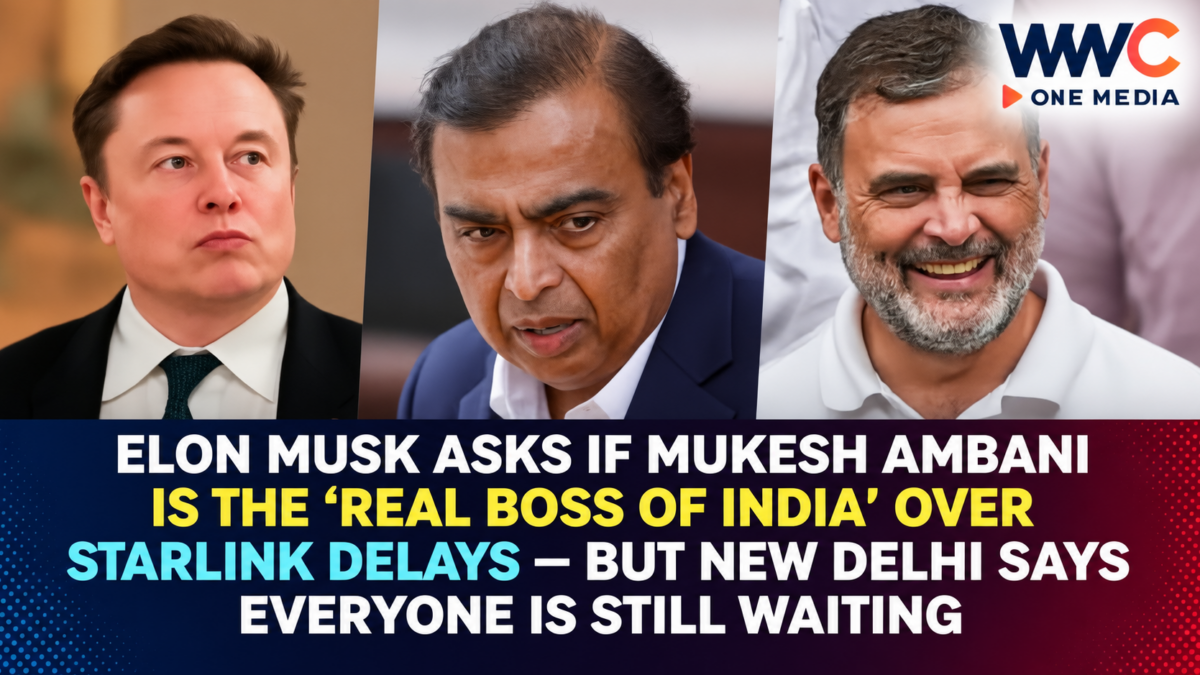
NEW DELHI — Elon Musk has escalated his battle over Starlink’s long-delayed India launch, directly dragging billionaire Mukesh Ambani into the dispute and asking whether the Reliance chairman is effectively “the real boss of India.”
The remark marked a sharp escalation.
Just one day earlier, Musk had accused unnamed:
“oligarchs”
of blocking Starlink in order to preserve what he called a:
“monopolistic chokehold”
over Indian consumers.
He initially refused to name them.
Then he did.
On X, Musk asked:
“Is Ambani the real boss of India?”
The comment immediately turned a telecom-regulatory dispute into a much bigger political and corporate confrontation involving:
SpaceX
Reliance Jio
India’s government
and
one of the world’s most valuable telecom markets.
But there is an important factual complication.
Starlink is not entirely unlicensed in India.
It already holds a key satellite-communications authorization.
The real problem is that it still cannot commercially switch on service.
STARLINK ALREADY HAS A SATELLITE LICENSE
India’s Department of Telecommunications officially lists:
Starlink Satellite Communications
Jio Satellite Communications
and
OneWeb India
as holders of authorization to provide:
Global Mobile Personal Communication by Satellite services, or GMPCS.
That license gives Starlink legal authorization to operate as a satellite-communications provider.
So when Musk says Starlink still has:
“no license,”
the situation is more nuanced.
Starlink has a license.
What it does not yet have is everything required to begin selling commercial service.
THE TWO REMAINING OBSTACLES ARE SECURITY AND SPECTRUM
India requires every satellite operator to pass:
Security assessment
before moving to the next stage.
After that, operators must obtain:
Spectrum assignment.
Spectrum is the radio frequency capacity used to communicate between:
Satellites
Ground stations
and
Customer devices.
Without it, Starlink cannot commercially operate even if its physical infrastructure is ready.
India says all three licensed satellite operators are still undergoing security assessment.
That includes:
Starlink
Jio
and
OneWeb.
INDIA SAYS MUSK’S DISCRIMINATION CLAIM IS BASELESS
India’s Ministry of Communications issued a public statement after Musk’s accusations.
The government said its satellite regulatory framework is:
“fair and non-discriminatory.”
It added that:
all three licensed entities are at broadly the same regulatory stage.
That is the government’s central response to Musk.
India is essentially saying:
Starlink is waiting because everyone is waiting.
Not because Starlink is being blocked specifically.
MUSK IS NOT BUYING THAT EXPLANATION
Musk responded aggressively.
He said Starlink has spent:
five years
trying to comply with every Indian regulatory requirement.
He noted that Starlink operates in more than:
165 countries.
And he questioned why a company with years of regulatory engagement still cannot launch in one of the world’s biggest internet markets.
That frustration culminated in the direct shot at Ambani.
WHY MUKESH AMBANI?
Because Ambani controls:
Reliance Jio.
Jio is India’s largest telecom operator.
It has more than:
500 million customers.
The company transformed Indian mobile internet by driving down data prices and rapidly expanding 4G and 5G coverage.
It is now also pursuing:
satellite connectivity.
That makes Jio one of Starlink’s most important potential competitors.
JIO HAS ITS OWN SATELLITE LICENSE
Reliance’s satellite unit:
Jio Satellite Communications
holds the same broad GMPCS authorization category as Starlink.
Jio has worked with:
SES
to develop satellite broadband capabilities.
That means Reliance is not simply defending its existing mobile business.
It wants a piece of the satellite market itself.
That commercial overlap is why Musk’s attack immediately resonated.
BUT HERE’S THE STRANGE PART: JIO IS ALSO A STARLINK PARTNER
In 2025, Reliance Jio signed an agreement with SpaceX to:
offer Starlink services in India
once regulatory approvals were complete.
The deal envisioned Jio selling:
Starlink equipment
and
connectivity services
through its own retail and digital networks.
That creates an unusual relationship.
Jio can be:
Starlink’s competitor
and
Starlink’s distributor
at the same time.
AIRTEL HAS THE SAME DUAL ROLE
Bharti Airtel also signed a Starlink distribution agreement.
At the same time, Airtel is closely tied to:
Eutelsat OneWeb,
one of Starlink’s biggest global satellite competitors.
Airtel chairman Sunil Bharti Mittal has pushed back against Musk’s claims.
He said:
OneWeb is waiting too.
That reinforces the government’s argument that Starlink is not uniquely delayed.
INDIA’S SATELLITE MARKET IS BECOMING A FOUR-WAY RACE
The emerging competition involves:
Starlink
Jio Satellite Communications
OneWeb
and potentially
Amazon Kuiper.
Amazon’s Indian application has been under regulatory review.
If all four ultimately operate, India could become one of the most competitive satellite-broadband markets in the world.
That could bring:
Lower prices
More rural coverage
and
Greater redundancy.
But it also creates enormous pressure on spectrum policy.
SPECTRUM HAS ALWAYS BEEN THE BIG FIGHT
Musk and Ambani have already clashed over one critical question:
Should satellite spectrum be auctioned or administratively assigned?
Reliance argued for:
auctioning.
Starlink argued for:
administrative allocation.
Why the difference?
Traditional telecom companies spend billions buying spectrum at auction.
Jio argued satellite providers should not receive valuable frequencies under more favorable terms.
Starlink countered that satellite spectrum is different because it is:
shared
and
globally coordinated.
India eventually leaned toward administrative allocation.
That outcome was much closer to Starlink’s preferred position.
THE DISPUTE IS REALLY ABOUT FUTURE TELECOM POWER
At first glance, this looks like a battle over rural satellite broadband.
But the long-term stakes are much larger.
Starlink is rapidly moving toward:
direct-to-device communications.
That means satellites communicating directly with ordinary smartphones.
If that technology becomes capable enough, Starlink could eventually compete not only with:
satellite broadband providers
but also with:
mobile operators.
That changes the strategic calculation for Jio and Airtel.
SPACEX IS ALREADY DOING THIS IN THE UNITED STATES
SpaceX has aggressively expanded into mobile spectrum.
It recently agreed to acquire roughly:
$8 billion
of low-band 800 MHz spectrum from Grain Management.
That spectrum can travel long distances and penetrate buildings more effectively than higher-frequency signals.
SpaceX plans to use it to strengthen:
Starlink Mobile.
The company is clearly signaling that satellite connectivity will move beyond rooftop dishes.
SPACEX ALSO BOUGHT $19.6 BILLION OF ECHOSTAR SPECTRUM
SpaceX had already agreed to acquire approximately:
$19.6 billion
of spectrum from EchoStar.
The combined transactions give SpaceX an enormous wireless-spectrum portfolio.
That puts it closer to becoming a true:
satellite-mobile hybrid operator.
Traditional carriers noticed.
U.S. telecom stocks have reacted sharply to SpaceX’s expanding wireless ambitions.
THE FCC IS OPENING EVEN MORE SPECTRUM FOR SATELLITE-TO-PHONE SERVICE
The U.S. Federal Communications Commission plans to vote on expanding spectrum available for:
direct-to-device services.
The FCC has proposed making hundreds of megahertz available for satellite connectivity.
That gives SpaceX a major regulatory tailwind in its home market.
India, by contrast, is moving much more cautiously.
That difference helps explain Musk’s frustration.
INDIA HAS GOOD REASONS TO BE CAUTIOUS
Satellite communications raise unique national-security concerns.
Unlike traditional cellular networks, satellite systems can potentially provide connectivity in:
Border areas
Conflict zones
Remote regions
and
Places without terrestrial infrastructure.
India therefore wants strong controls over:
User identification
Traffic routing
Lawful interception
and
Network monitoring.
Those requirements are especially sensitive given India’s security environment.
STARLINK TERMINALS HAVE ALREADY APPEARED IN SENSITIVE CASES
Indian authorities previously recovered Starlink equipment during:
law-enforcement
and
security-related incidents.
Those discoveries raised questions because Starlink was not commercially authorized at the time.
SpaceX said its beams were:
disabled over India
and argued that terminals could have been brought into the country from elsewhere.
Still, the incidents reinforced regulatory concern.
MUSK SAYS SECURITY COMPLIANCE IS ALREADY COMPLETE
Musk’s argument is that Starlink has spent years addressing exactly those concerns.
He says the company has complied with every Indian law and requirement asked of it.
SpaceX executives have also said the company has built local infrastructure and prepared operational systems for launch.
That includes:
Gateway facilities
and
Local management.
From Starlink’s perspective, the remaining delay is increasingly difficult to justify.
India disagrees.
STARLINK HAS ALREADY BUILT GATEWAY INFRASTRUCTURE
SpaceX says it has constructed around:
20 gateway sites
in India.
Those facilities connect Starlink satellites with terrestrial internet networks.
That suggests the company is not simply waiting at the starting line.
It has already committed capital.
The closer Starlink gets to operational readiness, the more expensive regulatory delay becomes.
INDIA IS TOO BIG FOR MUSK TO IGNORE
India has more than:
1.4 billion people.
It also has more than:
one billion internet users.
Even a small percentage of the population could translate into:
millions of Starlink customers.
The strongest opportunities would likely be in:
Rural regions
Mountainous areas
Remote businesses
Schools
Government facilities
and
Areas with weak fiber coverage.
That makes India strategically important to SpaceX.
INDIA’S SATELLITE BROADBAND MARKET COULD REACH $1.9 BILLION
Deloitte estimates India’s satellite broadband market could reach around:
$1.9 billion by 2030.
That may look small relative to India’s enormous mobile market.
But satellite customers can generate higher revenue per user.
Enterprise and government connectivity can also be highly profitable.
And future direct-to-device services could expand the opportunity far beyond fixed broadband.
THE BIGGER THREAT TO JIO IS NOT TODAY’S STARLINK DISH
A rooftop Starlink terminal is not necessarily a major threat to Jio in:
Mumbai
Delhi
or
Bengaluru.
Fiber and 5G are typically cheaper and offer greater urban capacity.
The bigger strategic threat is what Starlink could become.
If SpaceX eventually offers:
Direct smartphone connectivity
Voice
Messaging
and
Broadband
without relying on traditional cell towers, then satellite service begins to overlap much more directly with Jio’s core business.
That possibility could reshape global telecom.
RELIANCE HAS REASON TO WATCH SPACE X VERY CAREFULLY
Jio built its empire through infrastructure.
It invested enormous amounts in:
Fiber
Spectrum
Cell towers
and
5G.
SpaceX is trying to create a different architecture.
Instead of adding towers everywhere, it is putting communications infrastructure:
in orbit.
Both models require huge capital.
But their economics are very different.
That is why satellite-mobile convergence is potentially disruptive.
MUSK’S ATTACK HAS ALSO BECOME POLITICAL
India’s opposition leader:
Rahul Gandhi
responded publicly after Musk’s Ambani remark.
Gandhi told Musk:
“Wait till you discover the other guy.”
He did not name anyone.
The remark was widely interpreted in Indian political coverage as an apparent reference to:
Gautam Adani.
That interpretation remains political commentary rather than an established fact.
Musk responded that the situation was:
“troubling.”
The exchange pulled Starlink directly into India’s domestic political debate.
THAT MAKES THE DISPUTE RISKIER FOR SPACE X
SpaceX needs:
Indian regulatory approval.
Becoming entangled in partisan politics rarely makes a regulatory process simpler.
Musk’s confrontational strategy may increase public pressure.
But it could also harden political positions.
India has historically been extremely sensitive about foreign business leaders appearing to challenge:
Domestic sovereignty
or
Government authority.
That creates a delicate balance.
INDIA AND THE U.S. ARE ALSO NEGOTIATING TRADE
The dispute comes at a sensitive moment for:
U.S.-India relations.
Washington has promoted American technology companies as India deepens its digital infrastructure.
Starlink has reportedly been part of that broader diplomatic conversation.
At the same time, India wants to protect:
Domestic industry
National security
and
Regulatory autonomy.
That makes Starlink a surprisingly important test case.
THIS IS NO LONGER JUST MUSK VERSUS AMBANI
The fight now touches:
Telecom competition
Trade policy
National security
Satellite spectrum
and
U.S.-India relations.
That makes it much larger than a corporate personality clash.
Musk and Ambani may symbolize the conflict.
But the real questions are institutional.
Who controls spectrum?
Who sets security rules?
How much influence should domestic telecom incumbents have?
And how aggressively should India open strategic infrastructure to foreign satellite operators?
RELIANCE IS ABOUT TO FACE EVEN MORE INVESTOR SCRUTINY
The timing is especially important for Ambani.
Reliance Jio Platforms is preparing for what could become:
India’s largest-ever IPO.
Reuters has reported a possible public offering worth billions of dollars.
Jio has expanded far beyond mobile services into:
Cloud
AI
Enterprise networking
and
Digital platforms.
Satellite connectivity is another part of that strategy.
Any perception that competition is being restricted could therefore attract greater scrutiny as investors evaluate the company.
STARLINK’S OWN GLOBAL MOMENTUM IS GROWING
SpaceX is also scaling rapidly.
Starlink now serves millions of users across more than:
160 countries and territories.
The network contains thousands of satellites.
It is increasingly used for:
Home broadband
Aviation
Maritime connectivity
and
Mobile communications.
American Airlines just expanded plans to install Starlink across its entire mainline fleet.
That shows the service is moving far beyond remote household broadband.
AVIATION IS BECOMING A MAJOR STARLINK MARKET
American Airlines plans to equip more than:
1,000 mainline aircraft
with Starlink.
Other airlines have already adopted or announced satellite broadband.
Aircraft connectivity is attractive because traditional in-flight internet has often been:
Slow
Expensive
and
Unreliable.
Low-Earth-orbit satellites can dramatically improve that experience.
Every new aviation contract makes Starlink more strategically important.
INDIA DOES NOT WANT TO MISS THE TECHNOLOGY SHIFT
India’s government wants better connectivity across remote parts of the country.
Satellite broadband can help.
The government itself acknowledges that these systems can serve:
Rural
Underserved
Coastal
Border
and
Mountainous areas.
So India is not rejecting satellite internet as a technology.
The argument is about:
how
and
when
it should be allowed to operate.
ALL THREE OPERATORS STILL HAVE TO PASS THE SAME SECURITY TEST
This remains the most important factual counterweight to Musk’s accusations.
India says:
Starlink
Jio Satellite Communications
and
OneWeb India
are all undergoing security assessment.
No operator has been publicly declared exempt.
No evidence has been presented publicly showing Reliance directly controls Starlink’s approval process.
That means Musk’s claim about Ambani’s influence remains:
an allegation.
It should not be reported as established fact.
THE MARKET STRUCTURE DOES GIVE RELIANCE ENORMOUS INFLUENCE
At the same time, Musk’s broader complaint taps into a genuine structural reality.
Reliance Jio is one of India’s dominant digital-infrastructure companies.
It has enormous influence through:
Telecom
Retail
Digital platforms
Cloud
and
Capital investment.
That does not prove regulatory favoritism.
But it explains why Musk chose Ambani as the symbol of the obstacle he believes Starlink faces.
THE BIGGER STORY: MUSK IS REALLY CHALLENGING WHO CONTROLS INDIA’S NEXT COMMUNICATIONS NETWORK
The latest Musk-Ambani confrontation looks like billionaire drama.
But underneath it is a much bigger technological fight.
India’s current communications system depends heavily on:
Cell towers
Fiber
and
Spectrum owned by terrestrial telecom operators.
SpaceX is building a future where a significant part of connectivity could come directly from:
satellites.
That threatens to redraw the boundaries of the telecom industry.
Today, Starlink mainly wants permission to connect:
Remote homes
Businesses
and
Underserved regions.
Tomorrow, Starlink Mobile could connect:
ordinary smartphones.
That is where the strategic stakes become enormous.
Jio and Airtel are not simply defending today’s broadband market.
They are preparing for a future where:
satellite networks
and
mobile networks
increasingly become the same thing.
And SpaceX is moving aggressively toward that future.
India says Starlink is not being discriminated against.
Musk says five years of waiting prove something is wrong.
Reliance has not publicly demonstrated that it controls the regulatory process Musk is attacking.
But the commercial rivalry is undeniable.
Elon Musk may be asking whether Mukesh Ambani is “the real boss of India” — but the much bigger question is whether SpaceX can break into one of the world’s largest telecom markets before satellites begin competing directly with the mobile networks Ambani spent billions building.