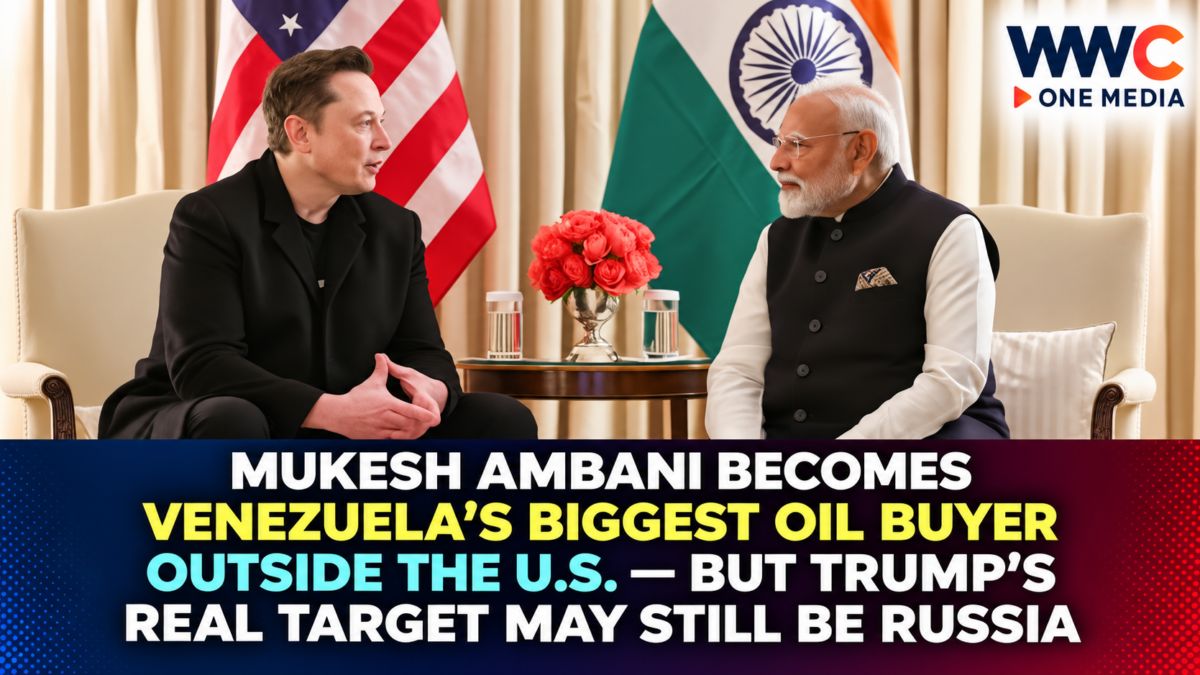
MUMBAI — Mukesh Ambani’s Reliance Industries is making one of the biggest shifts yet in India’s global oil strategy, emerging as the largest buyer of Venezuelan crude outside the United States just as President Donald Trump intensifies pressure on New Delhi to reduce its dependence on Russian energy.
The numbers are striking.
India imported approximately:
257,000 barrels per day
of Venezuelan crude during September.
Reliance Industries accounted for about:
76%
of those barrels.
That means roughly three out of every four barrels of Venezuelan crude entering India went to the company’s massive:
Jamnagar refining complex.
And October could be even bigger.
Kpler estimates Venezuelan shipments scheduled for India could rise as high as:
465,000 barrels per day.
If those cargoes arrive on schedule, that would represent India’s strongest Venezuelan crude intake in almost:
seven years.
The shift is not simply about cheap oil.
It sits at the intersection of:
Donald Trump’s foreign policy
India’s energy security
Russia’s war economy
Venezuela’s oil revival
and
Mukesh Ambani’s enormous refining empire.
RELIANCE IS NOW VENEZUELA’S BIGGEST BUYER OUTSIDE AMERICA
Reliance’s rise to the top of Venezuela’s non-U.S. customer list is significant because the company had largely been cut off from those barrels during years of American sanctions.
That changed after Washington loosened restrictions following the dramatic political upheaval in Caracas and the removal of Nicolás Maduro from power.
Reliance subsequently secured authorization to resume direct purchases.
Now the barrels are flowing again.
And Jamnagar is perfectly designed to use them.
VENEZUELAN OIL IS NOT EASY TO REFINE
Much of Venezuela’s crude is:
heavy
and
high in sulfur.
That makes it harder to process than lighter crude grades.
Many refineries cannot handle large volumes economically.
Reliance can.
Its Jamnagar complex is one of the world’s most sophisticated refining systems and has processed more than:
200 different crude grades.
That gives Reliance a powerful advantage.
It can buy discounted oil that less sophisticated refineries may avoid and convert it into higher-value products such as:
Gasoline
Diesel
Jet fuel
and
Petrochemicals.
JAMNAGAR IS BUILT FOR EXACTLY THIS KIND OF OIL
Reliance operates one of the world’s largest refining complexes in:
Jamnagar, Gujarat.
The site can process roughly:
1.2 million to 1.4 million barrels per day,
depending on how capacity is measured across its integrated facilities.
More importantly, Jamnagar is extraordinarily complex.
That means it can take difficult feedstocks and extract more value from them.
For Reliance, the question is not simply:
Which crude is cheapest?
It is:
Which crude creates the best refining margin after transportation and processing costs?
Right now, Venezuelan oil looks increasingly attractive.
VENEZUELA’S MEREY CRUDE IS TRADING AT A DISCOUNT
Venezuela’s flagship:
Merey crude
has been trading at attractive discounts.
At the same time, Russian:
Urals crude
has become more expensive.
That changes the economics for India.
Russian oil became enormously attractive after Moscow’s 2022 invasion of Ukraine because Western sanctions forced Russia to offer large discounts.
Indian refiners stepped in.
But those discounts have narrowed.
Venezuelan barrels are now becoming more competitive.
INDIA IS TRYING TO DIVERSIFY AWAY FROM RUSSIA
Russia remains one of India’s largest crude suppliers.
India was importing around:
1.8 million barrels per day
of Russian oil in September.
But its share of India’s crude market has begun falling.
Kpler data suggest Russia’s share fell to around:
35% in September
after reaching as high as roughly:
56% in July.
The decline is partly economic.
But politics matter too.
TRUMP HAS BEEN PRESSURING INDIA OVER RUSSIAN OIL
Washington wants India to reduce purchases of Russian crude.
Trump has argued that oil revenue helps Moscow finance its war effort.
U.S.-India trade negotiations have repeatedly become entangled with the issue.
A new American sanctions framework has also increased the risk of punitive tariffs connected to continued Russian energy purchases.
For India, this creates a difficult balancing act.
It wants:
cheap oil
but also wants to protect:
trade access to the United States.
Venezuelan crude offers a possible compromise.
TRUMP ACTUALLY WANTS MORE VENEZUELAN BARRELS MOVING
This is what makes the shift unusual.
For years, Venezuela was under heavy U.S. oil sanctions.
Now Washington wants more Venezuelan production reaching global markets.
Why?
Because oil supplies remain tight.
Middle East instability has pushed Brent crude above:
$100 per barrel.
The Strait of Hormuz crisis has disrupted logistics.
Fuel markets are under pressure.
And American consumers are dealing with historically high gasoline prices for October.
More Venezuelan oil helps increase Atlantic Basin supply.
VENEZUELA HAS THE OIL — BUT NOT THE OLD PRODUCTION MACHINE
Venezuela possesses the world’s largest proven crude reserves.
But decades of:
underinvestment
economic collapse
sanctions
and
operational deterioration
devastated production.
The country currently produces roughly:
1.2 million to 1.25 million barrels per day.
That is far below its historical peak.
Rebuilding the industry will be expensive.
ConocoPhillips executives have warned Venezuela may need:
tens of billions of dollars
and possibly:
a decade or more
to restore much of its lost capacity.
U.S. COMPANIES ARE BEING ENCOURAGED BACK INTO VENEZUELA
Washington now wants Western investment to help rebuild Venezuelan production.
Chevron already has significant exposure.
Other oil companies are examining the opportunity.
But investors want:
stable laws
predictable taxes
contract enforcement
and
political stability.
Without those conditions, Venezuela’s enormous reserves may remain difficult to monetize.
Reliance does not need to solve all of those problems.
It simply needs reliable cargoes.
SEPTEMBER EXPORTS SHOW VENEZUELA IS ALREADY RECOVERING
Venezuela exported roughly:
1.08 million barrels per day
in September.
That was down about:
9%
from August because high freight rates and logistics problems slowed shipments.
But U.S. deliveries actually increased.
Exports to America reached roughly:
629,000 barrels per day.
India received about:
253,000 barrels per day
according to Reuters shipment data.
The slight variation from Kpler’s 257,000-bpd estimate reflects different tracking methodologies.
Both datasets tell the same story:
India has become Venezuela’s biggest destination outside the United States.
OCTOBER COULD SET A SEVEN-YEAR HIGH
The next month may strengthen that relationship dramatically.
Scheduled Venezuelan deliveries to India could reach approximately:
465,000 barrels per day.
Kpler cautions actual arrivals may be closer to:
350,000 barrels per day
because some ships may not unload before month-end.
Even that lower figure would represent a major jump.
And one detail stands out.
The scheduled cargoes reportedly point toward:
Sikka.
That is Reliance territory.
AMBANI IS PLAYING BOTH SIDES OF TRUMP’S ENERGY STRATEGY
Reliance’s position becomes even more interesting when America enters the picture.
Ambani is buying more Venezuelan crude under a U.S.-approved framework.
At the same time, Reliance is helping support a new refinery project in:
Texas.
The project is known as:
America First Refining.
It is planned for:
Brownsville.
Trump personally promoted the project in March.
TRUMP CALLED IT A $300 BILLION DEAL — BUT THAT NUMBER NEEDS CONTEXT
Trump described the arrangement as a:
$300 billion deal.
That number generated major headlines.
But it should not be confused with the refinery’s actual construction budget.
Reuters reported the Brownsville project itself is expected to cost around:
$6.7 billion.
It would process approximately:
168,000 barrels per day.
The proposed plant would be one of the first major greenfield U.S. refineries built in decades.
That alone makes it highly unusual.
RELIANCE IS PROVIDING MONEY AND A 20-YEAR OFFTAKE AGREEMENT
Reliance’s involvement is strategically important.
The Indian company has invested in the project.
It also signed a:
20-year offtake agreement.
That means Reliance would purchase refinery output over a long period.
For a new refinery, that kind of long-term customer commitment can be extremely valuable because it gives lenders and investors greater confidence that the plant will have buyers.
Trump has promoted the project as evidence that his energy policies are attracting:
foreign capital
and
new refining capacity.
THE U.S. DESPERATELY WANTS MORE REFINING CAPACITY
America produces enormous amounts of crude oil.
But turning crude into:
gasoline
diesel
and
jet fuel
requires refineries.
The U.S. refining system is already operating at very high utilization.
The Trump administration has even considered using the:
Defense Production Act
to accelerate expansion of domestic refining capacity.
That shows how serious the situation has become.
Refining—not crude production alone—is increasingly a bottleneck.
THIS IS WHY RELIANCE MATTERS TO WASHINGTON
Few companies understand large-scale refining better than Reliance.
Jamnagar is among the most complex refining systems anywhere in the world.
Reliance therefore brings something Washington wants:
capital
and
technical expertise.
That gives Ambani unusual leverage.
Reliance is simultaneously:
one of India’s biggest buyers of foreign crude
and
a strategic investor in America’s downstream energy system.
RELIANCE’S AMERICAN CONNECTION HAS ALSO ATTRACTED SCRUTINY
The Texas project is not free from controversy.
Investigative reporting has examined connections between America First Refining and:
Donald Trump Jr.
ProPublica reported that Trump Jr. had acquired an interest in the startup behind the project before Reliance’s investment became public.
Reliance has said its commercial decisions are based on normal business considerations.
There has been no established finding that Reliance’s Venezuelan authorization or other U.S. policy outcomes were improperly exchanged for its refinery investment.
That distinction is important.
Political scrutiny does not by itself establish wrongdoing.
STILL, THE TIMING IS POLITICALLY SENSITIVE
The sequence is striking.
Washington had previously criticized India heavily over Russian oil.
Reliance was among the companies exposed to that pressure.
U.S.-India relations later improved.
Reliance received authorization connected with Venezuelan crude.
It invested in an American refinery project promoted by Trump.
And it has now become Venezuela’s biggest oil customer outside the United States.
Those are legitimate commercial and geopolitical developments.
But they naturally attract scrutiny when they occur simultaneously.
FOR RELIANCE, THE ECONOMIC LOGIC IS STRAIGHTFORWARD
Strip away the politics and the refining strategy is easier to understand.
Reliance wants:
the cheapest suitable crude available.
If Russian Urals is cheapest, it can buy Russian barrels.
If Venezuelan Merey offers better economics, it can buy Venezuelan barrels.
If Middle Eastern crude is more attractive, Jamnagar can switch again.
The refinery’s flexibility is the competitive advantage.
That is why Reliance has invested so heavily in complexity.
THE REAL MONEY IS IN THE CRUDE DIFFERENTIAL
Imagine Brent crude trades at:
$100.
A lighter, desirable crude might trade near that benchmark.
A heavy Venezuelan barrel may trade at a significant discount because it is harder to refine.
A simple refinery cannot necessarily take advantage.
Reliance can.
If Jamnagar buys the discounted crude and efficiently converts it into premium diesel, gasoline or jet fuel, the difference can become:
refining profit.
That is the heart of the trade.
HIGH FREIGHT RATES ARE THE BIG RISK
Venezuelan oil has one major disadvantage for India:
distance.
Shipping crude from Latin America to India requires a long voyage.
And tanker costs have exploded.
Global freight rates have risen dramatically because of:
Middle East disruptions
Hormuz rerouting
and
tight vessel availability.
Reuters reported some U.S.-to-Asia VLCC voyages now cost as much as:
$80 million.
At some point, high shipping costs can erase the discount on Venezuelan crude.
THAT MEANS THE CURRENT SURGE MAY NOT LAST FOREVER
Kpler analysts have already warned that India’s October Venezuelan-import surge could be difficult to sustain.
The economics depend on:
crude discounts
versus
freight costs.
If Venezuelan sellers offer sufficiently cheap barrels, Jamnagar will keep buying.
If shipping costs rise further or discounts narrow, Reliance can switch feedstocks.
That flexibility is why it remains one of the world’s most competitive refiners.
INDIA MAY ALSO BECOME MORE IMPORTANT AS A GLOBAL FUEL EXPORTER
India’s refining capacity is roughly:
5.6 million barrels per day.
That makes it one of the world’s largest refining centers.
India already exports more refined fuel than China.
In 2025, it exported about:
47 million metric tons
of fuels compared with China’s roughly:
25.4 million tons.
That matters because China recently restricted some fuel exports.
India could fill part of the gap.
THE PHILIPPINES AND SOUTHEAST ASIA COULD FEEL THIS SHIFT
India’s fuel exports increasingly matter to markets including:
Singapore
Indonesia
Australia
and
the Philippines.
If Chinese exports remain constrained while Indian refineries secure enough crude, more Indian diesel and other products could flow toward Southeast Asia.
That could help stabilize regional supply.
But prices will still depend heavily on:
crude oil
and
shipping costs.
RELIANCE’S STRATEGY IS REALLY ABOUT ENERGY OPTIONALITY
Reliance does not want dependence on:
Russia.
Or Venezuela.
Or Saudi Arabia.
Or the United States.
It wants access to:
all of them.
That is the advantage of an enormous flexible refinery.
The company can switch between crude grades based on:
geopolitics
prices
and
refining margins.
That makes Jamnagar almost a trading platform disguised as an industrial complex.
INDIA IS FOLLOWING A SIMILAR NATIONAL STRATEGY
India itself is trying to maximize options.
It imports most of the crude it consumes.
That means energy security requires diversification.
Depending too heavily on one supplier creates vulnerability.
Russia was extraordinarily attractive when its barrels were deeply discounted.
Venezuela is becoming attractive now.
Middle Eastern crude remains essential.
The U.S. can also supply India.
New Delhi’s strategy is ultimately:
buy where the economics and national interest make sense.
TRUMP WANTS THAT CALCULATION TO SHIFT TOWARD AMERICA’S FRIENDS
Washington’s objective is different.
Trump wants India to:
buy less Russian oil
and
support a U.S.-aligned energy system.
Venezuela’s post-Maduro oil industry fits that strategy.
So does Reliance’s investment in Texas.
From Washington’s perspective, the ideal outcome is:
India buys more Venezuelan and American-linked oil.
Russia loses revenue.
American refining expands.
And U.S.-India trade ties deepen.
Reliance is increasingly positioned in the middle of every one of those objectives.
THE BIGGER STORY: AMBANI IS TURNING GEOPOLITICAL CHAOS INTO REFINING OPTIONALITY
Mukesh Ambani is not betting everything on Venezuela.
He is doing something more sophisticated.
Reliance has built an energy system capable of profiting from:
shifting alliances.
Russian oil becomes discounted?
Jamnagar can process it.
Washington reopens Venezuelan supply?
Jamnagar can process that too.
The U.S. wants new refining capacity?
Reliance can provide capital, expertise and long-term purchasing commitments.
That makes the company unusually well positioned in a world where energy trade is increasingly determined by:
sanctions
wars
tariffs
and
political alliances.
The numbers tell the story.
Reliance took roughly:
76% of India’s Venezuelan crude in September.
October deliveries could rise sharply.
Jamnagar can process some of the world’s most difficult barrels.
And Reliance is simultaneously supporting a major new refinery project in:
Texas.
For Trump, the shift provides a potential strategic win.
India gains an alternative to Russian crude.
Venezuela gains a giant Asian customer.
And American energy projects gain Indian capital.
But the arrangement also demonstrates something much bigger.
Global oil trade is no longer simply about who produces the cheapest barrel — it is increasingly about which companies can navigate sanctions, politics and shipping disruptions faster than everyone else.
And right now, Mukesh Ambani’s Reliance appears determined to do exactly that.