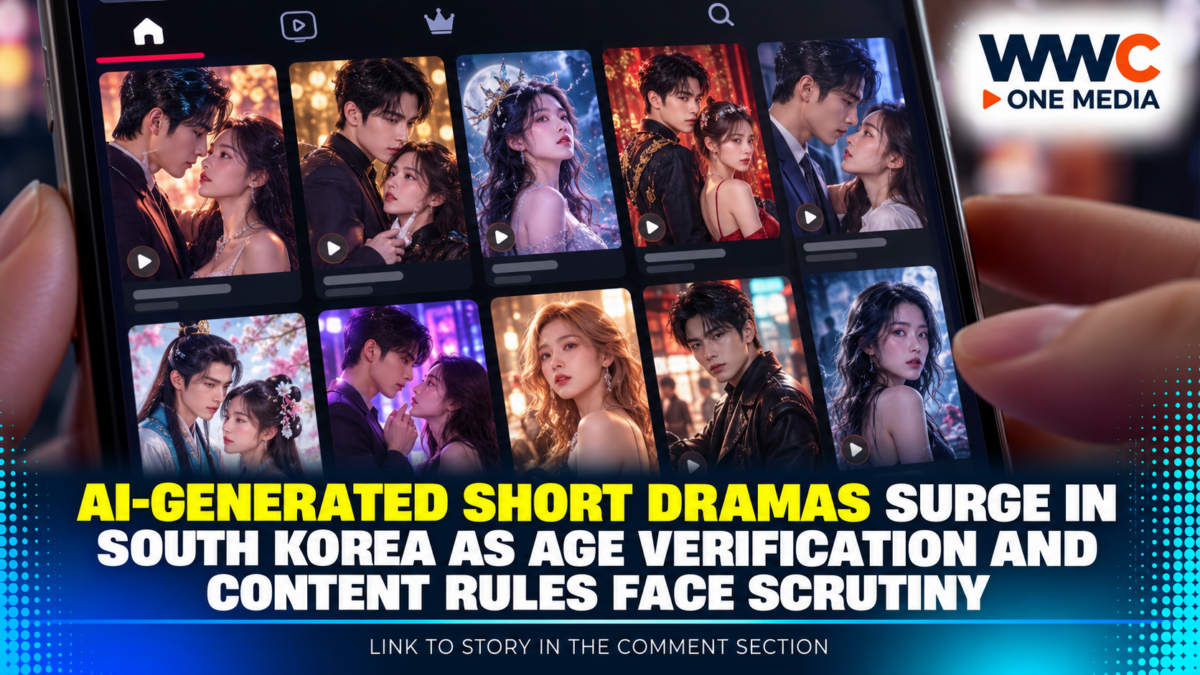
AI Dramas Are Taking Over Short-Form Entertainment in South Korea—but Regulators Face a Growing Challenge
South Korea’s fast-growing short-form drama industry is drawing millions of viewers with dramatic storylines, digitally generated characters and rapid-fire plot twists. But as the genre expands, concerns are mounting over inadequate age verification, sexualized portrayals of women and gaps in content regulation.
The emerging format combines artificial intelligence (AI) video generation with the storytelling techniques of traditional melodramas, delivering episodes that often last just one or two minutes.
According to market analytics service Wiseapp·Retail, major short-form drama platforms in South Korea recorded a combined 2.98 million monthly active users in August 2026, excluding duplicate users. That was approximately 3.3 times the 900,000 recorded in August 2025.
The rapid growth highlights the commercial potential of AI-assisted entertainment. However, the popularity of provocative storylines has also raised questions about whether safeguards are keeping pace with the industry’s expansion.
Why Are AI-Generated Dramas Attracting So Many Viewers?
Short-form dramas typically feature around 50 episodes per series, with each installment designed to deliver a quick emotional payoff or an unexpected twist.
Common themes include revenge, secret identities, wealthy families, complicated romances and long-hidden family secrets.
The format borrows from South Korea’s melodrama tradition, often called makjang, which is known for exaggerated conflicts and surprising revelations.
AI-generated visuals add another attraction. Characters can have highly stylized appearances, while fantasy settings and elaborate scenes can be produced without the same filming requirements as conventional television dramas.
Some viewers also find the artificial look entertaining in its own right, particularly when visual inconsistencies appear on screen.
For audiences accustomed to scrolling through short videos, the combination of quick episodes and continuous cliffhangers offers an easy way to consume serialized stories.
A Fast-Growing Market With Subscription Costs
The business model typically begins with free promotional clips distributed through social media and video-sharing services.
Viewers who want to continue watching may need to pay for access to full series.
The Hankook Ilbo report cited subscription prices of around 20,000 won per week or more than 50,000 won per month on some services.
That model creates a commercial incentive to keep viewers engaged, using dramatic revelations and unresolved conflicts to encourage them to watch the next episode.
The growth of the genre also reflects a wider transformation in digital entertainment, where AI tools are making it easier to produce large volumes of visual content.
However, the expansion of production capacity has also increased pressure on platforms and regulators to ensure that content is appropriately classified and that viewers receive clear information about what they are watching.
Age Verification Emerges as a Major Regulatory Concern
One of the most significant issues identified in the report is the difficulty of ensuring that age-restricted material reaches only appropriate audiences.
Some short-form drama services reportedly allow users to view content without logging in or completing meaningful age verification, even when the material contains sexually suggestive scenes or dialogue.
The Korea Media Rating Board has said that short-form drama platforms are not among the operators authorized to independently determine their own age classifications. Paid content must therefore undergo the required prior classification process.
Yet the existence of classification rules does not automatically ensure that every title is properly rated or that access restrictions are consistently enforced.
Data submitted to Rep. Kim Seung-soo of the ruling People Power Party showed that only 293 of 4,572 short-form video titles classified by the board between April 2025 and August 2026 received adult-only ratings.
That represents approximately 6.4 percent of the titles reviewed.
The figure does not establish that all remaining titles were unsuitable for younger audiences. It does, however, illustrate the scale of the classification process and the importance of applying ratings accurately.
The board also filed complaints last year against 30 overseas platforms that allegedly failed to meet mandatory classification requirements or complied with them only partially.
Critics Warn About Gender Stereotypes in AI Stories
Beyond age restrictions, researchers have raised concerns about how women are portrayed in some AI-generated dramas.
Critics argue that certain productions repeatedly depict female characters as passive figures or reduce them to their physical appearance, while presenting controlling relationships and unequal power dynamics as sources of entertainment.
Hong Nam-hee, an academic research professor at Yonsei University’s Institute of Media and Arts, warned that the combination of idealized appearances, submissive character portrayals and sensational storylines could reinforce negative attitudes toward women.
She also cautioned that AI-assisted mass production and personalized content distribution could reproduce gender stereotypes at scale.
The concern extends beyond individual scripts. When production tools make it easier to generate large quantities of similar stories, recurring patterns in character design and storytelling can become more widespread.
Researchers say this makes it important to consider not only the volume of content being produced, but also the messages that audiences repeatedly encounter.
Social Media Advertising Creates Another Oversight Problem
Short-form drama clips frequently reach audiences through promotional posts and advertisements on social media.
That creates a potential regulatory gap when an advertisement resembles an episode rather than a conventional commercial.
Viewers may encounter a provocative scene before they understand which service produced the content, what age classification applies or whether accessing the full series requires payment.
Yoo Hyun-jae, a professor in the Department of Communication at Sogang University, argued that advertising standards should account for the ages of people who may encounter these promotions.
The issue is especially relevant when clips circulate beyond the platforms that host the complete dramas, making it harder to apply consistent safeguards across different services.
Clearer labeling, appropriate age controls and effective complaint procedures could help address some of these concerns without treating all AI-generated entertainment as inherently problematic.
Can South Korea’s Rules Keep Up With AI Entertainment?
South Korea’s experience reflects a broader challenge facing digital media regulators around the world: technology can transform how content is produced and distributed faster than existing oversight systems can adapt.
AI-generated dramas can offer creators new ways to experiment with storytelling and visual effects. Their short episodes may also appeal to viewers who prefer brief entertainment over traditional television formats.
But faster production does not remove the need for responsible content classification, meaningful age verification and protections against harmful or discriminatory portrayals.
The challenge for regulators is to distinguish between creative experimentation and practices that expose audiences to inappropriate material or fail to meet existing requirements.
Platforms also have a role to play in ensuring that ratings are visible, access restrictions work as intended and promotional clips are suitable for the audiences likely to see them.
What Happens Next for South Korea’s AI Drama Industry?
The industry’s next phase may depend on whether platforms can maintain their rapid growth while responding to concerns over content standards and viewer protection.
Regulators face questions about the enforcement of existing classification requirements, the oversight of overseas services and the treatment of promotional material distributed through social media.
For audiences, the debate is about more than the quality of AI-generated visuals. It also concerns transparency, responsible storytelling and the ability to make informed choices about digital entertainment.
AI may be making dramatic stories faster and cheaper to produce, but the growth of the genre is also testing the rules that govern what audiences can access.
The central question is whether safeguards can keep pace with an entertainment format that is growing almost as quickly as the technology behind it.
WWC ONE MEDIA G,A