
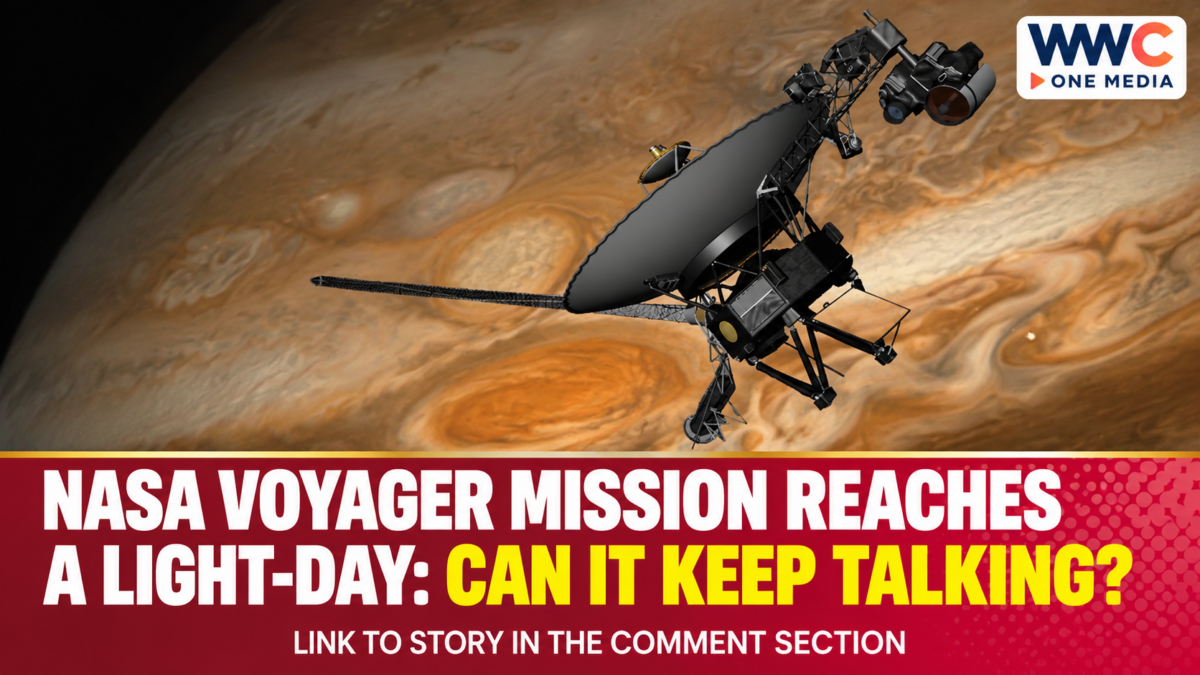
NASA’s Voyager 1 became the first spacecraft to reach a distance of one light-day from Earth on Nov. 18, 2026, extending a journey that began more than 49 years ago. But the NASA Voyager mission marked that achievement while engineers were investigating an interruption to the probe’s science and engineering data.
The distinction is important: reaching a record distance does not mean every onboard system is working normally. NASA confirmed the milestone using the spacecraft’s remaining carrier signal and its calculated trajectory, while the fate of the interrupted data stream remained unresolved in the agency’s Nov. 19 update.
NASA Voyager Mission: What One Light-Day Means
A light-day is a distance, not a deadline or an estimate of how long a spacecraft has been travelling. Light takes 24 hours to cover it, which makes the one-way journey for a radio message from Voyager 1 to Earth about a full day. A command sent outward needs roughly the same amount of time to arrive.
NASA placed Voyager 1 at approximately 16.1 billion miles, or 25.9 billion kilometres, from Earth when it crossed that threshold at 2:16 a.m. Pacific Standard Time on Nov. 18. The figure is an extraordinary measure of distance, but it also describes the practical difficulties of managing an ageing spacecraft.
A problem cannot be examined through an instant conversation. Even in the simplest case, a command and its response involve a round-trip delay of about two days, before engineers account for the work of preparing and interpreting instructions.
Compare that delay with WWC’s coverage of SpaceX Starship and its lunar mission requirements, which operates much closer to Earth.
A Signal Remains, But Science Data Faces a Problem
In its Nov. 19 release, NASA said it had not received science and engineering data from Voyager 1 since Nov. 14. The spacecraft was still transmitting a carrier signal, which allowed mission controllers to establish that the probe was communicating at a basic level.
A carrier signal is not the same as a recovered stream of scientific readings. It indicates a detectable radio transmission, but it does not by itself prove that the spacecraft’s instruments are returning usable measurements or that a fault has been repaired.
NASA said engineers were analysing the interruption. It did not establish a cause or give a confirmed restoration date in that release. Those limits matter when assessing the mission’s current condition: the distance record was confirmed, while the data problem remained open.
The Grand Tour Became an Interstellar Observatory
Voyager 2 launched on Aug. 20, 1977, followed by Voyager 1 on Sept. 5. The two probes were originally designed to examine Jupiter and Saturn, including their moons, rings and surrounding environments.
Voyager 1 encountered Jupiter in 1979 and Saturn in 1980. Voyager 2 followed a different route that also brought it to Uranus in 1986 and Neptune in 1989. The planetary mission later became an interstellar mission.
Voyager 1 crossed the heliopause, the boundary of the Sun’s protective bubble of solar-wind particles and magnetic fields, in 2012. Voyager 2 followed in 2018. Crossing that boundary means entering interstellar space; it does not mean the spacecraft has travelled beyond every distant object gravitationally associated with the solar system.
The probes now investigate fields and particles in a region no other working spacecraft has reached. Losing a sensor therefore matters when no other probe can repeat its observations.
The risks of extended operations also appear in WWC’s report on Japan’s revised Hayabusa2 asteroid mission, although the spacecraft, equipment and scientific objectives are different.
The Power Budget Is Tightening
The Voyager spacecraft do not rely on solar panels for their electricity. Their radioisotope thermoelectric generators convert heat from radioactive decay into electrical power, allowing them to work at distances where sunlight is weak.
The useful electrical output falls with age. NASA says each spacecraft loses roughly four watts of available power annually, forcing engineers to choose which equipment can remain active and which must be turned off.
On April 17, 2026, the team shut down Voyager 1’s Low-Energy Charged Particles experiment to conserve power. NASA’s published instrument table lists its magnetometer and plasma-wave subsystem as on. That listing describes instrument configuration, not a guarantee that all measurements were reaching Earth during the November interruption.
An August engineering effort on Voyager 2 replaced selected powered devices with lower-consumption alternatives. NASA subsequently reported a similar change on Voyager 1 and projected enough savings to keep the then-current science-instrument suites operating through at least the probes’ 50th launch anniversaries in 2027. This was an engineering projection, not a promise of uninterrupted operations.
What the Mission Still Means for Space Exploration
Voyager is a case study in the difference between building a spacecraft for a planned mission and managing it through decades of unexpected possibilities. The science returned from close planetary encounters is already part of the historical record; the interstellar measurements extend that legacy into a new environment.
The probes also carry Golden Records containing images and sounds selected to represent Earth. The records are a symbolic part of the project, separate from the active scientific instruments and the communications equipment needed to send findings home.
For the Philippines, Voyager illustrates why sustained engineering, data handling and communications are central to space programmes, not merely launching hardware. WWC has separately examined the Philippines’ push for wider ASEAN space cooperation. The same broad need for dependable mission operations connects them.
Analysis: Voyager’s next achievement may be measured less by how far it flies than by whether engineers can preserve a useful flow of observations as electricity and hardware margins shrink.
What Happens Next
The immediate question is whether NASA can restore Voyager 1’s science and engineering data after the interruption reported on Nov. 19. Until an official update confirms recovery, the existence of a carrier signal should not be described as a full restoration.
Longer term, engineers must balance power savings against the scientific value of the instruments still operating. The spacecraft will continue travelling outward, but how much longer it can provide useful measurements and communicate with Earth remains uncertain.










