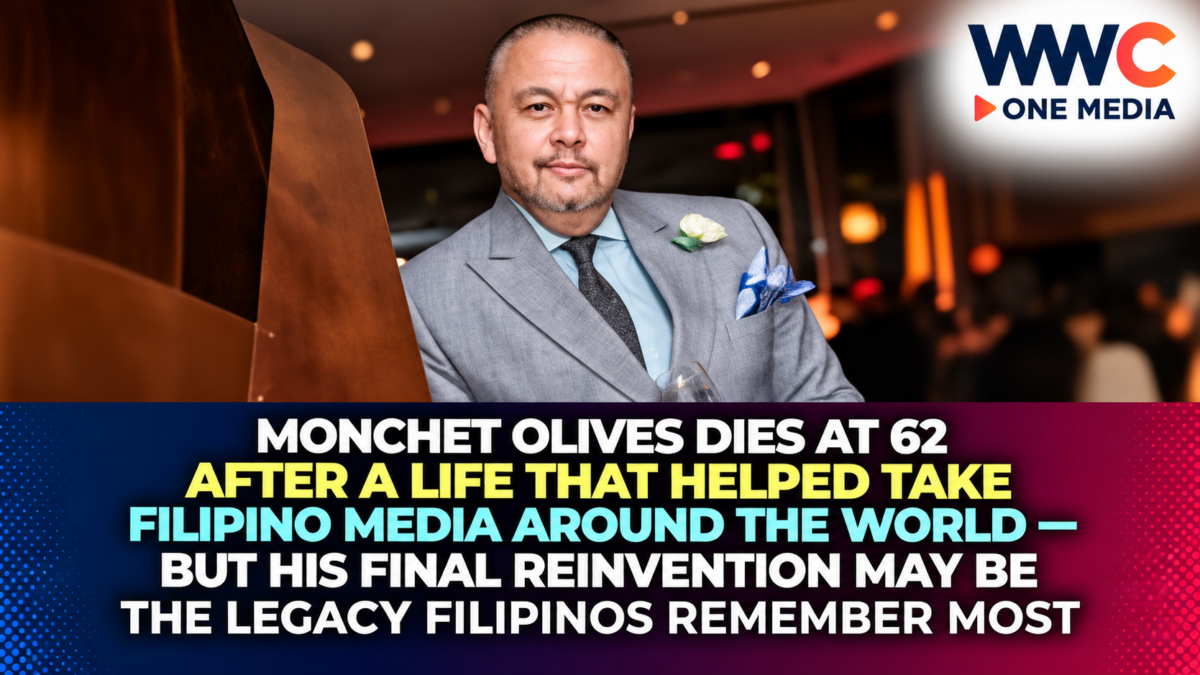
MANILA — Jose Ramon “Monchet” Diokno Olives spent much of his life helping Filipino stories travel farther than anyone thought possible. Then, after decades inside one of the country’s most influential media institutions, he came home to something far smaller, older and intensely personal: the handmade Filipino fan.
Olives died unexpectedly on:
September 29, 2026.
He was:
62.
His death came just before his birthday and closed a career that crossed:
Television
International media
Corporate strategy
Environmental advocacy
Design
and
Filipino heritage.
To generations of ABS-CBN employees, he was part of the network’s rebuilding after the 1986 People Power Revolution.
To Filipino communities abroad, he helped build the machinery that would eventually become:
The Filipino Channel.
To younger designers and heritage enthusiasts, he became:
“The Fanman”
— the stylish steward who helped make the traditional abanico witty, contemporary and desirable again.
His story is ultimately one of repeated reinvention.
HE JOINED ABS-CBN WHILE THE NETWORK ITSELF WAS STARTING OVER
Olives entered ABS-CBN shortly after the network returned to the air following the fall of the Marcos dictatorship.
He had just graduated:
magna cum laude
from the University of the Philippines Diliman with a degree in:
Communication Research.
In those early years, ABS-CBN was far removed from the giant media institution it would later become.
Its newsroom was makeshift.
Equipment was scarce.
Employees improvised.
Olives began at the bottom, working in the Public Affairs Department headed by:
Cheche Lazaro.
His early work included:
transcribing interviews
photocopying materials
and
dubbing tapes.
It was hardly glamorous.
But it placed him inside a media organization rebuilding almost from nothing.
HE BECAME PART OF THE ORIGINAL “KAPAMILYA” GENERATION
Those early ABS-CBN employees worked during an extraordinary period.
The network was trying to reclaim:
audiences
talent
facilities
and
its national identity.
Olives would later remember those years as chaotic but exhilarating.
Everyone was figuring things out together.
There was no established formula.
That experience would become important when he was later handed an even more difficult assignment:
taking ABS-CBN outside the Philippines.
THAT ASSIGNMENT CHANGED HIS CAREER
After a period away from news and study opportunities overseas, Olives was moved into:
international ventures.
It became the role that would define much of his corporate legacy.
ABS-CBN founder Eugenio “Geny” Lopez Jr. had articulated a simple but ambitious principle:
Filipino media should reach Filipinos wherever they lived.
The challenge was turning that vision into an actual business.
In the early 1990s, there was no obvious roadmap.
Streaming did not exist.
Internet video did not exist.
International Filipino television was still largely unexplored.
ABS-CBN had to persuade foreign cable systems that Filipino programming had an audience worth serving.
Olives helped take on that fight.
HE HELPED BUILD THE FILIPINO CHANNEL
ABS-CBN began developing its international operations in:
Daly City, California
and other markets with significant Filipino communities.
Olives moved to the San Francisco Bay Area and helped lead the effort to persuade U.S. cable operators to carry Filipino programming.
It was difficult.
Cable systems were not automatically interested in a relatively small ethnic-language audience.
So Olives kept pushing.
One of the breakthrough moments came when ABS-CBN secured access to senior executives at:
Tele-Communications Inc.,
then one of America’s largest cable companies.
The result helped open the door for:
The Filipino Channel.
THE FILIPINO CHANNEL CHANGED HOW OVERSEAS FILIPINOS EXPERIENCED HOME
Before services such as TFC, Filipinos abroad could wait days or weeks to see:
Philippine television
news
and
entertainment.
International distribution changed that relationship.
The Philippines could suddenly feel much closer.
Families abroad could watch familiar:
newscasts
dramas
variety shows
and
personalities.
For migrant workers and immigrants, television became another way to maintain a connection with home.
That made TFC much more than a media product.
It became part of the emotional infrastructure of the Filipino diaspora.
THE NETWORK MOVED FROM TAPES TO LIVE INTERNATIONAL FEEDS
A major technological step came through satellite distribution.
ABS-CBN entered a landmark arrangement with:
PanAmSat
that helped move international programming from taped distribution toward direct feeds from Manila.
By the mid-1990s, TFC was expanding through cable systems and direct-to-home satellite services.
Olives eventually served as:
managing director
and
chief operating officer
of the international operation.
By 1995, TFC had tens of thousands of U.S. subscribers and was quickly expanding its reach.
HIS CONTRIBUTION WAS EVENTUALLY FORMALLY RECOGNIZED
The importance of that work was later recognized by the University of the Philippines College of Mass Communication.
Olives was among the:
2018 Glory Award
recipients.
The citation credited him with helping lay the groundwork for TFC and establishing its footprint across:
North America
Europe
the Middle East
Japan
and
Australia.
ABS-CBN likewise recognized Olives among the figures who helped turn Geny Lopez’s international vision into reality.
HE EVENTUALLY RETURNED TO MANILA
After years abroad, Olives returned to the Philippines and took on increasingly senior positions at ABS-CBN.
His roles included:
chief of staff
and senior leadership responsibilities covering:
business development
special projects
cable channels
print media
and later
corporate social responsibility and environmental advocacy.
He also served as a trustee of the:
ABS-CBN Lingkod Kapamilya Foundation.
The career path illustrates how far he had traveled from the young production assistant dubbing tapes in a makeshift newsroom.
HE WAS EVEN DISCUSSED AS A POSSIBLE ABS-CBN PRESIDENT
When longtime ABS-CBN executive:
Federico “Freddie” Garcia
prepared to retire in 2004, several senior executives were discussed as potential successors.
Among the names reportedly considered was:
Monchet Olives.
He ultimately did not get the job.
But simply being in the conversation demonstrated how far his standing inside the organization had risen.
He had gone from production assistant to someone considered capable of leading one of the Philippines’ most powerful media companies.
HIS LATER ABS-CBN YEARS MOVED TOWARD PUBLIC SERVICE
Olives eventually took responsibility for:
corporate social responsibility
and
environmental advocacy.
His work included involvement in initiatives such as:
Kapit Bisig Para sa Ilog Pasig
and
Run for the Pasig River.
That marked another shift.
His career had begun with journalism.
Moved into international expansion.
Then corporate strategy.
And eventually environmental advocacy.
But the biggest personal reinvention was still ahead.
A STROKE CHANGED THE DIRECTION OF HIS LIFE
Olives suffered a stroke at:
52.
Afterward, he eventually left ABS-CBN and the media industry.
For someone whose identity had been intertwined with television for decades, retirement might have represented an ending.
Instead, it became the beginning of another career.
He returned to:
Casa Mercedes.
CASA MERCEDES WAS HIS FAMILY’S HERITAGE BUSINESS
Casa Mercedes traces its origins to:
1951.
It was founded by women in the Diokno family after Mercedes Diokno Rovira noticed demand for Spanish-style hand fans.
She and her sisters traveled to:
Madrid
to learn fanmaking.
One of those sisters was Olives’ mother:
Angelita.
The business eventually became one of the Philippines’ oldest surviving fanmakers.
For decades, its creations were associated with:
Filipiniana
formal occasions
and
traditional craftsmanship.
But the challenge was obvious.
How do you keep a hand fan relevant in a world of:
air-conditioning
and
rechargeable electric fans?
That became Olives’ next problem to solve.
HE DIDN’T WANT CASA MERCEDES TO BECOME A MUSEUM PIECE
Olives understood that heritage brands can die when they become too precious.
Respecting tradition was not enough.
A product also needed to feel:
current.
Fashion designer:
Rajo Laurel
helped convince him that his family had inherited something worth preserving.
The question then became:
How could Casa Mercedes remain recognizably Filipino while speaking to younger consumers?
Olives’ answer was not subtle.
HE PUT WORDS LIKE “PUÑETA” ON AN ABANICO
Under his creative direction, Casa Mercedes produced playful fans featuring expressions including:
PUÑETA
SUSMARYOSEP
and
QUE HORROR.
The designs were witty.
Irreverent.
And far removed from the image of an old-fashioned fan stored in a grandmother’s cabinet.
Some retailers considered them too provocative.
Others embraced them.
Young consumers noticed.
Suddenly the abanico became something people could:
carry
photograph
gift
and
talk about.
It was heritage with humor.
THAT MAY HAVE BEEN HIS MOST PERSONAL FORM OF BRAND BUILDING
At ABS-CBN, Olives helped expand one of the Philippines’ largest media brands.
At Casa Mercedes, he worked with something intimate.
A handcrafted object.
A family inheritance.
A fading tradition.
The challenge was similar in both cases:
Take something Filipino and make it travel into a new world without stripping away what makes it Filipino.
That connection runs through much of his career.
HE ALSO TURNED THE ABANICO INTO A DIPLOMATIC GIFT
During the 2012 Philippine visit of:
Queen Sofia of Spain,
Olives personally presented her with a Spanish-style fan incorporating materials including:
sterling silver
and
mother-of-pearl.
That helped lead to additional commissions for:
state gifts
and
official occasions.
Casa Mercedes demonstrated that traditional Filipino craftsmanship could exist comfortably alongside:
contemporary design
and
international luxury.
HE UNDERSTOOD THAT HERITAGE HAS TO EVOLVE
The philosophy behind his work was straightforward.
Tradition does not survive simply because it is old.
It survives when each generation finds a reason to care about it.
Olives understood that an abanico competing with an electric pocket fan could not win on:
cooling efficiency.
It had to offer something technology could not.
Personality.
Craftsmanship.
History.
Humor.
And a sense of occasion.
That is what he sold.
HIS STYLE BECAME PART OF HIS PUBLIC IDENTITY
Olives was also widely remembered for:
how he dressed.
Colleagues described him as elegant and theatrical without appearing forced.
Fashion was not incidental to his personality.
It was part of how he communicated.
Former editors recalled seeing him enter ABS-CBN offices in:
bright shirts
raised collars
and carefully chosen accessories.
People noticed when Monchet Olives walked into a room.
That sense of presentation followed him naturally into:
design
and
Casa Mercedes.
BUT HIS LEGACY WAS NOT ONLY ABOUT STYLE
Friends and institutions remembering him after his death repeatedly emphasized:
mentorship
generosity
and
wit.
The Manila Boat Club, where he had been a member and past patron, remembered him as a longtime supporter and mentor whose wisdom would be missed.
The club extended condolences to his wife:
Margie Manzano Olives
and their family.
HE ALSO BECAME A WRITER IN HIS LATER YEARS
After leaving full-time corporate life, Olives wrote about:
friendship
design
food
memory
and
Filipino culture.
His published work often reflected on people from his earlier life.
In one essay about Charo Santos-Concio, he returned to the chaotic early years of ABS-CBN and reflected on what leadership had taught him.
In other pieces, he wrote about relationships and the significance of thoughtful everyday objects.
PhilSTAR Life described him as a veteran of more than 30 years in media and television who later devoted himself to fanmaking and passion projects in:
art
design
and
corporate communications.
EVEN MONTHS BEFORE HIS DEATH, HE WAS STILL PROMOTING FILIPINO CRAFT
In July 2026, Casa Mercedes appeared at the:
Designers’ Holiday Bazaar.
Olives was there representing the heritage brand.
It was another example of his late-life mission:
put traditional Filipino craft in front of a new audience.
He did not seem interested in preservation as nostalgia.
He wanted the craft to remain commercially and culturally alive.
THAT MAKES HIS CAREER AN UNUSUAL PHILIPPINE BUSINESS STORY
Olives’ life can be read as several separate careers.
Media executive.
International expansion pioneer.
Corporate strategist.
Environmental advocate.
Writer.
Heritage entrepreneur.
But they share one theme.
He repeatedly worked on the problem of:
relevance.
How does a television network remain relevant to Filipinos who have left the country?
How does an old corporate institution reinvent itself?
How does a traditional craft survive a modern consumer economy?
Those are essentially the same question.
TFC MAY BE HIS BIGGEST CORPORATE LEGACY
From a business perspective, The Filipino Channel remains perhaps his most consequential contribution.
It helped prove that the Filipino diaspora was not just a social phenomenon.
It was also a viable global:
media market.
That insight later became enormously important.
Today, international Filipino audiences consume content through:
YouTube
streaming platforms
social media
and
digital subscriptions.
The technology changed completely.
The underlying idea did not.
There was a global Filipino audience waiting to be served.
Olives helped recognize that early.
CASA MERCEDES MAY BE HIS MOST PERSONAL LEGACY
Corporate achievements can eventually become anonymous.
People use a product without knowing who helped create it.
Heritage craft is different.
It carries the maker’s personality.
The playful fans Olives championed remain immediately identifiable.
They reflect:
humor
irreverence
craftsmanship
and
Filipino character.
That makes Casa Mercedes an unusually personal extension of the man himself.
HIS FINAL PUBLIC REFLECTION NOW READS DIFFERENTLY
Months before his death, Olives reflected publicly on what it means to live a colorful life.
His message focused not on achievements but on:
detours
second chances
friendships
hard lessons
and
the grace of continuing forward.
In retrospect, the sentiment feels almost like a summary of his own life.
He changed directions repeatedly.
Each time, he carried something from the previous chapter with him.
THE BIGGER STORY: MONCHET OLIVES SPENT HIS LIFE FINDING NEW AUDIENCES FOR FILIPINO IDENTITY
It would be easy to remember Monchet Olives simply as:
an ABS-CBN executive.
Or:
one of the people behind TFC.
Or:
the stylish “Fanman” of Casa Mercedes.
But his career becomes more interesting when those pieces are viewed together.
At ABS-CBN, he helped Filipino television find:
Filipinos abroad.
At Casa Mercedes, he helped Filipino craftsmanship find:
a younger generation.
The platforms were completely different.
One depended on:
satellites and cable systems.
The other depended on:
wood
fabric
craftsmanship
and
the human hand.
Yet the mission was surprisingly similar.
Keep something Filipino alive by helping it travel.
The Filipino Channel carried home across oceans.
Casa Mercedes carried heritage across generations.
That may be the clearest thread through his life.
Jose Ramon “Monchet” Diokno Olives died at only 62.
But he left behind proof that cultural preservation does not always mean keeping something unchanged.
Sometimes preserving a tradition requires:
risk
reinvention
humor
and
the confidence to make an old idea feel new again.
Monchet Olives helped take Filipino television around the world — but perhaps his most intimate achievement was proving that even something as traditional as a hand fan could still find a new story, a new audience and another generation willing to carry it forward.