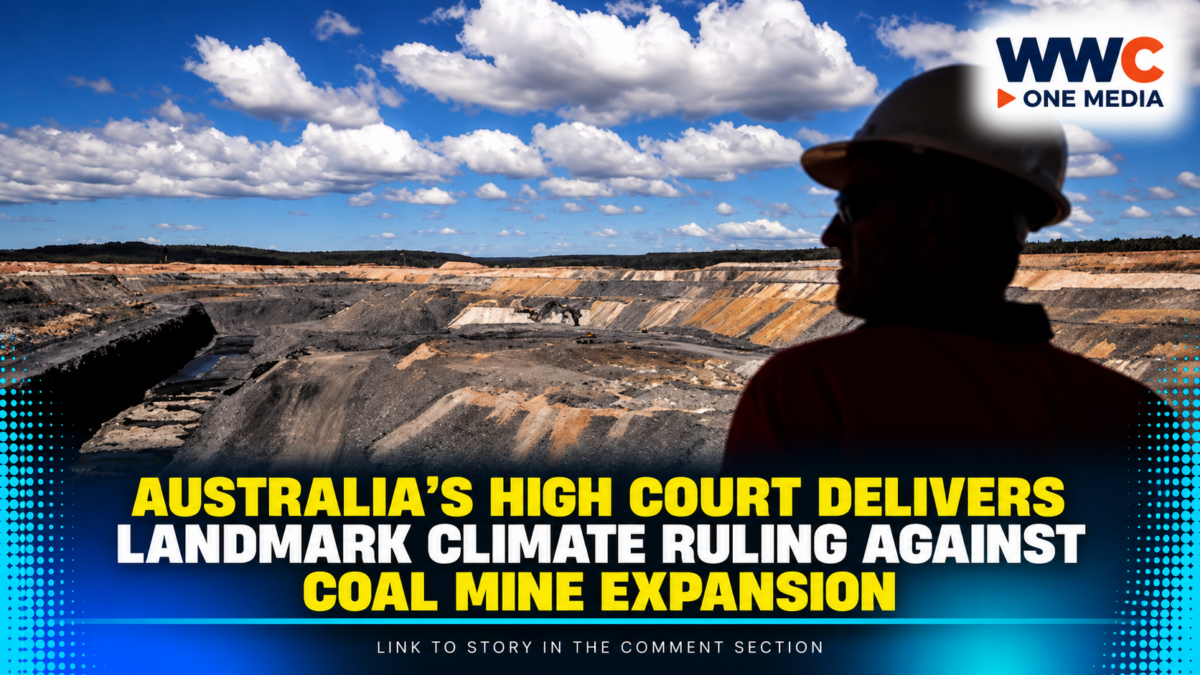
Australia’s top court has backed a grassroots environmental group in a landmark climate case, ruling that planning authorities must properly consider greenhouse gas emissions linked to exported coal before approving major projects.
Australia’s coal industry faces renewed scrutiny after the country’s highest court upheld a legal challenge against the proposed expansion of the Mount Pleasant coal mine in New South Wales (NSW), marking the first climate change case to reach the High Court of Australia.
In a decision handed down on October 7, 2026, the court dismissed an appeal by mine operator MACH Energy, upholding an earlier ruling that found planning authorities had failed to adequately consider the climate implications of the project’s emissions.
The case could influence how future fossil fuel projects are assessed, particularly when the pollution generated by burning exported coal occurs outside Australia but may still contribute to climate-related harm at home.
The decision is a significant development for environmental law, although it does not automatically prohibit all new coal or gas projects. Instead, it underscores the need for authorities to properly consider relevant environmental impacts when making planning decisions.
Why Australia’s Coal Mine Expansion Was Challenged
MACH Energy sought approval to extend the life of its Mount Pleasant mine near Muswellbrook in the Hunter Valley until 2048 and substantially increase coal production.
The proposed expansion would have enabled the extraction of hundreds of millions of additional tonnes of coal. The project received approval from the NSW Independent Planning Commission in 2022, but a local environmental group challenged the decision.
The Denman Aberdeen Muswellbrook Scone Healthy Environment Group, which represents residents in the region, argued that authorities had not properly assessed the climate consequences associated with the coal expected to be exported and burned overseas.
The group won an earlier legal challenge in the NSW Court of Appeal in 2025. MACH Energy then appealed to the High Court, seeking to overturn that decision.
The High Court rejected the company’s appeal, leaving the challenge to the mine expansion in place.
The Climate Issue at the Heart of the Case
A central issue was whether planning authorities needed to consider so-called Scope 3 emissions when assessing the mine expansion.
Scope 1 emissions are released directly by a project, while Scope 2 emissions arise indirectly from the electricity and energy it consumes. Scope 3 emissions cover other indirect emissions across a product’s value chain, including carbon dioxide released when exported coal is burned by customers overseas.
According to the court materials, Scope 3 emissions accounted for approximately 98 percent of the Mount Pleasant project’s projected greenhouse gas emissions.
The NSW planning authority had not imposed conditions addressing those emissions, in part because much of the pollution would occur outside Australia after the coal was exported.
The High Court found that the authority had failed to adequately consider whether conditions should be imposed to minimise the project’s greenhouse gas emissions as far as practicable.
The decision highlights a crucial distinction: even when emissions are released in another country, authorities may still need to consider the climate implications of a project when applying relevant domestic planning laws.
A Grassroots Group Takes on a Major Energy Project
The case was brought by a community organisation from the Hunter Valley, a region with a long history of coal mining.
Its campaign challenged the assumption that emissions associated with exported fossil fuels could be left out of local project assessments simply because the coal would be burned overseas.
The group’s victory at successive levels of the NSW court system culminated in the High Court’s first ruling on a climate change case.
Wendy Wales, the group’s president and a retired science teacher, welcomed the decision, arguing that Australia could not ignore the consequences of extracting coal for overseas use.
The ruling gives environmental advocates a significant legal development to point to in future disputes over fossil fuel projects and climate impacts.
However, the precise effect of the judgment will depend on the laws governing individual projects and how planning authorities apply the court’s reasoning.
Why the Ruling Has the Energy Industry Watching
The decision has drawn contrasting reactions from environmental campaigners and industry representatives.
Climate advocates see it as an important step toward accountability for the broader environmental consequences of fossil fuel production. They argue that authorities should not overlook downstream emissions when assessing the potential impacts of major coal projects.
Industry representatives, meanwhile, have warned that the decision could create uncertainty for future energy investments and affect the approval process for coal and gas developments.
Australia is a major exporter of both coal and liquefied natural gas, making the treatment of emissions from exported fossil fuels an important issue for its energy sector.
The ruling is likely to receive close attention from project developers, regulators and environmental organisations. But it should not be interpreted as a blanket ban on fossil fuel developments: the central issue was whether the relevant planning authority had fulfilled its legal obligations when assessing this particular expansion.
Could This Change Future Climate Cases?
The High Court’s decision could have implications for future fossil fuel approvals, especially in New South Wales, where planning authorities must comply with the relevant state legislation.
It reinforces the importance of examining a project’s potential environmental impacts and considering whether appropriate conditions are required to minimise greenhouse gas emissions.
Other disputes may turn on different facts, planning rules and statutory requirements. The ruling therefore does not guarantee that every proposed coal mine or gas project will be rejected, nor does it automatically invalidate existing approvals.
Its broader significance lies in the legal scrutiny it brings to the relationship between fossil fuel production, downstream emissions and local climate impacts.
For communities concerned about nearby industrial developments, the case also demonstrates how residents’ groups can use the courts to challenge decisions they believe do not comply with environmental planning laws.
What Happens Next?
The High Court’s decision leaves the proposed Mount Pleasant expansion without the approval needed to proceed on the original terms. The project’s environmental and planning implications will need to be addressed through the applicable regulatory and legal processes.
For Australia’s energy industry, the ruling adds another important consideration to future project assessments: authorities may need to look beyond emissions released directly at a mine and examine the wider climate consequences of its output.
For environmental campaigners, it marks a major legal victory—but not the end of the debate over Australia’s fossil fuel future.
The lasting impact will depend on how regulators, courts and project developers respond to the judgment in the cases that follow.
WWC ONE MEDIA G,A