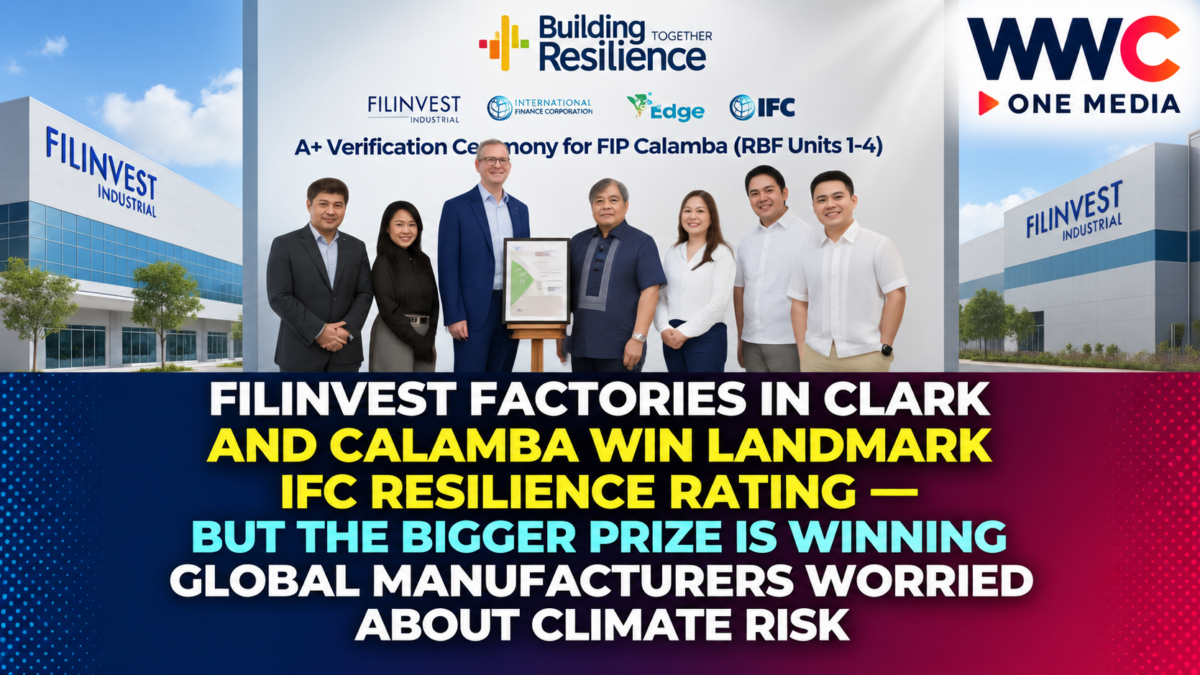
MANILA — Filinvest Land is turning climate resilience into a new selling point for Philippine industrial real estate after ready-built factories in New Clark City and Calamba became the first facilities in the sector to secure an A+ rating under the International Finance Corporation’s Building Resilience Index.
The recognition covers:
five ready-built factory units in New Clark City
and
four factory units in Ciudad de Calamba.
The rating matters because it goes beyond aesthetics or ordinary sustainability claims.
It asks a much more important question:
Can the factory keep operating when disaster strikes?
For global manufacturers increasingly worried about:
Typhoons
Flooding
Earthquakes
Fires
and
Supply-chain disruptions,
that question can directly affect where they invest.
THIS IS NOT AN ORDINARY GREEN-BUILDING AWARD
There is an important distinction.
Filinvest has numerous properties with:
EDGE
and
LEED
green certifications.
But this new recognition is different.
The factories received an:
A+ rating under the Building Resilience Index.
The BRI framework was developed by the:
International Finance Corporation
a member of the:
World Bank Group.
Instead of focusing mainly on energy and water efficiency, BRI measures how well a building can withstand:
Natural hazards
and
Climate-related risks.
That makes it particularly relevant to industrial tenants.
THE RATING WAS INDEPENDENTLY VERIFIED
The Filinvest facilities were assessed by:
Haskoning Philippines Inc.
an IFC-accredited third-party verifier.
That outside verification is important.
The rating is not simply a self-declared marketing label from the developer.
The sites underwent formal assessment.
For the Ciudad de Calamba ready-built factories, the public BRI database lists an:
A+ post-construction rating.
The project also received:
A ratings
for:
Wind
Water
Fire
and
Geoseismic resilience.
Operational continuity was also recognized.
FILINVEST SAYS THE FACTORIES CAN HANDLE 290-KPH WINDS
The physical standards are substantial.
Filinvest says the ready-built factories are designed to withstand winds of up to:
290 kilometers per hour.
That is critical in the Philippines.
The country regularly experiences powerful tropical cyclones.
For an industrial tenant, strong buildings can mean the difference between:
a temporary disruption
and
a catastrophic shutdown.
Manufacturers do not simply insure the building.
They also risk losing:
Inventory
Machinery
Production
Orders
and
Customer contracts.
That makes resilience an economic issue.
THE SITES ARE ALSO DESIGNED AROUND FLOOD RISK
Filinvest says the facilities are positioned on:
elevated sites
to improve flood protection.
Flooding is one of the most costly recurring hazards for industrial parks.
Factories can suffer losses from:
damaged electrical systems
contaminated inventory
waterlogged machinery
and
blocked access roads.
Even when a building itself survives, operations can stop if employees, trucks or suppliers cannot reach it.
That is why the resilience rating also considers:
operational continuity.
FIRE PROTECTION IS ANOTHER MAJOR PART OF THE DESIGN
The sites also include:
automated fire-protection systems.
Industrial fires can be especially destructive because factories may contain:
Machinery
Electrical equipment
Raw materials
and
Stored goods.
A strong resilience system therefore requires both:
prevention
and
rapid response.
For manufacturers, insurers and lenders, those protections can become increasingly important.
MULTIPLE TRANSPORT ROUTES HELP REDUCE SUPPLY-CHAIN RISK
The two industrial parks are also connected to multiple transport corridors.
That is another important resilience factor.
A factory may survive a typhoon.
But if the only access road is blocked, production can still stop.
Multiple routes reduce the risk that one disruption cuts a facility off from:
Workers
Suppliers
Ports
and
Customers.
This is where location becomes part of the resilience story.
NEW CLARK CITY HAS A STRATEGIC LOCATION
Filinvest Innovation Park–New Clark City sits within one of the Philippines’ most important emerging industrial corridors.
The development is connected to:
Clark International Airport
Subic Bay
Major expressways
and
Central Luzon manufacturing zones.
PEZA and BCDA have been promoting New Clark City as a strategic hub for:
Advanced manufacturing
Logistics
Technology
and
Export-oriented industries.
The area forms part of the broader:
Luzon Economic Corridor.
NEW CLARK CITY IS ALREADY ATTRACTING HIGH-TECH MANUFACTURERS
The industrial park has begun bringing in international locators.
Taiwan-based:
EDAC Group
signed a five-year lease for a:
5,000-square-meter ready-built factory
in New Clark City.
The facility will serve as a manufacturing hub for the company’s Southeast Asian operations.
EDAC specializes in:
interconnectivity solutions
used in electronics and advanced manufacturing.
That kind of tenant is exactly the type of company Filinvest wants to attract.
THE PARK ALSO HOSTS ADVANCED BATTERY MANUFACTURING
New Clark City has also attracted:
StB GIGA Factory.
The facility is backed by Australian investors and produces:
lithium iron phosphate batteries.
At full capacity, it is expected to produce hundreds of thousands of home battery systems.
That gives the park exposure to:
clean energy
electronics
and
advanced manufacturing.
For companies in those sectors, business continuity is particularly important.
CALAMBA OFFERS A DIFFERENT ADVANTAGE
Ciudad de Calamba sits in:
Laguna
one of the Philippines’ most established manufacturing locations.
The area already has deep supply chains for:
Electronics
Automotive parts
Food manufacturing
Logistics
and
Industrial services.
That means locators gain access not only to buildings.
They gain access to an existing manufacturing ecosystem.
That is a major advantage compared with developing a facility in a completely new location.
FILINVEST’S CALAMBA PARK IS ABOUT 25 HECTARES
The Filinvest Innovation Park Ciudad de Calamba development covers roughly:
25 hectares.
The project sits beside Filinvest’s existing:
Technology Park Calamba.
Its location gives tenants access to major roads connecting:
Metro Manila
Laguna
Batangas
and
Cavite.
Those areas form one of the country’s biggest manufacturing belts.
PEZA STATUS ALSO MATTERS
Filinvest’s industrial properties have been developed with:
PEZA accreditation
or access to economic-zone benefits.
That can make them more attractive to export manufacturers.
PEZA locators may benefit from:
Tax incentives
Customs facilitation
and
Streamlined government processes
subject to applicable Philippine investment laws.
For multinational companies deciding between countries, these incentives can materially affect investment returns.
BUT RESILIENCE MAY BE BECOMING JUST AS IMPORTANT AS TAX INCENTIVES
Historically, countries competed for factories using:
Cheap labor
Tax holidays
Industrial land
and
Infrastructure.
Those factors still matter.
But climate risk is becoming another major consideration.
A cheap factory is not attractive if it repeatedly shuts down because of:
Floods
Typhoons
or
Power interruptions.
That means resilient industrial estates can command more attention from multinational investors.
GLOBAL COMPANIES ARE REDESIGNING THEIR SUPPLY CHAINS
The pandemic changed how companies think about production.
Businesses learned how dangerous it can be to rely on:
one country
one supplier
or
one logistics route.
Geopolitical tensions made the problem even bigger.
Companies are now increasingly pursuing:
China+1
and
multi-country manufacturing strategies.
Southeast Asia has benefited.
The Philippines wants a larger share of that shift.
THE PHILIPPINES IS COMPETING WITH VIETNAM, MALAYSIA AND INDONESIA
Filinvest is not competing only with other Philippine developers.
Its industrial parks effectively compete with sites across:
Vietnam
Malaysia
Thailand
and
Indonesia.
Those countries are aggressively courting global manufacturers.
They offer:
Industrial parks
Tax incentives
Ports
Skilled labor
and
Large supplier networks.
For the Philippines to win, it needs to differentiate itself.
Resilience can become part of that pitch.
NATURAL DISASTERS ARE A REAL COMPETITIVE ISSUE FOR THE PHILIPPINES
The Philippines is regularly exposed to:
Typhoons
Earthquakes
Floods
Volcanic hazards
and
Landslides.
For investors, that creates unavoidable risk.
The answer is not pretending the hazards do not exist.
It is designing facilities capable of operating through them.
That is exactly what the BRI framework is designed to measure.
BUSINESS CONTINUITY CAN BE WORTH MILLIONS
Imagine a manufacturer producing:
electronics components
for global customers.
One week of downtime could mean:
missed shipments
penalties
lost customers
and
damaged equipment.
For a large factory, the financial loss can quickly reach:
millions of pesos
or more.
That means spending more on resilient construction can make financial sense.
The upfront cost may be higher.
The avoided losses can be much larger.
INSURANCE COMPANIES MAY ALSO CARE ABOUT RESILIENCE
Climate-related disasters are putting pressure on:
insurance premiums.
Properties with stronger protections may eventually benefit through:
better insurance terms
or
lower risk assessments.
That will depend on individual insurers.
But the broader trend is clear.
Insurers increasingly price physical climate risk more carefully.
Independent resilience ratings provide additional information.
BANKS AND INVESTORS ARE ASKING THE SAME QUESTIONS
Lenders financing factories increasingly evaluate:
physical climate risk.
A bank lending money against an industrial property wants confidence that the asset will:
survive
and
generate cash flow.
Institutional investors are also incorporating climate resilience into:
ESG
and
risk-management frameworks.
That can make internationally recognized ratings more valuable.
FILINVEST HAS ALREADY BEEN BUILDING A GREEN-CERTIFICATION PORTFOLIO
The resilience award fits into a broader strategy.
Filinvest properties already carry certifications including:
EDGE
and
LEED.
Its REIT portfolio includes numerous EDGE-certified office buildings.
Some have delivered measurable reductions in:
Energy consumption
Water use
and
Embodied carbon.
The new BRI recognition expands the strategy from:
environmental efficiency
to
physical resilience.
EDGE AND BRI SOLVE DIFFERENT PROBLEMS
This distinction matters.
EDGE asks:
How efficiently does this building use resources?
BRI asks:
How well can this building survive hazards and continue operating?
The strongest industrial developments increasingly need:
both.
A factory can be energy-efficient but vulnerable to flooding.
Or resilient to storms but inefficient in electricity use.
Investors increasingly want both risks addressed.
FILINVEST COULD USE THIS AS A LEASING ADVANTAGE
Ready-built factories are a highly competitive product.
Industrial tenants often compare:
Rental rates
Location
Power supply
Labor access
and
Logistics.
Filinvest can now add another selling point:
verified resilience.
For companies with strict global risk-management standards, that could influence site selection.
This is particularly relevant to:
Japanese
Korean
Taiwanese
American
and
European manufacturers.
READY-BUILT FACTORIES ALSO REDUCE ENTRY TIME
Another advantage is speed.
A multinational company entering the Philippines does not always want to spend:
18 months
or
two years
building a factory.
Ready-built units allow companies to:
lease
install equipment
and
begin operations
much faster.
That reduces the time between:
investment decision
and
revenue generation.
If the building is also resilient and PEZA-ready, the proposition becomes stronger.
NEW CLARK CITY COULD BENEFIT FROM THE LUZON ECONOMIC CORRIDOR
The Philippines, United States and Japan have been promoting the:
Luzon Economic Corridor
as a major infrastructure and investment initiative.
The corridor links:
Subic
Clark
Manila
and
Batangas.
The objective is to strengthen:
Ports
Railways
Clean energy
Semiconductors
and
Industrial infrastructure.
Filinvest’s New Clark City assets sit directly inside that broader strategic geography.
THAT COULD HELP ATTRACT SEMICONDUCTOR SUPPLY CHAINS
The Philippines already has a large:
electronics and semiconductor assembly
industry.
But policymakers want to move toward more sophisticated activities.
That could include:
advanced packaging
AI hardware
battery systems
and
higher-value electronics.
Those industries are extremely sensitive to downtime.
A resilient industrial park therefore becomes more strategically relevant.
CLIMATE RESILIENCE COULD BECOME PART OF THE COUNTRY’S INVESTMENT BRAND
For decades, Philippine investment promotion emphasized:
English-speaking workers
Labor costs
and
Strategic location.
The next phase could increasingly include:
Resilient infrastructure.
That would be a meaningful shift.
Instead of treating disasters only as a weakness, developers can show how modern infrastructure is designed around those risks.
Filinvest’s A+ rating is one example.
THE BIGGER STORY: GLOBAL FACTORIES ARE STARTING TO PRICE DISASTER RISK INTO WHERE THEY INVEST
The most important part of Filinvest’s A+ rating is not the certificate itself.
It is what the rating says about how manufacturing decisions are changing.
A company choosing a factory today no longer asks only:
How much is rent?
How close is the port?
or
How cheap is labor?
It increasingly asks:
Will this facility still be operating after the next typhoon?
Can employees still reach it?
Will trucks still move?
Will the power stay on?
Will inventory survive?
Can customers still be supplied?
Those questions matter enormously in a country regularly exposed to extreme weather.
Filinvest’s factories in:
New Clark City
and
Ciudad de Calamba
now have an independent international rating designed to answer some of them.
That gives the developer a new competitive tool.
But the bigger opportunity is national.
If the Philippines can combine:
PEZA incentives
Strategic logistics
Skilled labor
and
Verified climate resilience,
it could strengthen its position in the global race for:
electronics
battery manufacturing
AI hardware
and
high-value industrial investment.
Filinvest’s A+ factories may look like a property story — but the real test is whether resilient industrial parks can help the Philippines win factories that might otherwise go to Vietnam, Malaysia or Indonesia.