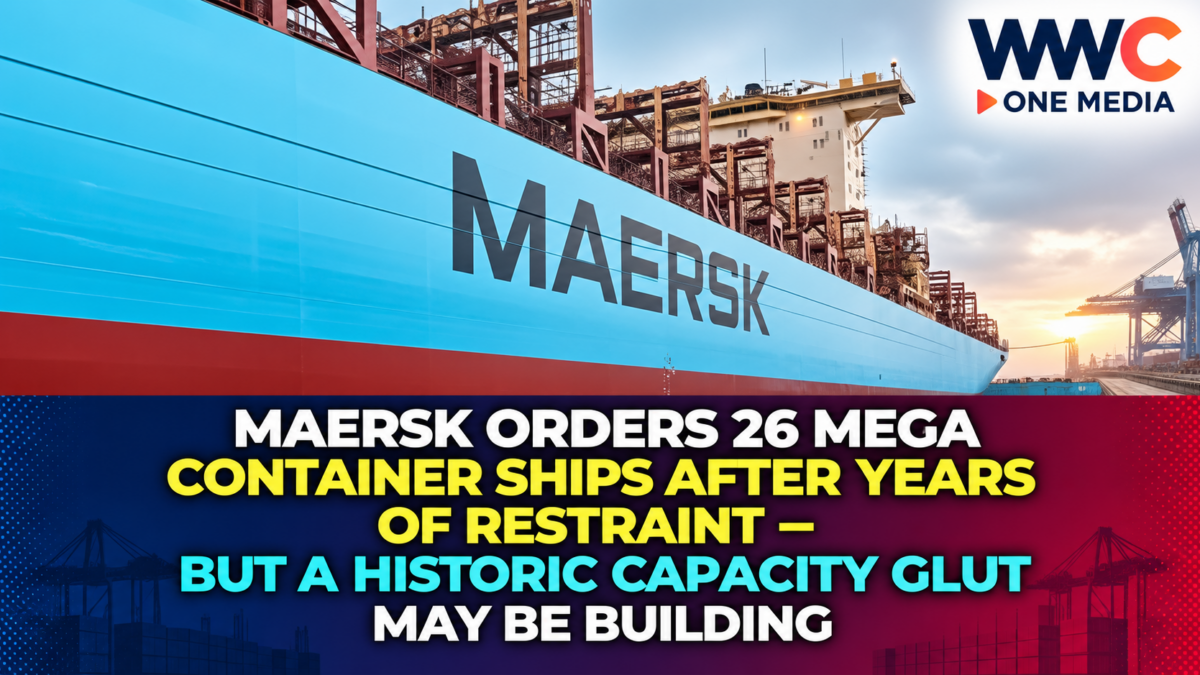
COPENHAGEN — Maersk spent years telling investors that bigger was not necessarily better.
Now the Danish shipping giant is buying ships again — aggressively.
A.P. Moller-Maersk has confirmed orders for 26 new container vessels capable of carrying 18,600 twenty-foot equivalent units, or TEU, each, adding almost 484,000 TEU of potential capacity in one of the company’s largest shipbuilding commitments in years.
The ships are expected to arrive during 2029 and 2030 and will use dual-fuel engines capable of operating on liquefied gas. Maersk has not publicly disclosed their total contract value or officially identified all of the shipyards involved.
But the more important number may be this:
131.
According to Alphaliner’s latest industry data, Maersk now has 131 ships on order, representing about 1.76 million TEU — capacity equivalent to roughly 37% of its existing operated fleet.
That represents a dramatic change for a company that had spent much of the past decade resisting the container industry’s obsession with fleet expansion.
The Financial Times describes the move as a strategic U-turn as Maersk confronts a rapidly growing MSC, an ambitious CMA CGM and a container market where disruption has made owning more ships extraordinarily profitable.
But Maersk itself uses different language.
It calls the programme fleet renewal.
That distinction could become crucial by 2030.
Because while today’s freight market is tight, profitable and disrupted, shipping companies are simultaneously ordering so many vessels that the industry’s global orderbook has climbed to levels not seen since before the financial crisis.
The bet is simple:
Maersk needs more ships today. The danger is that everybody else thinks the same thing.
The 26 vessels alone can carry almost half a million containers
Each new ship will have nominal capacity of 18,600 TEU.
Multiply that by 26 and the order represents approximately:
483,600 TEU.
A TEU represents the capacity of a standard 20-foot shipping container.
The vessels therefore belong firmly in the ultra-large container-ship category, although Maersk has deliberately stopped short of ordering the industry’s very biggest 24,000-TEU giants.
That appears intentional.
In February, when Maersk announced an earlier order for eight vessels of the same 18,600-TEU design, it said the ships would be 366 metres long and 58.6 metres wide and emphasised their deployment flexibility.
Maersk argued that although the vessels are large, they are more flexible than the roughly 400-metre ships at the extreme end of the market.
That matters because a slightly smaller ship can operate across a wider range of ports and trade lanes.
Instead of building only for maximum scale, Maersk appears to be trying to balance scale with network flexibility.
This is not Maersk’s only 18,600-TEU order
The September deal follows the eight 18,600-TEU vessels ordered from China’s New Times Shipbuilding in February.
Those ships are also scheduled for delivery in 2029 and 2030.
The February vessels use dual-fuel engines capable of running on conventional fuel or liquefied gas.
By September, Maersk had dramatically expanded that programme with another 26 ships.
That means the September announcement should not be treated as the beginning of Maersk’s newbuilding programme.
It represents a major acceleration of one already under way.
Maersk now operates about 751 container ships
Current Alphaliner data puts Maersk’s operated fleet at:
751 ships
with approximately 4.74 million TEU of capacity.
That gives Maersk around 13.7% of worldwide container capacity.
But it is no longer the world’s largest container line.
That title belongs overwhelmingly to Mediterranean Shipping Company, or MSC.
MSC currently operates around:
1,015 vessels
with approximately 7.45 million TEU
and roughly 21.6% global market share.
That is an enormous lead.
And MSC still has another 164 vessels representing about 2.91 million TEU on order.
In other words, Maersk is not ordering 26 ships because it is about to reclaim the No. 1 position.
MSC is also getting bigger.
CMA CGM is closing in too
The more immediate competitive threat comes from France’s CMA CGM.
Alphaliner currently places it third with approximately:
728 ships
4.47 million TEU
and about 12.9% market share.
That puts it relatively close to Maersk’s 4.74 million TEU.
CMA CGM has 160 ships on order, according to Alphaliner, compared with Maersk’s 131.
The FT says CMA CGM is positioned to challenge Maersk’s second-place position as their fleets evolve.
But that outcome should not be described as guaranteed.
The final rankings will depend not simply on new deliveries but also on ships that are scrapped, sold, chartered in or returned to owners.
Fleet size is constantly changing.
This is why “882 Maersk ships by 2030” needs a caveat
The Financial Times calculates that Maersk’s current fleet plus ships on order could take the total to about 882 vessels by 2030.
But that should not be interpreted as a firm Maersk forecast that precisely 882 ships will be operating in 2030.
Maersk describes much of the programme as fleet renewal.
Older ships can leave the fleet as newer vessels enter.
Maersk also charters hundreds of ships rather than owning every vessel it operates.
Alphaliner currently shows roughly 392 chartered vessels in Maersk’s fleet.
Charters can be returned.
Other ships can be scrapped or sold.
So simply adding the orderbook to today’s fleet gives a useful picture of the scale of investment — but not necessarily the final net fleet count.
Maersk says renewal. The industry sees expansion.
That difference is at the centre of the strategy debate.
Maersk’s official position is that the vessels are part of its continuing renewal programme and will help preserve the competitiveness of its ocean fleet.
Industry analysts see something bigger.
For years, Maersk deliberately restrained fleet expansion while focusing heavily on building an integrated logistics business around shipping, terminals, warehouses, trucking, customs and air freight.
Rivals did not show the same restraint.
MSC expanded aggressively and overtook Maersk as the world’s largest container carrier.
CMA CGM and Cosco also ordered extensively.
Industry analysis cited in September argued that Maersk’s fleet had grown only modestly since 2018 compared with much faster expansion by key competitors.
The new orders suggest Maersk has concluded that there are limits to how much market share it can concede at sea while still calling ocean shipping the foundation of its integrated logistics network.
And today’s container market is giving Maersk plenty of reasons to buy ships
Shipping economics have changed dramatically during 2026.
Maersk’s second-quarter revenue rose 20% year on year to US$15.8 billion.
Underlying EBITDA reached US$3 billion, while EBIT climbed to US$1.6 billion.
Ocean volumes grew 4.1%.
More importantly, freight rates increased significantly.
Maersk responded by raising its 2026 underlying EBITDA guidance to US$10.5 billion-US$12.5 billion, up from an earlier US$8 billion-US$10 billion forecast.
Its expected underlying EBIT was lifted to:
US$4.5 billion-US$6.5 billion
from:
US$2 billion-US$4 billion.
That is a striking turnaround for an industry that had previously been preparing for falling freight rates as pandemic-era distortions disappeared.
Global container demand is proving surprisingly resilient
Maersk now expects the global container market to grow by roughly 4% in 2026.
U.S. data provide another indication.
American ocean-container imports reached a record for the month of September, increasing 10.3% from a year earlier, according to Descartes data reported by Reuters.
Imports from China jumped 21.2%.
That is occurring despite tariffs and broader uncertainty over world trade.
Demand has therefore been stronger than many shipping executives and investors expected.
But demand is only half the story
Supply-chain disruption is making the ships already in existence less efficient.
Port congestion has increased.
Middle East conflict has disrupted shipping lanes.
Severe weather has affected Asian ports.
Vessels have been rerouted.
Shipping schedules have become less reliable.
And capacity that looks ample on paper can suddenly become scarce because ships are spending longer completing voyages.
Maersk said in its second-quarter report that spot freight rates were being supported by strong demand, trade-flow imbalances, tight capacity and congestion across Europe, the Middle East, South America’s east coast and West Africa.
Reuters reported this week that Maersk and Hapag-Lloyd are among the European shipping groups expected to report strong third-quarter results because elevated freight rates and resilient trade have persisted.
Geopolitics is effectively removing shipping capacity
This is what makes today’s container market unusual.
A ship does not have to sink or be scrapped to disappear from effective supply.
If a vessel must make a longer voyage around a conflict zone, it spends more days carrying the same cargo.
That means more ships are required to move the same annual volume.
The Red Sea crisis demonstrated that phenomenon dramatically when vessels avoided the Suez Canal and travelled around Africa.
Maersk and partner Hapag-Lloyd began returning some Gemini Cooperation services to the Suez route in September, but Maersk stressed that this did not yet represent a wholesale restoration of its entire east-west network.
The wider Middle East situation remains volatile.
Fuel costs are rising too
The current shipping boom is therefore not pure profit.
Maersk’s Ocean costs rose as Middle East disruption pushed up fuel expenses. Reuters reported that the conflict increased its Ocean division costs substantially during the second quarter even as higher freight rates more than compensated.
On October 8, Maersk announced that its emergency fuel surcharge for some inland UK and Ireland transport would increase to 20% from October 12 because of sharply higher fuel costs linked to Middle East instability.
The surcharge does not apply globally and should not be described as a 20% increase on every Maersk shipment.
But it illustrates the pressure flowing through logistics networks.
Yet the industry is responding to scarcity by ordering an extraordinary number of ships
This is where today’s solution could become tomorrow’s problem.
Industry analysis from Linerlytica said the global container-ship orderbook climbed above 45% of the existing fleet, its highest ratio since around 2009, after the latest Maersk and CMA CGM orders.
Linerlytica estimated about:
1,925 ships
representing approximately:
15.6 million TEU
were on order at that point.
That is more than double the post-pandemic orderbook peak of about 7.6 million TEU recorded in August 2023, according to the same analysis.
That creates the industry’s biggest unresolved question:
What happens if today’s disruptions disappear before all those ships arrive?
A return to normal shipping routes could release enormous effective capacity
Imagine two things happening at once.
First, ships ordered during the current boom begin arriving from Asian shipyards.
Second, geopolitical conditions improve enough for major shipping routes to operate normally again.
Voyages become shorter.
Fewer vessels are needed per service.
Port congestion eases.
Ships currently tied up in disrupted networks become more productive.
Suddenly an industry suffering from tight capacity could be facing too much of it.
That would put downward pressure on container freight rates.
And because ships typically operate for decades, carriers cannot simply erase their orderbooks overnight.
2029 and 2030 are therefore unusually important years
Maersk’s 26 latest vessels are not arriving next month.
They are due in 2029 and 2030.
That means the company is making decisions today based on assumptions about world trade several years from now.
Will China still be exporting at today’s pace?
Will U.S. tariffs reduce trade volumes?
Will Suez be fully normalised?
Will Middle East instability still be disrupting shipping?
Will AI infrastructure keep driving huge imports of electronics and industrial equipment?
Will global economic growth justify the additional tonnage?
No shipping executive can answer those questions with certainty.
Yet ship orders have to be placed years before the vessels are needed.
That is why container shipping repeatedly swings between shortage and overcapacity.
Maersk is also making a fuel bet
The 26 new ships will have dual-fuel engines capable of operating on liquefied gas.
That represents another evolution in Maersk’s decarbonisation strategy.
The company became one of the highest-profile early advocates of methanol-capable container ships.
But its current strategy is increasingly fuel-agnostic.
Maersk says it expects a multi-fuel future, incorporating methanol, biomethane and potentially ethanol and ammonia rather than relying on one solution.
The company recently completed the first U.S. commercial ship-to-ship ethanol bunkering of one of its deep-sea dual-fuel container vessels.
It is also preparing to receive liquefied biomethane for gas-capable vessels from 2027.
LNG capability does not automatically make the ships “green”
This distinction matters.
A dual-fuel LNG-capable engine can burn different fuels.
If it burns fossil LNG, the ship still produces greenhouse-gas emissions.
The climate benefit varies significantly depending on fuel production and methane leakage across the supply chain.
Maersk’s longer-term decarbonisation argument relies partly on the possibility of using lower-emission alternatives such as bio-LNG, not simply fossil natural gas indefinitely.
So calling the new vessels “zero-emission ships” would be inaccurate.
They are fuel-flexible ships designed to support future lower-emission pathways.
Maersk is still fundamentally an integrated logistics company
The newbuild spree does not mean the company has abandoned its logistics strategy.
In the second quarter, Maersk’s Logistics & Services revenue increased 15%, while its EBIT margin improved to 5.1%.
Terminals volumes rose 2.2%.
The group continues investing in warehouses, inland transport, terminals, customs services and supply-chain technology.
The difference is that Maersk increasingly appears unwilling to let its ocean fleet become the weak link in that integrated strategy.
You cannot sell customers an end-to-end global supply chain if the company lacks enough ships to carry their containers.
The irony is that the industry may be ordering because disruption has made undercapacity look worse
Maersk CEO Vincent Clerc has argued that the biggest constraint is not necessarily a shortage of vessels alone.
He has repeatedly pointed to insufficient port, rail, trucking and landside infrastructure.
The FT reported in September that Clerc believes years of inadequate infrastructure investment are helping produce bottlenecks even as enormous amounts of new vessel capacity enter the market.
If that diagnosis is right, simply adding more ships does not solve everything.
More vessels arriving at already-congested ports can make bottlenecks worse.
A container network is only as efficient as the terminals, roads, rail links and warehouses connecting to the ships.
Which means Maersk’s biggest risk may not be buying too few ships
It may be buying them at exactly the point when everybody else is doing the same.
MSC has 164 vessels on order.
CMA CGM has 160.
Cosco has 155, representing capacity equivalent to more than half of its existing fleet.
Maersk has 131.
Even Hapag-Lloyd, ONE and Evergreen have substantial orderbooks.
Nobody wants to be short of ships while freight rates are high.
But shipping history repeatedly shows that when every carrier expands simultaneously, scarcity can become excess surprisingly quickly.
For now, Maersk’s bet is paying
Container demand remains strong.
U.S. imports are hitting records.
Freight rates remain elevated.
Port congestion continues.
Geopolitical disruption remains severe.
And Maersk has raised its profit outlook twice this year.
Under those conditions, expanding the fleet looks rational.
The question is whether those conditions survive long enough.
The 26 latest ships will not begin arriving until 2029.
By then, today’s shortage could still be with us.
Or the Suez Canal could be fully normalised, ports could have cleared their backlogs and hundreds of other ships ordered during the same boom could already be entering service.
That is what makes Maersk’s new strategy so consequential.
The company that once resisted shipping’s capacity race has decided it can no longer watch MSC, CMA CGM and others build around it.
Maersk is buying ships again.
But with a global orderbook now approaching historic proportions, the biggest question is no longer whether those ships can be built.
It is whether the world will still need all of them when they finally arrive.