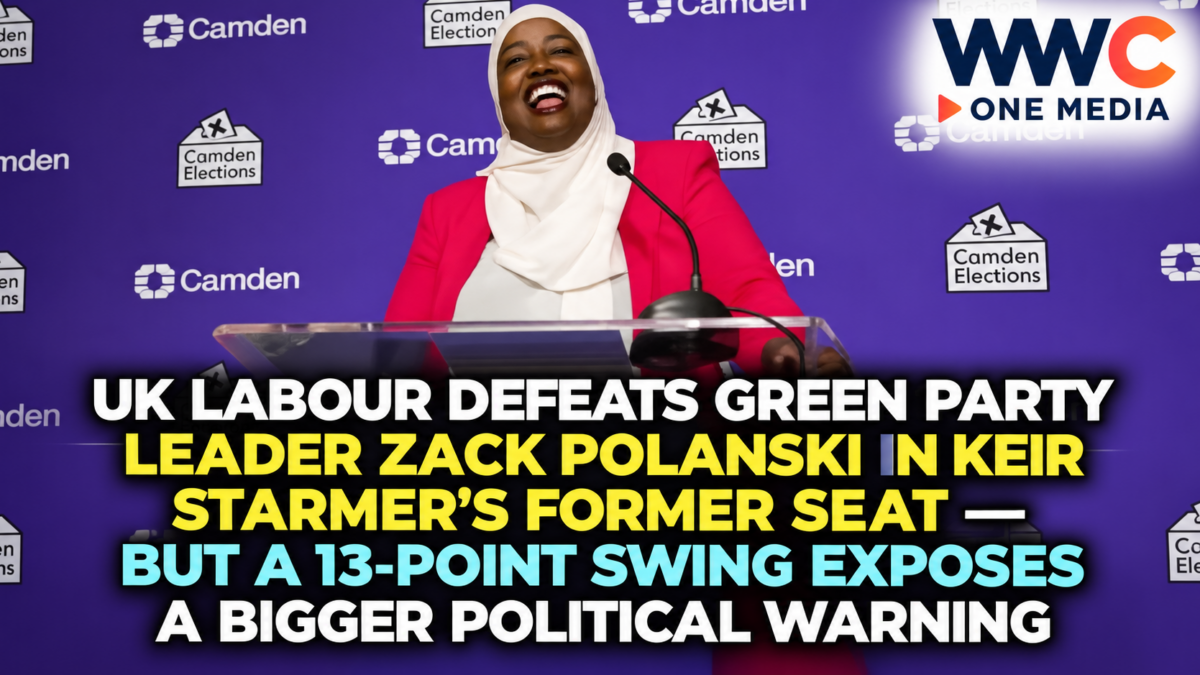
LONDON — Britain’s governing Labour Party has survived a high-stakes political showdown in the former parliamentary constituency of ex-prime minister Keir Starmer, defeating Green Party leader Zack Polanski in a closely watched London by-election.
But behind Labour’s victory lies a warning that could reshape the country’s political landscape.
Labour candidate Sagal Abdi-Wali secured 45.2% of the vote in Holborn and St Pancras, defeating Polanski, who received 32.8%, according to results announced early Friday, October 9.
The victory hands Prime Minister Andy Burnham an important political boost, preventing the Greens from capturing one of Labour’s most symbolic parliamentary strongholds.
Yet the result also revealed a dramatic shift in voter support: the Greens increased their share by more than 22 percentage points compared with the 2024 general election, while Labour’s majority narrowed considerably.
Labour won the seat. But the Greens demonstrated that a significant portion of the governing party’s traditional support is still vulnerable.
The Financial Times, Associated Press, The Guardian, ITV News and The Times reported that the contest had become an important test of Labour’s relationship with progressive voters and Polanski’s leadership of the increasingly ambitious Green Party.
Labour wins with 12,292 votes as Greens finish second
HOLBORN AND ST PANCRAS BY-ELECTION | OCTOBER 8, 2026
LABOUR
45.2%
12,292 votes
GREEN PARTY
32.8%
8,928 votes
LABOUR MAJORITY
3,364
Votes ahead of Greens
VOTER TURNOUT
38.8%
Down from 54.1% in 2024
Officially reported election results, corroborated by ITV News and LabourList. Percentages are rounded.
Vote share by party
0%12.5%25%37.5%50%LabourGreenConservativeReform UKLib DemRestore Britain
Constituency results reported by Politics.co.uk, October 9, 2026.
Labour’s winning margin of 3,364 votes was enough to secure the seat, but it was far smaller than the party’s historically dominant performances in this central London constituency.
The Conservatives finished a distant third, followed by Reform UK and the Liberal Democrats.
The result reinforces the increasingly fragmented nature of British politics, where both traditional major parties face challenges from smaller competitors.
Sagal Abdi-Wali makes history in Keir Starmer’s old constituency
For Labour, the result carries considerable personal and political significance.
Sagal Abdi-Wali, the leader of Camden Council, came to Britain as a child refugee from Somalia and built her political career in the community she now represents at Westminster.
She becomes the constituency’s first female MP, succeeding Keir Starmer after he relinquished the seat in September.
Her victory also makes her a prominent symbol of the social mobility and diversity Labour has sought to highlight.
Speaking after the result, Abdi-Wali emphasized belonging and representation, saying that people from backgrounds like hers should be able to see a place for themselves in British politics.
She campaigned on local concerns, including housing, homelessness, public services and opportunities for younger residents.
According to RTÉ and ITV News, she also advocated bringing Thames Water into public ownership and addressing rough sleeping.
Andy Burnham passes a crucial political test
The election was widely seen as a test of new Prime Minister Andy Burnham and his ability to prevent progressive voters from abandoning Labour.
Burnham’s government is seeking to rebuild support among voters frustrated by the party’s previous direction, economic pressures and debates over Britain’s relationship with Europe.
A defeat in Starmer’s former constituency would have been a major embarrassment, handing the Greens a symbolically powerful parliamentary victory.
Instead, Labour successfully held the seat despite the intense attention surrounding Polanski’s candidacy.
The Guardian described the result as evidence that Burnham has, at least temporarily, slowed the movement of left-leaning voters toward the Greens.
Still, one constituency result cannot establish a nationwide recovery.
Labour’s vote share in Holborn and St Pancras remains below its 2024 level, while the turnout was significantly lower than at the previous general election.
Zack Polanski loses — but Greens triple their previous vote share
For Green Party leader Zack Polanski, the result represents both a political setback and evidence of the party’s expanded electoral appeal.
The Greens won approximately 10.4% of the constituency vote in 2024. Under Polanski, they increased that share to 32.8% in the by-election.
That represents a gain of roughly 22.4 percentage points, even though the party failed to capture the seat.
Polanski had hoped to enter the House of Commons personally and establish himself as a more direct parliamentary opponent of the Labour government.
His campaign emphasized housing affordability, climate policy, economic inequality and support for Palestinian rights.
Following the defeat, Polanski rejected suggestions that he should resign as Green Party leader.
He insisted that he would continue in the position and portrayed the campaign as evidence that the party was expanding its support.
However, the size of the Green Party’s advance needs context.
At the 2024 general election, an independent candidate critical of Israel’s actions in Gaza attracted approximately 19% of the constituency vote. That candidate was absent from this contest.
Some of the Greens’ increased support may therefore reflect the consolidation of voters who previously supported another candidate rather than an entirely new political constituency.
Green Party controversy over Zionism creates internal divisions
The by-election took place against a backdrop of internal controversy within the Green Party.
At the party’s recent conference, members approved a motion characterizing Zionism as a form of racism.
The decision generated significant criticism from Jewish organizations, political opponents and some Green Party members.
Critics, including former Green Party leader Caroline Lucas, raised concerns about the motion and its implications for the party’s approach to antisemitism.
Supporters of the resolution argued that it reflected opposition to political Zionism and Israeli policies toward Palestinians.
The distinction between criticism of Israeli government policies, opposition to Zionism and antisemitism remains a highly contested political issue. Not all criticism of Zionism is inherently antisemitic, but language that targets Jewish identity or collectively holds Jewish people responsible can be discriminatory.
Polanski, who is Jewish, faced scrutiny over his handling of the resolution. The FT reported that the controversy had contributed to internal criticism and resignations among Green councillors.
The party leader subsequently indicated that the wording of the policy could be reconsidered.
Although the controversy was prominent during the campaign, the available election results do not establish how much it affected individual voters’ decisions.
Britain’s political landscape is becoming more fragmented
The Holborn and St Pancras result illustrates a wider challenge for Britain’s traditional political parties.
Labour faces competition from the Greens for progressive voters, particularly those concerned about climate policy, housing affordability, public services and the government’s position on international conflicts.
The Conservatives face their own electoral competition, including pressure from Reform UK.
Meanwhile, political campaigns are increasingly shaped by local concerns, voter dissatisfaction and the ability of smaller parties to mobilize supporters.
The Green Party’s substantially increased vote share shows that it can compete seriously in constituencies previously viewed as secure Labour territory.
But the defeat also demonstrates that attracting protest votes and building a winning electoral coalition are different challenges.
For Polanski, winning future constituencies may depend on broadening the Greens’ appeal beyond their existing activist base and resolving internal party disagreements.
For Burnham, maintaining Labour’s electoral coalition will require more than defeating the Greens in a single contest.
Why the result matters internationally
Britain’s political direction has significance beyond its borders, including for countries across Asia.
The UK remains an important diplomatic, financial and trade partner for the Philippines and other Southeast Asian economies.
Changes in Britain’s governing party can influence immigration policy, foreign investment, trade negotiations, education and relations with the European Union.
Burnham has signaled interest in closer EU ties, adding an international dimension to his government’s effort to redefine Labour’s political agenda.
The by-election does not directly change those policies. However, the result gives the prime minister greater political breathing room as his government pursues its priorities.
The bigger picture: Labour won, but the warning remains
For now, Labour has achieved its immediate objective.
It retained Keir Starmer’s former parliamentary seat, defeated the Green Party’s national leader and avoided a politically damaging loss.
The victory gives Burnham’s government renewed confidence following a period of electoral uncertainty.
But there are important limits to the result.
Labour received less than half the votes cast. The Greens tripled their previous share. Turnout declined sharply. And the constituency produced Labour’s smallest majority there since its creation in 1983.
The Greens, meanwhile, face questions about leadership, internal unity and their ability to turn increased support into parliamentary seats.
Labour may have won the battle for Holborn and St Pancras — but the wider fight for Britain’s progressive voters is far from over.
That contest could become one of the defining political struggles ahead of the country’s next general election.