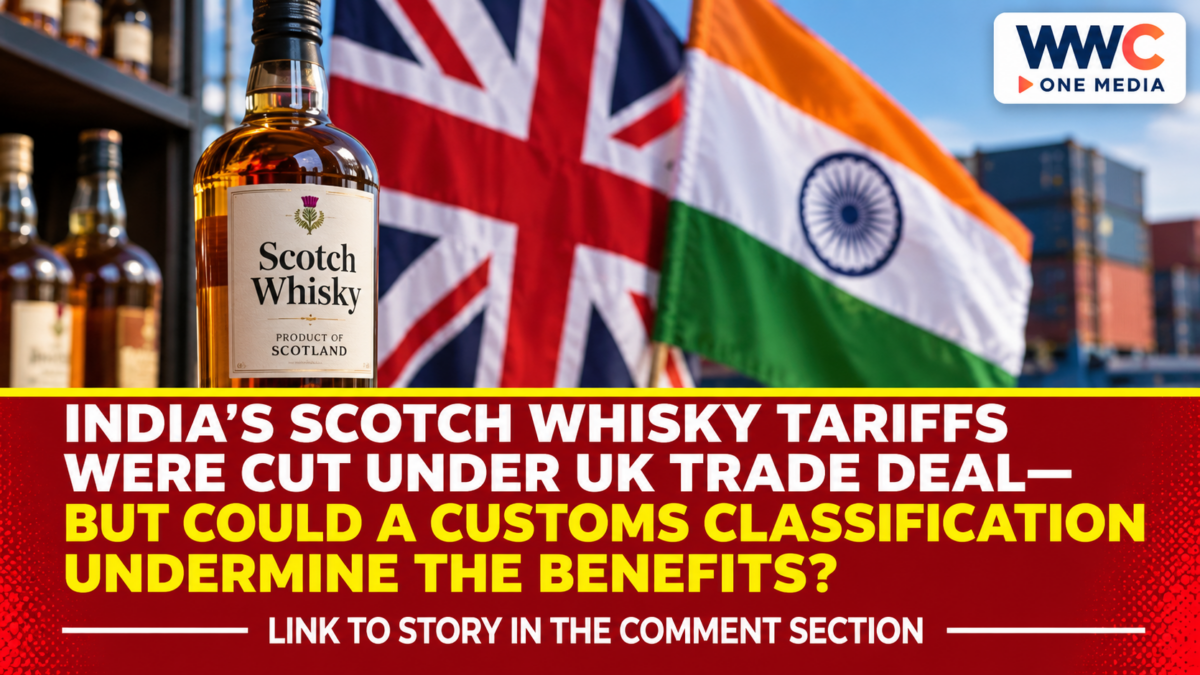
MANILA, Philippines — India’s Scotch whisky tariffs were reduced from 150% to 75% for qualifying imports under the Comprehensive Economic and Trade Agreement (CETA) with the United Kingdom, which entered into force on July 15, 2026.
However, a British parliamentary report published on Jan. 21 documented concerns about a separate customs classification used extensively for bulk Scotch whisky exports that did not receive equivalent tariff liberalisation.
The distinction highlights a potentially significant implementation challenge for businesses operating under the bilateral agreement.
While negotiated tariff reductions can improve market access, their commercial value ultimately depends on how individual shipments are classified and assessed by customs authorities.
Scotch Whisky Tariffs: What the Trade Agreement Changed
The British government’s official trade guidance identifies Scotch whisky under Harmonised System Code 2208.30 as one of the products benefiting from staged tariff reductions.
The applicable preferential tariff fell to 75% when the agreement entered into force, with further reductions scheduled to bring it down to 40% over the agreed implementation period.
The government’s sector-specific guidance includes bottled and bulk whisky under this classification.
For exporters, the reduction represents a substantial improvement in the negotiated conditions for accessing the Indian market.
However, the applicable customs classification remains essential. A tariff concession covering one category of goods does not necessarily extend to merchandise declared under another category.
This distinction matters particularly when products are imported in bulk for subsequent processing, blending or packaging.
The commercial benefits of the agreement therefore depend not only on negotiated tariff rates but also on the correct application of customs rules.
Parliament Identified a Bulk Import Classification Concern
Before the agreement entered into force, the UK House of Commons Business and Trade Committee examined potential implementation challenges arising from CETA.
Its January 2026 report recorded concerns submitted by the Scotch Whisky Association regarding tariff line HS 22089099.
The industry association explained that this classification was used for much of the UK’s bulk Scotch whisky exports for regulatory reasons.
It also raised concerns that the classification had not received the same extent of tariff concessions as the whisky-specific categories.
This introduces an important distinction between the general description of an imported product and its legally applicable customs classification.
Two shipments associated with the same industry may face different tariff treatment depending on their characteristics and the relevant classification rules.
The parliamentary report establishes that the industry raised this concern before the agreement became operational.
It does not independently establish the duties charged on particular shipments in November 2026 or whether either government has subsequently adopted a definitive solution.
Why Customs Classification Can Affect Business Costs
A customs tariff is generally calculated using the applicable duty rate and the value determined under relevant customs rules.
For businesses importing raw materials or intermediate products, a difference in tariff treatment could affect production costs, inventory management and commercial margins.
Consider a hypothetical shipment with a customs value of £100,000.
At a duty rate of 150%, the corresponding tariff would amount to £150,000. At 75%, it would amount to £75,000, assuming the same customs valuation and excluding other taxes or charges.
The illustration demonstrates why determining the applicable classification can have substantial financial consequences.
An importer expecting preferential treatment may prepare its purchasing budget around the lower tariff rate. If the goods are instead assessed under a category carrying a different rate, the business could face additional expenditure.
These financial consequences are hypothetical and should not be interpreted as confirmed losses incurred by any particular company.
WWC’s coverage of US–Philippines trade arrangements and tariff requirements examines a related issue: businesses need legally applicable trade provisions rather than broad political announcements when estimating import and export costs.
Preferential Tariffs Require More Than an Eligible Product
The UK–India agreement also establishes rules governing the origin of goods.
British government guidance explains that exporters must establish whether their products qualify for preferential treatment under the relevant origin requirements.
Importers may claim preferential treatment using an origin declaration prepared by an eligible UK producer or exporter.
The guidance also provides information about registration with HM Revenue and Customs before exporters complete such declarations.
For international businesses, origin and classification are separate but complementary considerations.
A shipment may originate in a participating country but still require the correct classification before its preferential duty rate can be determined.
Documentation, customs valuation and compliance with domestic regulations can also influence the final cost of importing goods.
A signed agreement can establish legal commitments, but businesses still need accurate operational guidance to use them effectively.
What Philippine Businesses Can Learn From the Tariff Issue
The customs classification question offers a broader lesson for Philippine manufacturers, exporters and importers.
Businesses entering international markets should examine the tariff schedule applicable to their specific products before negotiating supply contracts or committing to long-term pricing arrangements.
This is particularly important for companies importing ingredients, industrial materials or components for processing into finished products.
A lower tariff on a finished product does not necessarily establish identical treatment for all materials used in its manufacture.
Businesses should also consider how changes in customs assessments could affect working capital and cash-flow requirements.
WWC’s coverage of Bangladesh–Thailand trade cooperation and shipping connectivity provides additional context on why regulatory arrangements and physical supply chains must be evaluated together.
For smaller enterprises, consulting qualified customs professionals before concluding major transactions could help identify compliance requirements and reduce unexpected costs.
What Happens Next?
The important developments to monitor include any official clarification concerning the classification of bulk Scotch whisky imports, amendments to customs instructions or published administrative determinations.
A definitive clarification could help importers establish which tariff provisions apply to their shipments and improve the predictability of future transactions.
Until such records are available, businesses should avoid assuming that every shipment associated with Scotch whisky automatically receives identical preferential treatment.
The UK–India agreement demonstrates the potential for trade liberalisation to reduce barriers between major economies.
Its practical effectiveness, however, depends on whether the negotiated commitments can be applied consistently to actual commercial transactions.
For international businesses, the lesson is straightforward: the value of a trade agreement is determined not simply by the tariff reductions announced, but by the conditions under which companies can actually claim them.
Frequently Asked Questions
How much were India’s Scotch whisky tariffs reduced under the UK trade agreement?
The preferential rate for qualifying whisky under HS Code 2208.30 fell from 150% to 75%, with further scheduled reductions to 40%.
When did the UK–India trade agreement enter into force?
The agreement entered into force on July 15, 2026.
Why is bulk Scotch whisky classification important?
An industry submission recorded by the British Parliament identified concerns about a separate tariff classification that did not receive equivalent concessions.
Has the bulk whisky classification issue been resolved?
The official records reviewed do not establish a definitive November 2026 resolution.
Do UK–India tariff concessions automatically apply to Philippine exporters?
No. Philippine businesses must assess their eligibility under the relevant trade agreements, product classifications and rules of origin.