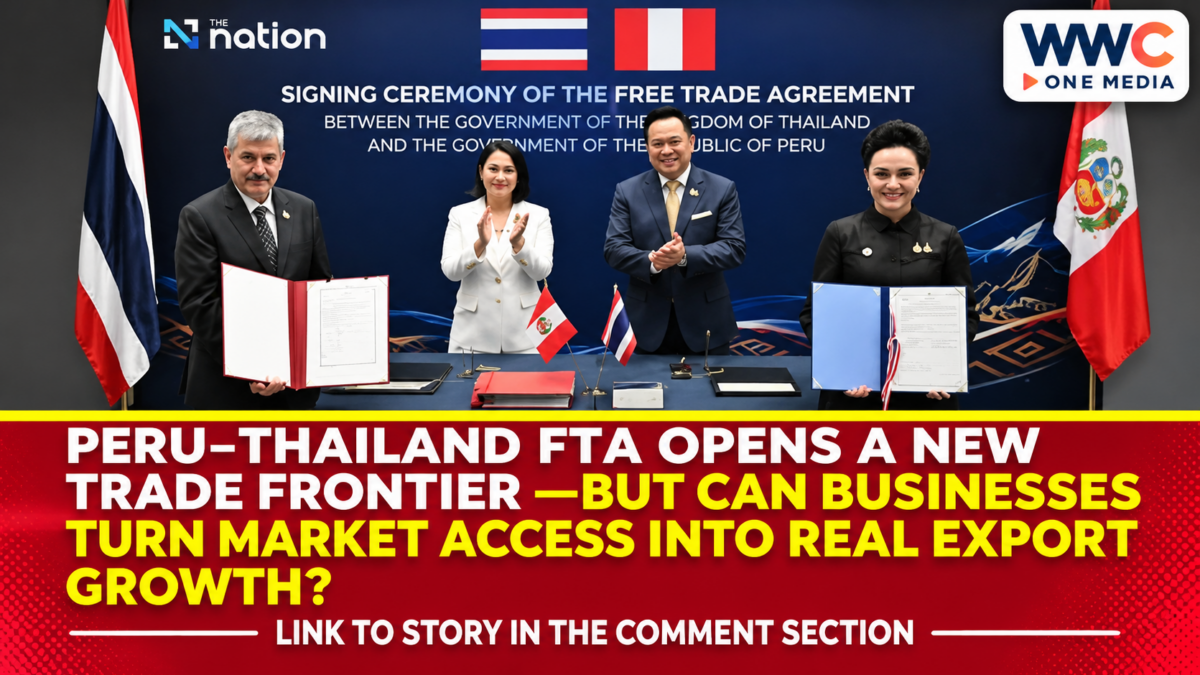
THAILAND— Peru and Thailand signed a comprehensive free trade agreement on Nov. 19, 2026, during the Asia-Pacific Economic Cooperation (APEC) meetings in Shenzhen, China, expanding their framework for commercial cooperation across the Pacific.
Thai Commerce Minister Suphajee Suthumpun and Peruvian Foreign Trade and Tourism Minister Rogers Martín Valencia Espinoza signed the Peru–Thailand FTA following bilateral discussions between their respective national leaders.
The agreement seeks to strengthen merchandise trade, expand opportunities for service providers and improve commercial connections between Southeast Asia and Latin America.
For businesses, however, the real economic opportunity will depend on how effectively the negotiated commitments translate into competitive prices, reliable supply chains and sustainable relationships with overseas customers.
Peru–Thailand FTA Builds on an Established Trade Relationship
The agreement represents an expansion of an existing commercial partnership rather than the creation of an entirely new trading relationship.
Peru and Thailand established a framework for closer economic cooperation in 2003. A subsequent goods-trade protocol and three additional protocols entered into force on Dec. 31, 2011.
Those arrangements addressed customs procedures, tariff treatment, product-origin requirements, technical regulations and mechanisms for resolving trade disputes.
Both countries pursued a broader agreement in 2012, completing negotiations the following year without proceeding to formal signature.
The process gained renewed momentum after the 2024 APEC leaders’ meeting, followed by further negotiations in Lima and Bangkok in 2025.
The latest signing therefore represents the culmination of years of efforts to expand the scope of bilateral economic cooperation.
Importantly, the existing trade protocol and the newly signed comprehensive agreement must be distinguished. Businesses should continue checking the applicable legal provisions rather than assuming that every new commitment became effective immediately after the signing ceremony.
Manufacturing and Food Exporters Could Gain New Opportunities
Thailand’s official announcement identifies automobiles, automotive components, tyres and processed fruits among the products positioned to benefit from the expanded commercial relationship.
The agreement could also improve access to Peruvian raw materials that support Thailand’s manufacturing industries.
For manufacturers, export diversification offers potential advantages beyond higher sales volumes.
Developing relationships with buyers in additional markets can help reduce dependence on a limited number of customers or destinations.
However, entering a new market involves costs. Businesses may need to adapt product packaging, establish distribution arrangements, obtain regulatory approvals and maintain inventory closer to overseas customers.
Food exporters face additional considerations involving product shelf life, transportation conditions and food safety requirements.
A lower import duty could improve a product’s competitiveness, but its final selling price would still reflect freight charges, insurance, distribution expenses and local taxes.
The commercial value of the agreement will therefore depend on whether exporters can deliver products that remain attractive after all associated costs are considered.
The Agreement Extends Beyond Physical Goods
One of the most significant developments is the expanded treatment of cross-border services.
Thailand’s Ministry of Foreign Affairs confirmed that the comprehensive agreement addresses service-trade liberalisation and updates commercial regulations.
Peru’s official negotiation history also identifies financial services, temporary business entry, intellectual property and competition policy among the areas pursued during negotiations.
These subjects matter because international commerce increasingly involves activities that accompany merchandise transactions.
A manufacturer entering an overseas market may require engineering support, logistics coordination, marketing assistance or professional consulting.
Clearer rules governing such activities could make international business relationships easier to establish and maintain.
Nevertheless, liberalising services does not necessarily eliminate licensing requirements, immigration restrictions or professional qualifications.
Companies should examine the final commitments and relevant domestic regulations before assuming that they can operate freely in the other country’s market.
Logistics Could Determine the Agreement’s Economic Value
During their Shenzhen discussions, Thai Prime Minister Anutin Charnvirakul and Peruvian President Keiko Sofía Fujimori Higuchi identified Peru’s Port of Chancay as an opportunity to strengthen logistics connections between Asia and Latin America.
The emphasis on transportation highlights a practical challenge for companies trading across the Pacific.
Tariff preferences may improve market access, but international shipping costs and delivery times can significantly influence whether a transaction remains profitable.
Businesses need reliable freight services, predictable customs processing and distribution arrangements capable of meeting customer demand.
For smaller exporters, consolidating shipments or working with experienced logistics partners could be more practical than establishing independent overseas distribution networks.
WWC’s coverage of Bangladesh–Thailand trade and maritime connectivity examines a related distinction between physical transportation infrastructure and the legal arrangements that govern international commerce.
Both elements can support trade, but neither automatically guarantees commercial success.
What the Philippines Can Learn From the Agreement
The Peru–Thailand partnership is particularly relevant as Philippine businesses examine opportunities to diversify their export markets and international suppliers.
WWC previously examined the Philippines–Chile Comprehensive Economic Partnership Agreement, including its potential implications for manufacturing costs and commercial access to Latin America.
The two agreements offer useful comparisons for businesses evaluating international expansion.
Rather than focusing exclusively on announced tariff concessions, companies should assess product eligibility, transportation expenses, local demand and their ability to meet regulatory requirements.
The Peru–Thailand agreement does not automatically provide equivalent preferences to Philippine exporters.
Filipino companies seeking to participate in regional supply chains would still need to examine the applicable rules of origin and other eligibility requirements.
Export diversification may also become increasingly important when trade policies change across major markets.
For Southeast Asian businesses, the wider lesson is that trade agreements are tools for commercial expansion rather than guarantees of increased revenue.
What Happens Next?
The immediate priority is determining when the newly signed agreement will enter into force and how businesses can use its individual provisions.
Exporters and importers should monitor official publications containing the final treaty text, preferential tariff schedules, origin requirements and implementation instructions.
Companies can use the intervening period to assess market demand, identify potential distribution partners and prepare the documentation required for preferential treatment.
The long-term performance of the agreement should be evaluated through actual trade activity, broader product diversification and sustained commercial relationships.
For Peru and Thailand, signing the comprehensive agreement establishes a new framework for economic cooperation.
Turning that framework into measurable export growth will depend on effective implementation and the ability of businesses to compete in markets on opposite sides of the Pacific.
Frequently Asked Questions
When did Peru and Thailand sign their free trade agreement?
The two countries signed the agreement on Nov. 19, 2026, during APEC Economic Leaders’ Week in Shenzhen, China.
Which Thai products could benefit from the agreement?
Thai government announcements identify automobiles, automotive components, tyres and processed fruits among the potential beneficiaries.
Does the agreement cover services?
Yes. The comprehensive agreement expands the bilateral trade framework to include services and modernised commercial regulations.
Has the new Peru–Thailand FTA entered into force?
The official records reviewed confirm its signing but do not establish a verified entry-into-force date.
Will Filipino exporters automatically receive the same tariff preferences?
No. The agreement concerns trade between Peru and Thailand. Philippine businesses must establish their eligibility under the applicable trade arrangements and origin requirements.