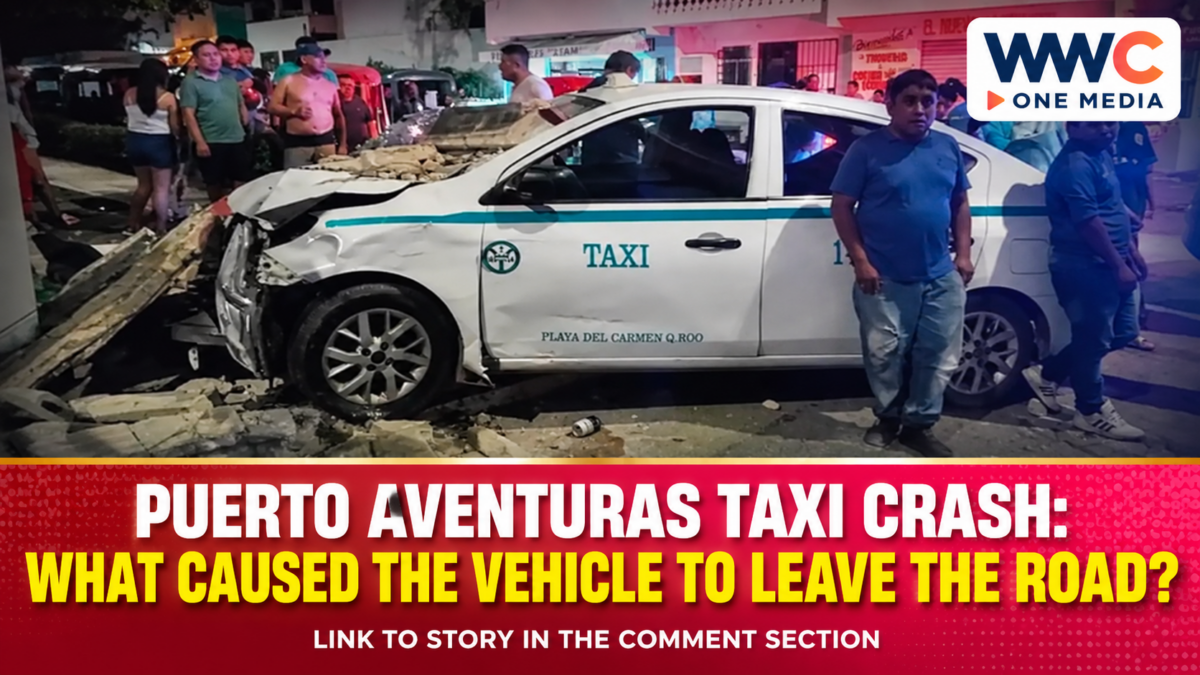
PUERTO AVENTURAS, MEXICO — Reports of a taxi colliding with a wall in Puerto Aventuras on November 20 have brought attention to public transportation safety in Mexico’s Quintana Roo state. The circumstances surrounding the reported accident, including its cause and the condition of those involved, remain subject to official verification.
The Puerto Aventuras taxi crash highlights the importance of examining vehicle roadworthiness, driver accountability, road infrastructure and emergency response procedures when assessing public transportation safety.
Although the municipal government of Playa del Carmen has documented recent efforts to improve security and mobility in Puerto Aventuras, those initiatives do not establish the cause of this particular collision.
Puerto Aventuras taxi crash: Questions surrounding the incident
Establishing what caused a vehicle to leave its intended path requires more than examining the damage sustained during a collision.
A comprehensive assessment would ordinarily consider the condition of the vehicle, road surface, visibility, traffic environment and available witness accounts.
Investigators would also need to establish whether mechanical problems, environmental conditions or driver actions contributed to the incident.
Excessive speed, distracted driving and mechanical failure should not be treated as established causes without supporting evidence.
The distinction is important because preliminary impressions can differ substantially from the conclusions reached after a formal examination.
Previous incidents involving public transportation, including the Changi Airport limousine taxi collision, provide separate examples of why accident circumstances deserve careful examination.
Municipal government strengthens public safety measures
The government of Playa del Carmen has previously announced coordinated security operations in Puerto Aventuras involving multiple municipal departments.
An October 2026 municipal announcement documented the participation of traffic and road safety personnel, preventive police and community safety teams.
The initiative was intended to strengthen preventive security and maintain public order within the community. H. Ayuntamiento de Playa del Carmen
Separate municipal activities included inspections and maintenance of public lighting and improvements to shared urban spaces as part of broader efforts to improve mobility and community safety. H. Ayuntamiento de Playa del Carmen
These programmes provide relevant context for discussions about local road safety, although they should not be interpreted as evidence that infrastructure deficiencies contributed to the reported taxi crash.
The challenge for local authorities is translating preventive programmes into measurable improvements in everyday transportation safety.
Why commercial vehicle safety deserves attention
Taxis serve a commercial function that makes vehicle maintenance and responsible operation particularly important.
A collision involving a public transport vehicle can potentially affect passengers, pedestrians, other motorists and nearby property owners.
Regular vehicle inspections, appropriate maintenance and compliance with applicable traffic regulations are important components of accident prevention.
However, determining whether a particular operator failed to meet those responsibilities requires documentary evidence rather than assumptions.
Vehicle maintenance records, inspection certificates and technical assessments could help establish whether mechanical conditions played any role in a collision.
The broader issue of driver accountability has also featured in WWC’s coverage of administrative action following multiple vehicle collisions in Cebu, although that case involves a different jurisdiction and unrelated circumstances.
Road infrastructure and accident prevention
Road safety depends on more than individual driving behaviour.
Street lighting, clearly visible traffic signs, appropriate road markings and properly maintained surfaces can help motorists navigate their surroundings.
The Playa del Carmen municipal government has also announced infrastructure improvements involving 50 absorption wells across areas of Playa del Carmen and Puerto Aventuras as part of efforts to manage rainfall-related disruptions. H. Ayuntamiento de Playa del Carmen
Such projects demonstrate the broader importance of infrastructure maintenance, particularly in communities where residents depend on local road networks for daily mobility.
There is no verified evidence, however, connecting drainage conditions or other infrastructure issues to the reported November 20 collision.
From a public policy perspective, reviewing road conditions alongside vehicle and driver-related evidence can support a more comprehensive understanding of transportation risks.
Establishing responsibility after a collision
Determining responsibility is one of the most consequential aspects of a traffic investigation.
A collision may result in vehicle damage, repair expenses, property losses or medical costs. The actual consequences depend on the circumstances of each incident.
Insurance coverage, applicable regulations and formal findings can influence how those costs are addressed.
A driver should not automatically be presumed negligent simply because a vehicle was involved in a collision.
Likewise, transportation operators should not be accused of failing to maintain their vehicles unless evidence establishes such shortcomings.
Other incidents, such as the private-hire vehicle collision and near-miss in Chai Chee Street, illustrate the wider potential consequences when vehicles leave their intended path.
What happens next
An incident-specific statement from municipal traffic authorities would provide a stronger basis for understanding what occurred in Puerto Aventuras.
Among the outstanding questions are whether an official collision assessment has been completed, whether vehicle defects were identified and whether any administrative proceedings will follow.
The available public municipal records establish that road safety and community security form part of the government’s ongoing activities. They do not establish findings concerning the reported taxi collision.
Until additional documentation becomes available, conclusions about responsibility, injuries and possible penalties should remain open.
For residents and transportation users, the broader priority remains ensuring that commercial vehicles are maintained appropriately and that traffic safety measures are consistently implemented.
The effectiveness of those measures ultimately depends on prevention, enforcement and evidence-based accountability.