WINDSOR, CANADA — A 35-year-old motorist died after a sedan struck an underpass wall in eastern Windsor, Ontario, late on Nov. 20, 2026. Police have opened an investigation into the fatal East Windsor crash, with preliminary findings pointing to excessive speed and a possible traffic signal violation.
The incident has renewed the relevance of Windsor’s long-term road safety strategy, which seeks to eliminate fatal and serious-injury collisions across streets under municipal jurisdiction.
While investigators work to establish the circumstances surrounding the driver’s death, the collision also raises broader questions about traffic enforcement, infrastructure design and the prevention of serious road incidents.
East Windsor Crash: What Police Have Established
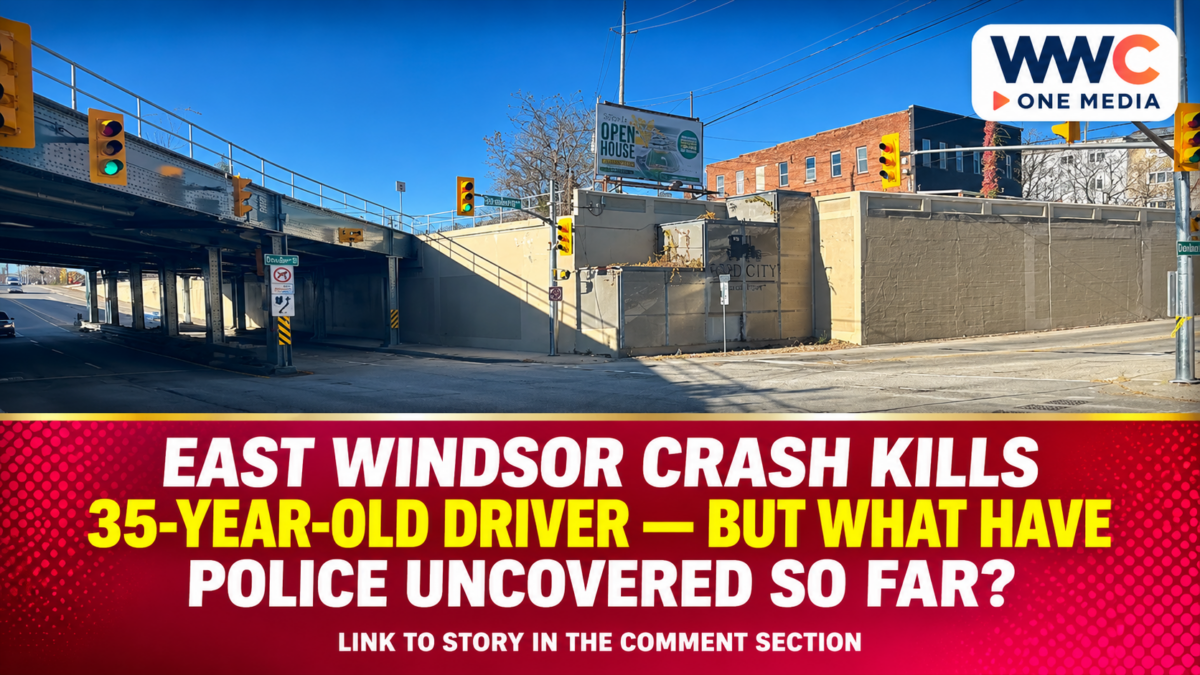
Emergency responders were alerted to the collision shortly before midnight near the junction of Drouillard Road and Wyandotte Street East.
Police discovered a damaged passenger car that had struck a concrete structure beneath an underpass. The driver was taken to hospital, where medical personnel confirmed his death.
The preliminary police assessment suggests that the car was heading west along Wyandotte Street East at considerable speed.
Investigators also indicated that the vehicle may have crossed against a red traffic signal and narrowly missed another vehicle before hitting the wall.
These observations remain preliminary. They should not be interpreted as a completed determination of the collision’s cause.
The difference between initial findings and established conclusions is also relevant to WWC ONE MEDIA’s coverage of the Surrey dirt bike collision in British Columbia, another Canadian road incident requiring investigative scrutiny.
Traffic Disruptions End as Investigation Continues
Authorities temporarily restricted access to portions of Drouillard Road and Wyandotte Street East to allow collision investigators to examine the area.
The affected streets subsequently reopened.
Members of Windsor’s specialised Traffic Reconstruction Unit participated in the investigation, which remains active under the police case reference 26-130051.
The reopening of a roadway should not be confused with the completion of a collision investigation.
From a public safety perspective, restoring normal traffic operations and determining the circumstances of a fatal incident are separate objectives. A road may become accessible again before investigators have reached their final conclusions.
The distinction between traffic management and investigative findings is similarly relevant to the Route 138 collision in Quebec.
Windsor’s Ambitious Vision Zero Road Safety Goal
The fatal collision occurred against the backdrop of an established municipal effort to improve road safety.
Windsor City Council approved its Vision Zero Policy on Feb. 24, 2020, followed by the adoption of its Vision Zero Action Plan on Jan. 15, 2024.
The city’s objective is to eliminate fatal and major-injury collisions on municipal streets within 15 years of the action plan’s adoption.
That places its long-term target in 2039.
The strategy recognises that preventing serious road injuries requires more than expecting every motorist to avoid mistakes. It incorporates a broader approach involving the design and operation of transportation systems.
Windsor’s programme combines strategic priorities, recommended initiatives and intermediate objectives. It also recommends regular progress assessments and annual reporting.
The November collision does not establish that a particular infrastructure measure failed. Nevertheless, incidents of this nature illustrate why the city’s long-term road safety commitments require continued evaluation.
Canada’s Road Fatalities Increased in 2024
National collision statistics provide a wider perspective on the challenges facing Canadian communities.
Transport Canada’s figures recorded 2,050 motor vehicle fatalities in 2024, compared with 2,000 in 2023. That represented a 2.5% annual increase.
The 2024 dataset also recorded 9,357 serious injuries and 130,551 injuries overall.
However, the longer-term picture is more encouraging. Road fatalities declined by 29% between 2005 and 2024.
The figures demonstrate that sustained improvements over several decades can coexist with setbacks in individual years.
For policymakers, the challenge is to ensure that national progress translates into safer conditions across individual municipalities, neighbourhoods and transportation corridors.
WWC’s earlier coverage of the fatal Coteau-du-Lac truck collision provides further context on the importance of investigating serious road incidents before assigning responsibility.
National statistics do not explain the circumstances of the Windsor driver’s death, nor do they establish a common cause among these separate collisions.
Why the Investigation Matters
WWC Analysis: The East Windsor incident highlights the importance of distinguishing between individual driving behaviour and the broader responsibilities of road safety authorities.
The police’s preliminary assessment makes speed and traffic signal compliance relevant areas of inquiry. However, conclusions about responsibility should remain grounded in verified evidence rather than assumptions.
For municipal authorities, a separate policy question concerns whether existing prevention measures are delivering the intended improvements in road safety.
Evaluating that question requires long-term collision data, an assessment of implemented safety measures and evidence of their effectiveness.
A single fatal collision cannot establish whether an entire municipal road safety programme is succeeding or failing.
The appropriate approach is to examine each incident on its own merits while continuing to measure progress against established safety objectives.
What Happens Next
Police are requesting assistance from anyone who observed the collision or possesses relevant recordings or other information.
Members of the public may contact the Windsor Police Traffic Enforcement Unit at 519-255-6700, extension 7032.
The official statement reviewed for this report does not provide a final collision reconstruction, identify the deceased motorist by name or announce criminal charges.
Further reporting should depend on subsequent verified findings.
For Windsor, the immediate priority remains establishing the circumstances of the driver’s death. The longer-term challenge is ensuring that its commitment to preventing serious road incidents produces measurable improvements.
Frequently Asked Questions
When did the East Windsor crash happen?
The collision was reported late on Nov. 20, 2026, in Windsor, Ontario.
Who died in the East Windsor collision?
A 35-year-old male motorist died after being transported to hospital. Police did not publicly identify him in the statement reviewed.
Was speeding the confirmed cause of the crash?
Police identified high speed in their preliminary assessment, but a final determination of the collision’s cause has not been established in the reviewed release.
Have the affected roads reopened?
Yes. The temporary traffic restrictions were lifted after investigators completed their work at the location.
How can witnesses assist Windsor Police?
Witnesses and individuals with relevant recordings may call the Traffic Enforcement Unit at 519-255-6700, extension 7032.