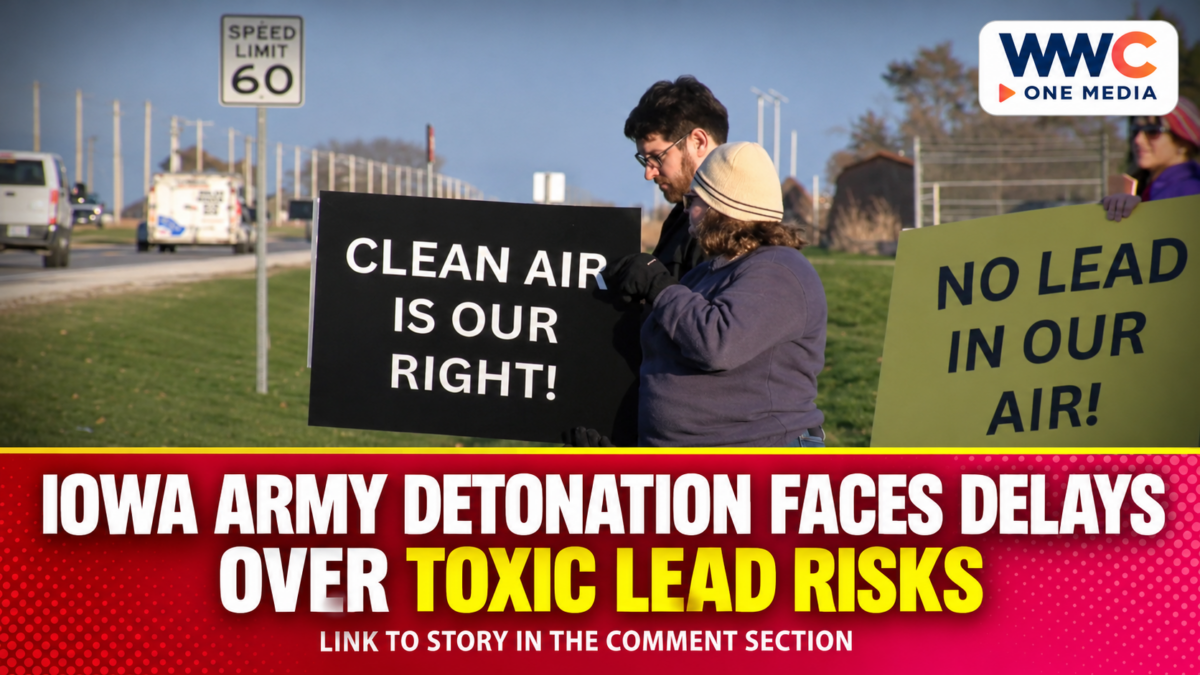
MIDDLETOWN, IOWA — The United States Army’s plan to eliminate deteriorating hazardous materials at the Iowa Army Ammunition Plant has put environmental protection and public safety at the centre of a growing regulatory dispute.
The Iowa Army detonation, originally planned for Nov. 20, 2026, was subsequently postponed, with a Nov. 22 Army announcement identifying Nov. 25 as a revised target date.
At the heart of the controversy is lead azide, a hazardous substance that presents both explosive and toxicological risks.
Federal authorities maintain that a controlled disposal operation offers the safest way to address the deteriorating material. Environmental organisations, however, have challenged the adequacy of the safeguards and the government’s assessment of alternative disposal options.
The dispute highlights a difficult question for military installations and environmental regulators: How can authorities remove dangerous industrial waste without transferring additional risks to surrounding communities?
Iowa Army detonation requires emergency environmental permit
The US Environmental Protection Agency (EPA) issued an emergency permit on Nov. 13, 2026, authorising the Department of the Army to manage and treat hazardous lead azide waste at its Middletown installation.
The emergency authorisation was issued under the Resource Conservation and Recovery Act, which governs hazardous waste management in the United States.
The facility’s existing permit did not cover the particular location where the material was being stored and where the proposed treatment would occur.
The emergency permit was originally issued for a period extending through Feb. 11, 2027.
The regulatory intervention demonstrates that hazardous waste disposal at a military installation requires consideration of environmental obligations alongside operational safety.
Similar questions about waste containment and regulatory accountability have emerged in the Philippines, including the environmental concerns surrounding Cebu’s Binaliw landfill.
Although the circumstances differ, both cases illustrate the importance of ensuring that waste-management decisions adequately protect surrounding communities.
Why the US Army considers the situation dangerous
The Army disclosed that it identified deteriorating lead azide at the installation in March 2026.
Military authorities subsequently examined possible responses before selecting controlled detonation as their preferred disposal method.
The EPA determined that the deteriorating condition of the stored hazardous material presented a serious threat to people and the environment.
The central challenge is that leaving the material in storage does not eliminate its existing dangers, while the proposed disposal operation introduces separate environmental concerns.
Federal agencies have defended their decision-making process and pledged to implement measures intended to protect the public.
However, identifying the preferred disposal option does not remove the need to demonstrate that its environmental consequences can be effectively managed.
Toxic lead exposure extends concerns beyond military property
The potential release of airborne lead has prompted preparations beyond the boundaries of the ammunition plant.
Illinois environmental and public health authorities have requested additional information from their federal counterparts, including updated assessments of potential airborne contamination and details about environmental monitoring.
Officials have identified possible implications for households, agricultural properties and businesses in both Iowa and Illinois.
Lead exposure is particularly concerning for children. The US Centers for Disease Control and Prevention has established that there is no identified safe blood lead level for children.
Exposure can interfere with neurological development, learning and behaviour. Children who have been exposed may not immediately display noticeable symptoms.
These established health risks do not mean that contamination or illness has already occurred because of the proposed Iowa operation.
Rather, they explain why prevention, environmental testing and reliable communication are essential.
The importance of monitoring airborne pollution is also relevant to Philippine communities, as demonstrated by Metro Cebu’s experience with unhealthy air quality during the Indonesian haze episode.
Environmental groups challenge the disposal plan
On Nov. 19, the Iowa Environmental Council and the Sierra Club Iowa Chapter, represented by Earthjustice, announced a legal challenge against the EPA’s emergency authorisation.
The organisations questioned whether the permitting process sufficiently considered alternative treatments and provided adequate protections for affected communities.
Their objections represent the position of the parties challenging the permit and should not be interpreted as a judicial finding that environmental violations have occurred.
The Army and federal environmental regulators have maintained that their selected approach is necessary to address the existing hazard.
The competing positions place considerable importance on the quality of the government’s supporting evidence.
Public confidence will depend not simply on assurances from officials, but also on whether the underlying assessments can withstand scrutiny.
State authorities prepare for environmental monitoring
Iowa Governor Kim Reynolds activated the State Emergency Operations Center on Nov. 20 to strengthen coordination among government agencies.
State health officials began evaluating potential public health consequences and coordinating with federal counterparts.
The Iowa Department of Natural Resources also announced plans to independently assess environmental monitoring information and determine whether further interventions would be necessary.
The EPA’s emergency authorisation included environmental sampling, public notifications, remediation obligations and reporting requirements.
These measures are important because managing the original hazardous material and determining whether surrounding areas require cleanup are separate responsibilities.
The same distinction applies to other environmental incidents, including the Bataan oil spill cleanup and subsequent monitoring operations.
WWC analysis: The Iowa situation demonstrates why environmental oversight should extend beyond the immediate completion of a hazardous waste disposal operation.
Independent testing, transparent reporting and clear remediation responsibilities would provide a stronger basis for evaluating whether the government’s intervention has effectively reduced overall risk.
What happens next
The Army’s disposal proposal remains subject to changing official instructions and regulatory developments. The revised date previously announced by military authorities should not be treated as an unconditional confirmation that the operation will proceed.
Residents should consult current instructions from state health departments and federal authorities rather than relying on superseded schedules or environmental forecasts.
The key issues are whether authorities can resolve the original hazard, adequately prevent public exposure and establish a credible process for assessing any resulting contamination.
The ultimate measure of success will be more than the elimination of deteriorating military waste. It will also be whether surrounding communities receive adequate protection and reliable evidence of environmental safety.
Frequently asked questions
What is the Iowa Army detonation?
It is a proposed US Army operation to dispose of deteriorating lead azide hazardous waste at the Iowa Army Ammunition Plant in Middletown.
Why has the Iowa Army detonation been delayed?
Military authorities have revised the schedule while addressing safety preparations and environmental conditions. The emergency permit has also faced a legal challenge.
Why is lead exposure dangerous?
Lead exposure can harm neurological development and other aspects of health, particularly among young children. Environmental monitoring and exposure prevention are therefore important.
Has lead contamination from the proposed operation been confirmed?
The reviewed environmental assessments concern potential exposure. They do not establish that contamination or illness resulting from the proposed operation has already occurred.