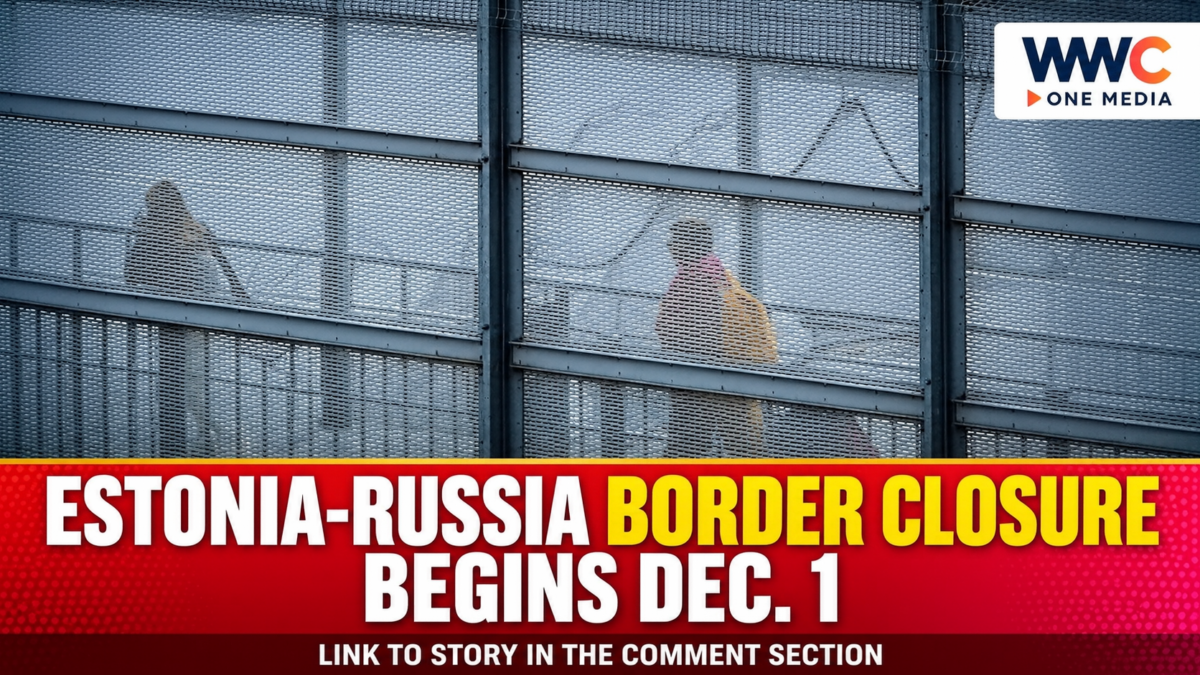
Estonia has approved the suspension of all its road border crossings with Russia beginning Dec. 1, 2026, citing national security concerns and hostile activities that Estonian authorities attribute to Russian intelligence services.
The Estonia-Russia border closure, formally announced on Nov. 20, will restrict the movement of passengers and road vehicles, with the government scheduled to reassess the measure after six months.
The decision marks a significant deterioration in relations between Tallinn and Moscow. However, beyond the geopolitical implications, it presents immediate challenges for families separated by the frontier, transport operators and communities whose livelihoods depend on cross-border activity.
For Estonia, the challenge is protecting national security while managing the economic and humanitarian consequences of restricting international movement.
Estonia-Russia border closure affects five checkpoints
The government identified five road border checkpoints covered by the decision:
- Narva-1
- Narva-2
- Koidula
- Luhamaa
- Saatse
The restriction will apply to passengers and road vehicles travelling in either direction.
The measure does not automatically terminate every commercial connection between Estonia and Russia. Freight operations through the Narva railway crossing will continue under existing restrictions and customs requirements.
This distinction is particularly important for businesses evaluating whether they can maintain legitimate commercial activities despite the suspension of road transport.
Companies should not interpret the continuation of railway operations as permission to transport goods prohibited under existing European sanctions.
National security takes priority
Estonia’s decision follows government assessments of security threats involving its defence industry.
In its Nov. 15 announcement, the Ministry of Foreign Affairs attributed an attempted act of sabotage targeting Estonian defence company Threod Systems to Russian military intelligence.
The attribution represents the Estonian government’s official assessment and should not be confused with a judicial determination of individual criminal responsibility.
Foreign Minister Margus Tsahkna subsequently presented the border suspension as part of Estonia’s broader response to security concerns involving Russia and Europe.
On Nov. 20, Estonia also summoned Russia’s chargé d’affaires and formally communicated the government’s border decision.
Estonia’s response comes amid continuing concerns surrounding regional security, including developments examined in WWC’s earlier coverage of NATO’s response to a drone intrusion in Lithuania.
The border closure is fundamentally a national security measure. It should not, by itself, be interpreted as a declaration of war or evidence that a direct military confrontation is inevitable.
Border communities face an uncertain adjustment
The economic consequences are unlikely to be distributed evenly throughout Estonia.
Government preparations identify Narva, Setomaa, Ida-Viru County and southeastern Estonia as areas particularly exposed to the effects of the closure.
For residents with personal connections across the frontier, the suspension could transform relatively straightforward journeys into complicated international travel arrangements.
People who depend on regular visits to relatives may have to reconsider their schedules, transportation options and household budgets.
The disruption could be especially difficult for elderly travellers, individuals requiring assistance and households with limited financial resources.
A national economic assessment cannot necessarily capture these individual circumstances.
Even if Estonia’s overall economy absorbs the disruption without a major setback, businesses and households near the frontier may experience a considerably more difficult transition.
The distinction between national resilience and local vulnerability will be important when assessing whether additional government assistance becomes necessary.
Transport businesses must reconsider their operations
Road freight operators face a different set of challenges.
Estonian carriers had applied for 5,249 permits for freight transport involving Russia as of Nov. 16, 2026, under figures published in the government’s border closure guidance.
The number represents permit applications rather than a count of individual companies.
Businesses using Russia as a transit corridor to other markets may also need to reorganise their distribution arrangements.
Potential consequences include longer delivery periods, higher operating expenses and difficulties meeting contractual commitments.
These risks are particularly relevant for smaller logistics businesses that may have fewer resources to absorb unexpected transportation costs.
The decision also comes as European institutions consider further restrictions involving Russia. WWC’s coverage of the European Union’s proposed 22nd Russia sanctions package examines another dimension of the changing commercial environment.
For businesses, the practical question is whether alternative transportation arrangements remain commercially viable while satisfying applicable customs and sanctions requirements.
What the closure could mean for European security
Estonia’s decision illustrates how geopolitical tensions can increasingly influence civilian mobility and commercial planning.
Border restrictions represent one available policy response to perceived security vulnerabilities. Diplomatic engagement represents another.
WWC’s earlier examination of Europe’s proposed participation in negotiations involving Russia and Ukraine provides additional context for understanding the diplomatic dimensions of regional security.
From a policy perspective, Estonia’s decision raises a difficult question: how can governments reduce security risks without imposing disproportionate burdens on ordinary residents?
Closing checkpoints may give authorities greater control over certain forms of cross-border activity. However, restrictions alone cannot resolve every underlying security concern.
Their effectiveness will depend on enforcement, coordination with neighbouring governments and the ability of public institutions to respond to emerging challenges.
What happens next
The immediate priority for affected travellers and businesses is preparation before Dec. 1.
Estonian citizens and residents who remain in Russia after the restrictions begin should not assume they will receive automatic exemptions from the closure.
Travellers will need to examine alternative routes, applicable immigration requirements and transportation availability before making arrangements.
Businesses should review delivery commitments, consult their logistics providers and assess whether their operations can continue through permitted transport channels.
The government’s six-month review will provide an opportunity to evaluate whether the restriction should be maintained, modified or discontinued.
Until that assessment takes place, the reopening of the road crossings cannot be guaranteed.
For Estonia’s border communities, the coming months will test whether the country can maintain its security objectives while helping residents and businesses adapt to a substantially different operating environment.