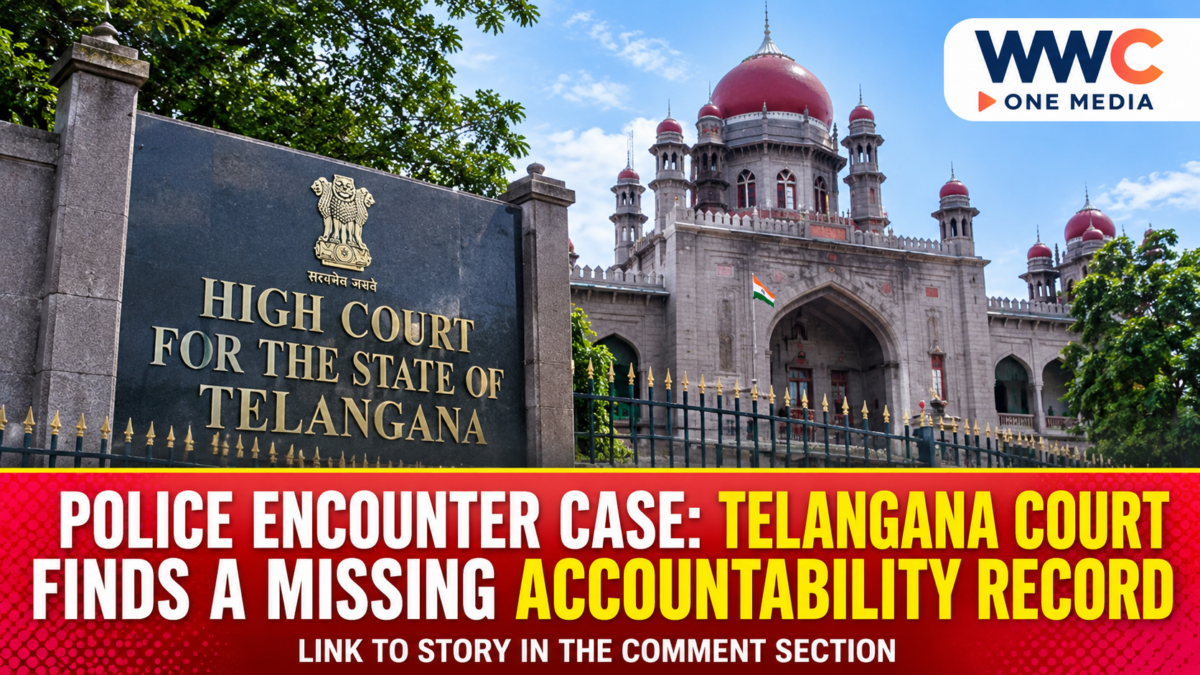
The Telangana High Court on November 13, 2026, directed the State and police authorities to pay ₹2,00,000 to Ponna Venkatamma over the death of her husband, B. Balanarsaiah, in a police firing incident in December 2001. The court partly allowed her long-pending petition, finding that the State had not produced evidence that the required inquiry into the death had been completed or that the police account of self-defence had been properly established.
The decision in Ponna Venkatamma v. Sri Kishen Singh, S.I. of Police, Chegunta Police Station and Others, Writ Petition No. 4377 of 2002, turned on a basic question of public accountability: when a person dies during police action, can the State rely on self-defence without producing the investigation and inquiry records required to examine that claim?
The judgment did not direct a criminal prosecution of the police personnel. It also did not order a fresh investigation, reasoning that the passage of time could make one ineffective. Instead, it granted compensation after concluding that the State had failed to follow the prescribed procedure. Indian Kanoon+1
Police encounter: the competing accounts before the court
The case concerned Balanarsaiah, whom the judgment described as a small farmer from Chetla Thimmayapalli village in the then Medak district. He died on December 11, 2001.
The petition filed by his wife alleged that he was shot by police personnel at a toddy shop on the outskirts of the village. Her account challenged the official explanation of the incident and argued that the authorities had failed to investigate the death in accordance with the applicable human-rights procedures.
The police presented a different version. In their counter-affidavits, they maintained that Balanarsaiah was associated with the Indupriyal local guerrilla squad of the outlawed People’s War Group. They said officers went to the village after receiving information about a meeting and that members of the group fired at the police party. The officers said they returned fire in self-defence.
Those were the parties’ competing positions, not findings that should be treated as interchangeable. The High Court examined the record before it, including the registration of Crime No. 129/2001 and the State’s explanation that a magisterial inquiry had been ordered.
The court noted that the case registered after the incident named alleged People’s War Group members, including Balanarsaiah, as accused. The central procedural concern was that the record did not show that the police personnel involved had been subjected to the independent investigation contemplated by the applicable guidelines. Indian Kanoon+1
Why the missing inquiry report mattered
The State told the court that the District Collector had ordered a magisterial inquiry on November 12, 2002, appointing the Revenue Divisional Officer or Sub-Divisional Magistrate of Medak as inquiry officer.
But the High Court said no material had been placed before it to establish that the inquiry had been completed. The details of any final report were also absent from the record.
That gap mattered because the State relied on self-defence to explain the police firing. The court said such a justification had to be supported by specific and convincing material. Without the required investigation or inquiry findings, the State had not established that the firing was justified on that basis.
The judgment referred to National Human Rights Commission guidelines issued on March 29, 1997. As summarised in the ruling, these called for encounter deaths to be recorded, treated as cognizable offences and investigated by an independent agency, such as the State Crime Investigation Department, rather than by officers from the same police station.
The court also discussed later changes to the guidelines, circulated in December 2003, including requirements for an FIR when a specific complaint was made against police and a magisterial inquiry in every encounter death.
The distinction between the 1997 guidelines and the later revisions is important. The court considered the rules in force when Balanarsaiah died and explained why the State was bound to follow them. It did not treat every later procedural change as though it had already applied in December 2001. Indian Kanoon
Article 21 and the State’s responsibility
The ruling placed the issue within Article 21 of the Indian Constitution, which protects life and personal liberty except according to procedure established by law.
For the court, the issue was not simply whether police officers claimed they had acted in self-defence. That explanation had to be tested through the process required by law. The State could not avoid responsibility by asserting a justification while failing to produce the records needed to support it.
This is a significant distinction in cases involving deaths during law-enforcement operations. An allegation that a person belonged to an armed or prohibited organisation does not, by itself, settle whether the use of force was lawful. Equally, a death during police action does not automatically establish criminal guilt by an individual officer. The circumstances must be examined through a process capable of testing the evidence.
WWC has previously examined the evidentiary standards and investigative safeguards that apply to police encounter deaths in its coverage of India’s police encounter rules and the evidence investigators must establish. A separate report on the records needed to verify an alleged encounter explores the same distinction between an official account and independently examined evidence.
Why the court declined to order a fresh investigation
Although the court found that the required procedure had not been followed, it declined to direct the State to register an FIR and conduct a new investigation through an independent agency.
Its reason was the length of time since the death. The judgment said an investigation undertaken after such a long interval might not produce meaningful results because of the difficulties involved in collecting evidence and establishing the circumstances that existed on the day.
That decision shaped the outcome. The court did not grant every form of relief sought by Venkatamma. It rejected the request for a new criminal investigation while holding that the State’s failure to follow the prescribed process justified compensation.
The petition was therefore partly allowed, not fully granted. The distinction matters: the ruling addressed the State’s procedural failure and compensation liability, but it did not amount to a criminal conviction of the police officer named in the petition. Indian Kanoon
What the ₹2 lakh order means
The High Court directed the respondent police authorities and the State to pay ₹2,00,000 to Venkatamma for the loss of her husband. The payment was ordered within eight weeks from the date a copy of the judgment was received.
The amount is the compensation specified in the court’s order. The judgment does not describe it as a criminal fine or as a substitute for a conviction. Nor does it state that the court had resolved every factual dispute surrounding the 2001 incident.
The decision instead underscores the consequences of failing to document and demonstrate compliance with safeguards governing deaths during police operations. A State explanation of self-defence must be supported by evidence and the procedures required by law.
The issue also connects with broader public debates about the relationship between law enforcement and human-rights oversight. WWC has examined a related accountability question in its coverage of police conduct and the review of protest-related arrests. The legal settings differ, but both illustrate why official action should be assessed against documented procedures rather than assumptions.
What happens next
The immediate requirement set out in the judgment is payment of ₹2,00,000 within eight weeks from receipt of the order’s copy. The judgment states that the writ petition was partly allowed and that there would be no order as to costs.
The public text reviewed for this report does not establish whether the compensation has since been paid. It also does not provide a completed magisterial inquiry report or a final investigative finding about the circumstances of the 2001 death.
Those records would be necessary to answer questions beyond the court’s ruling. Until they are available, the responsible account is the one reflected in the judgment: the State’s self-defence explanation was not supported by the required inquiry material, compensation was ordered, and a fresh FIR and investigation were not directed.
Frequently asked questions
1. What did the Telangana High Court order?
It directed the State and police authorities to pay ₹2,00,000 to Ponna Venkatamma for the death of her husband, B. Balanarsaiah.
2. When did the High Court issue its decision?
Justice Suddala Chalapathi Rao pronounced the judgment on November 13, 2026, in Writ Petition No. 4377 of 2002.
3. Did the court order a criminal case against the police officer?
No. The court declined to direct registration of an FIR and a fresh investigation, citing the long period since the 2001 incident and the difficulties of investigating it after so much time.
4. Why did the court award compensation?
It found that the State had not followed the applicable National Human Rights Commission procedures and had not produced material establishing that the claimed magisterial inquiry had been completed or that the self-defence explanation was supported.
5. Does the compensation order mean the officer was criminally convicted?
No. The judgment ordered compensation in the writ petition. It did not record a criminal conviction of the officer.