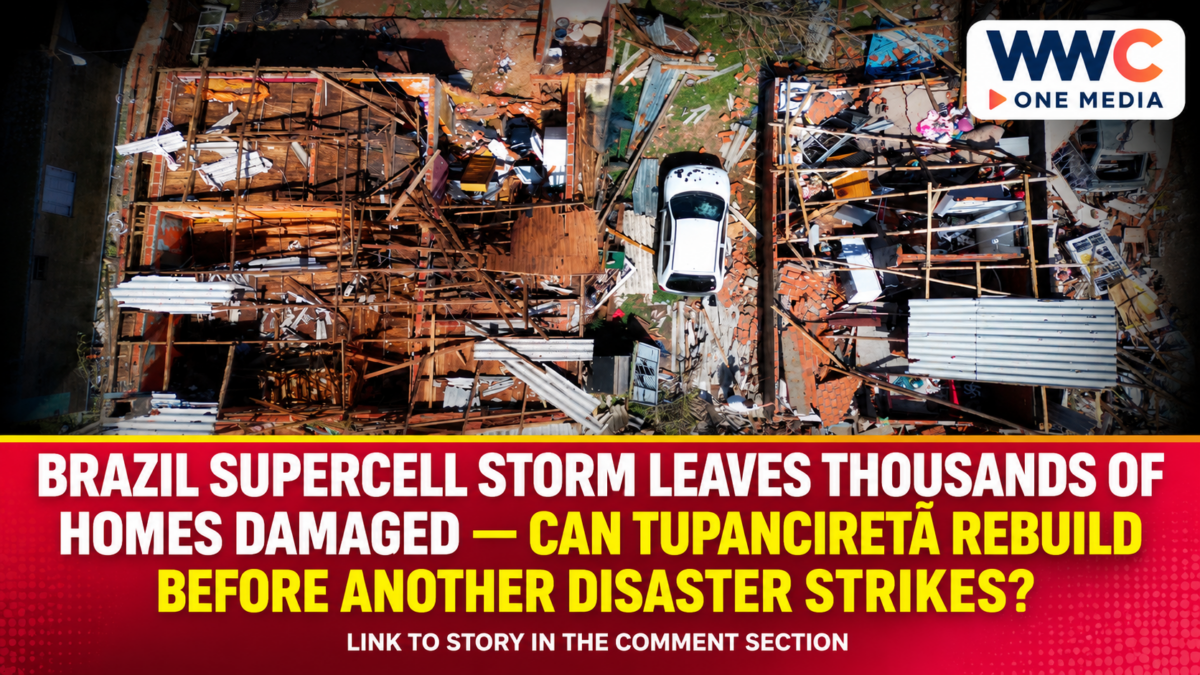
RIO GRANDE DO SUL, Brazil — Nov. 24, 2026 — Brazil has approved R$4.7 million in humanitarian assistance for Tupanciretã after a powerful supercell storm struck the southern municipality on Nov. 20, damaging thousands of homes and disrupting essential public services.
The Brazil supercell storm has also exposed the extent of the municipality’s agricultural vulnerability, with a preliminary assessment released on Nov. 23 indicating significant crop losses and damage to rural livelihoods.
The disaster has moved beyond an immediate humanitarian emergency. Authorities must now address the simultaneous challenges of restoring public infrastructure, rebuilding residential properties and helping agricultural producers resume economic activity.
Brazil supercell storm prompts emergency declarations
The severe weather struck Tupanciretã in the early hours of Nov. 20, bringing destructive winds, heavy rainfall and hail.
A monitoring station operated by Brazil’s National Institute of Meteorology recorded wind gusts reaching 114 kilometres per hour. State civil defence authorities identified a supercell as the weather system associated with the destructive winds.
The municipal government declared a state of public calamity through Decree No. 7,994, dated Nov. 20, 2026.
The declaration covers the municipality’s entire territory and establishes an initial validity period of 180 days, subject to a possible extension under applicable legislation.
It also allows municipal departments to mobilise resources, organise volunteers and undertake emergency procurement to support recovery.
Brazil’s federal government formally recognised the calamity on Nov. 21, allowing national authorities to advance assistance plans in coordination with the state and municipal administrations.
The response highlights the importance of pre-disaster planning by local governments, particularly when severe weather threatens communities and their essential infrastructure.
Thousands of homes damaged as infrastructure comes under pressure
The scale of residential damage has become one of the most significant obstacles to Tupanciretã’s recovery.
An initial state civil defence assessment on Nov. 20 identified approximately 5,000 homes with roof damage.
A subsequent federal government announcement, published on Nov. 21, cited a municipal estimate indicating that around 8,000 of the city’s 8,600 homes had sustained roof damage or been brought down by the storm.
The figures represent assessments made at different stages of the emergency rather than separate totals that should be combined.
Beyond residential damage, the storm affected electricity distribution, telecommunications and public infrastructure. Trees fell across the municipality, obstructing roads and complicating emergency operations.
The integrated disaster management authorities subsequently confirmed that water services had been restored. However, debris clearance remained a priority, with unstable structures presenting additional risks to recovery personnel.
Restoring water and electricity is particularly important because these services support virtually every other aspect of recovery, from healthcare delivery to business operations.
The situation also illustrates the broader reconstruction challenges explored in WWC’s coverage of Cebu City’s disaster recovery and flood preparedness.
Brazil approves R$4.7 million in humanitarian assistance
On Nov. 22, Brazil’s Ministry of Integration and Regional Development authorised the municipality’s initial humanitarian assistance plan worth R$4.7 million.
The funding covers essential household supplies, temporary sleeping arrangements and the transportation requirements associated with distributing assistance.
Additional plans involving roofing materials and municipal clean-up operations were still being developed when the ministry announced the initial approval.
The state government has separately established a new edition of its Volta por Cima assistance programme for affected residents.
Eligible families may receive a one-time payment of R$2,500, provided they meet the programme’s residence, income, social registration and housing-damage requirements.
The assistance is designed to reach economically vulnerable households whose residences were directly damaged by the disaster.
These measures address immediate financial needs, but their announcement does not establish that every eligible household has already received assistance.
Nor does the initial federal funding represent the final cost of rebuilding the municipality.
Agricultural losses threaten rural livelihoods
The economic consequences became clearer on Nov. 23 when the Rio Grande do Sul government released preliminary findings from agricultural extension specialists.
The assessment identified approximately 440 affected rural families and around 35,000 hectares of impacted land, equivalent to roughly 15% of the municipality’s territory.
The preliminary findings indicated losses of approximately 95% in soybean planting, while 80 hectares of oats that were ready for harvesting suffered complete losses.
Damage also extended beyond grain production.
Commercial vegetable and fruit producers sustained damage to productive facilities, while households engaged in subsistence farming and animal production were also affected.
Four agricultural processing businesses experienced structural damage and losses involving stored products following electricity disruptions.
Economic analysis: The agricultural impact could prolong the recovery well beyond the completion of emergency residential repairs.
Farmers facing damaged crops and production facilities may need additional working capital to resume operations. Agricultural businesses could also face interruptions in processing, storage and distribution.
However, the preliminary municipal findings should not be interpreted as evidence of a nationwide Brazilian soybean shortage or a confirmed increase in international commodity prices.
What the disaster means for vulnerable communities
Tupanciretã’s experience demonstrates why disaster resilience requires more than emergency relief funding.
Weather monitoring, reliable communications, resilient public infrastructure and coordinated local government responses must work together to reduce the consequences of destructive weather.
For countries such as the Philippines, the experience offers a relevant comparison concerning preparedness and recovery, even though local thunderstorms and tropical cyclones are different meteorological phenomena.
WWC previously examined Japan’s disaster-warning cooperation with the Philippines and Asia, highlighting the importance of connecting weather information with practical community protection measures.
Disaster resilience must also account for livelihoods. Rebuilding a household’s residence may provide immediate security, but restoring its income-generating activities is essential to longer-term financial recovery.
What happens next
Authorities face the continuing task of removing debris, evaluating unsafe buildings, distributing humanitarian assistance and determining the full extent of reconstruction requirements.
Agricultural assessments will also help establish what additional support rural producers may require.
The R$4.7 million humanitarian package represents an important initial intervention. The larger economic challenge will be restoring the municipality’s productive capacity while rebuilding infrastructure and protecting vulnerable residents.
For Tupanciretã, recovery will ultimately be measured not simply by how much funding is announced, but by how effectively families regain safe housing, dependable services and sustainable livelihoods.
Frequently asked questions
When did the Brazil supercell storm occur?
The destructive storm struck Tupanciretã in Rio Grande do Sul during the early hours of Nov. 20, 2026.
How much humanitarian assistance has Brazil approved?
The federal government approved an initial humanitarian assistance plan worth R$4.7 million on Nov. 22.
How many homes were affected?
A municipal estimate communicated by federal authorities on Nov. 21 indicated that approximately 8,000 of the city’s 8,600 homes experienced roof damage or collapse.
How did the storm affect agriculture?
A preliminary Nov. 23 assessment identified approximately 35,000 hectares of affected land, around 440 impacted rural families and extensive soybean planting losses.