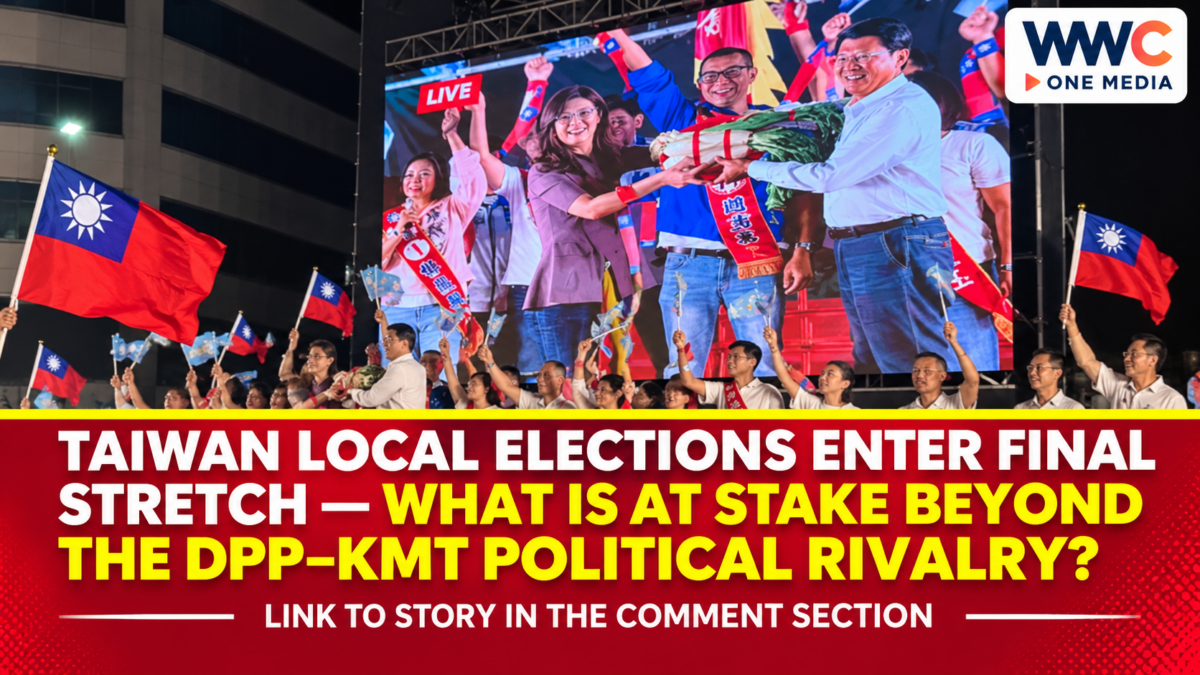
Taiwan local elections are entering their final campaign stretch ahead of Saturday’s Nov. 28 vote, with political parties intensifying their efforts across municipalities and counties. The Democratic Progressive Party (DPP) and the Kuomintang (KMT) have outlined campaign activities, while the central government has instructed relevant agencies to strengthen election preparations and security arrangements.
Beyond the competition between political parties, the elections carry important implications for municipal administration, infrastructure development and the delivery of public services.
For households and businesses, the economic significance of the vote will ultimately depend on how elected officials translate campaign commitments into practical local government policies.
Taiwan Local Elections: What Voters Will Decide
The Central Election Commission’s formal election announcement establishes Nov. 28, 2026, as polling day, with voting scheduled from 8 a.m. until 4 p.m.
The elections cover several levels of local government, including mayors, county magistrates and local council representatives.
Six special municipalities will elect mayors: Taipei, New Taipei, Taoyuan, Taichung, Tainan and Kaohsiung.
The commission’s Nov. 12 briefing also identified 18,248 polling stations for the local elections and accompanying national referendum.
The different offices involved mean that the election results should not be interpreted solely through the performance of individual mayoral candidates.
Local government leadership and council representation can have separate implications for policy implementation, expenditure approval and administrative oversight.
A successful mayoral campaign may establish an executive mandate, but implementing substantial development programmes can also require cooperation across government institutions.
DPP Coordinates Campaign Activities Across Municipalities
The DPP announced on Nov. 16 that it was coordinating campaign activities involving candidates from different cities during the closing stages of the election period.
Its announcement introduced joint campaign material featuring Taipei mayoral candidate Puma Shen and New Taipei mayoral candidate Su Chiao-hui.
The party also outlined a coordinated campaign initiative beginning Nov. 20, followed by plans for at least 14 campaign events across Taiwan during the Nov. 21–22 weekend.
President William Lai, Vice President Hsiao Bi-khim, former president Tsai Ing-wen and Premier Cho Jung-tai were identified among senior figures expected to participate in campaign activities.
The announcement establishes the party’s intended programme but does not independently establish attendance figures or the completion of every scheduled event.
The Taipei contest has previously featured discussions about candidate accountability and public policy presentations, as examined in WWC’s coverage of the proposed mayoral debate between Chiang Wan-an and Puma Shen.
Campaign coordination can help political parties communicate common priorities. However, its electoral effectiveness cannot be determined until votes are counted.
KMT Highlights Local Development and Public Policy
The KMT has also maintained campaign activities during the final stages of the election period.
Its official campaign archive records a Nov. 22 livestream programme in Jhubei, Hsinchu County, involving legislator Yeh Yuan-chih and local candidates.
In a separate Nov. 22 campaign statement concerning Yilan County, KMT Chairwoman Cheng Li-wun discussed energy policy, agricultural land use and local economic opportunities.
These statements establish the subjects emphasised by the party, rather than independently validating every assertion made during its campaign.
Southern Taiwan also remains relevant to the wider competition for municipal leadership.
WWC’s earlier coverage of the Kaohsiung mayoral contest between Ko Chih-en and Lai Jui-lung provides additional context for understanding the relationship between campaign mobilisation and proposed municipal development.
Neither the scale of campaign events nor the prominence of participating political figures guarantees a particular electoral outcome.
Why Municipal Elections Matter to Taiwan’s Economy
Local government decisions can influence the commercial environment experienced by households, property developers, manufacturers and service-sector businesses.
Transportation investment, for example, could improve access to workplaces and commercial districts if projects are properly designed and implemented.
However, major infrastructure programmes also require financing, procurement arrangements and long-term maintenance.
The economic value of such projects depends on their ability to deliver practical benefits relative to their total cost.
These considerations are relevant to the policy discussions examined in WWC’s coverage of Ho Hsin-chun’s Taichung campaign and its transportation and industrial development proposals.
A proposed transport system may attract considerable public attention, but its commercial benefits will depend on whether funding, construction and operations can be delivered successfully.
Election Authorities Prepare for Security Risks
At the Nov. 12 Cabinet meeting, Premier Cho received briefings concerning election administration and preparations from the Central Election Commission and relevant government ministries.
The premier instructed agencies to improve operational coordination and prepare for possible disruptions.
He also identified potential risks involving external funding, digitally manipulated content and misleading information.
These instructions establish the government’s precautionary position. They do not independently establish that any particular candidate, political organisation or foreign entity has committed an election offence.
For businesses and media organisations, the broader relevance concerns the reliability of information circulated during politically sensitive periods.
Unverified allegations and misleading digital material could complicate assessments of public policy or political developments.
The appropriate response is to distinguish official election records, campaign statements and independently established evidence.
What Happens Next?
Voting is scheduled for Nov. 28, with the national referendum taking place on the same day.
The election results will establish the distribution of local government leadership and representation, while subsequent budget decisions and administrative programmes will provide a clearer indication of policy implementation.
For Philippine observers, Taiwan’s election offers a regional comparison of how local political competition intersects with infrastructure, economic development and public administration.
The results will not constitute a presidential election or automatically establish a change in Taiwan’s national government.
The immediate priority is the orderly completion of the electoral process, followed by an evidence-based assessment of what the elected officials intend to implement.
Frequently Asked Questions
When are Taiwan’s 2026 local elections?
Voting is scheduled for Saturday, Nov. 28, 2026, from 8 a.m. to 4 p.m., Taiwan local time.
Which major municipalities are electing mayors?
Taipei, New Taipei, Taoyuan, Taichung, Tainan and Kaohsiung will elect mayors.
Is Taiwan electing a new president?
No. The November elections concern local government positions, alongside a separate national referendum.
How many polling stations will operate?
The Central Election Commission’s Nov. 12 briefing identifies 18,248 polling stations.
Why do Taiwan’s municipal elections matter to businesses?
Local government decisions concerning infrastructure, public expenditure, development planning and service delivery could influence commercial operating conditions.