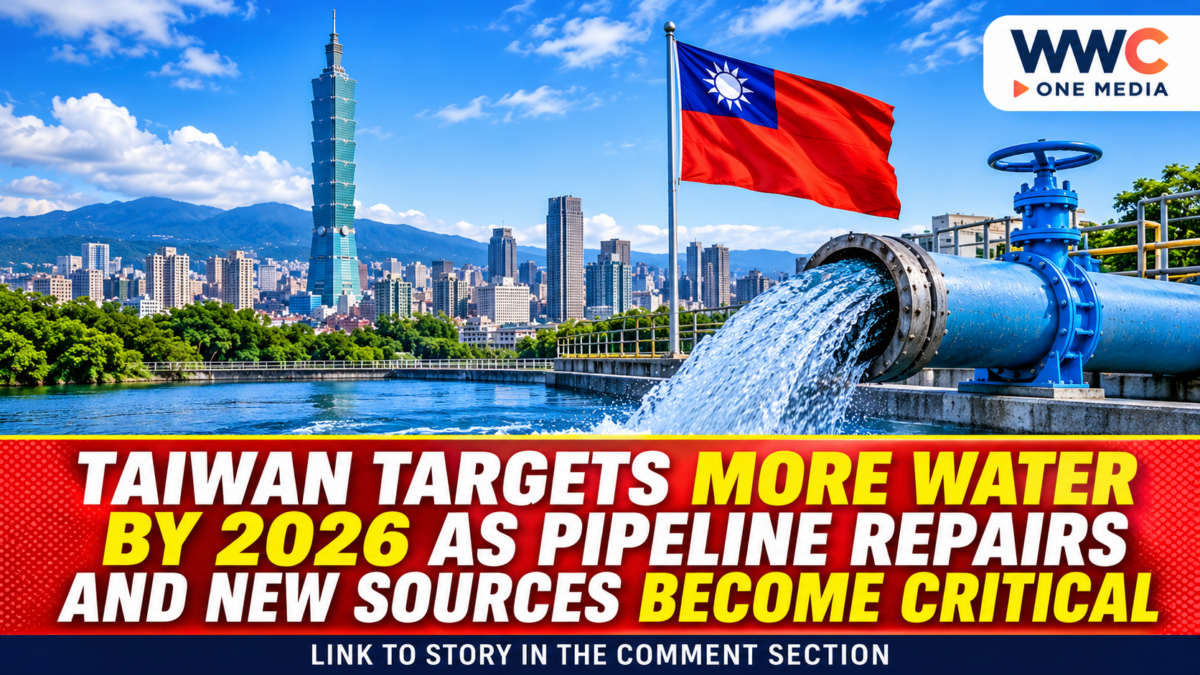
Taiwan is pursuing a broader water-security programme that combines new supply sources, regional transfer pipelines, reservoir maintenance and efforts to reduce distribution losses. A Ministry of Economic Affairs administrative report dated March 25, 2026, set a target of increasing water supply by 540,000 metric tons per day in 2026, following a reported increase of 263,700 tons per day in 2025.
The programme matters beyond household consumption. Taiwan’s manufacturing sector, including its high-tech industrial base, depends on a reliable water network, while uneven rainfall and drought exposure make it difficult to rely on reservoirs and rivers alone. The government’s strategy therefore places attention not only on finding additional water, but also on moving, treating and retaining more of what is already available.
Taiwan water security is becoming an infrastructure challenge
The Water Resources Agency has organised its response around five approaches: expanding resources, conserving water, allocating supplies between regions, maintaining backup sources and improving management.
That framework recognises a practical problem. Water may be available in one part of the island while another area faces tighter conditions. Taiwan’s official water-management plan describes the need to strengthen connections between supply regions because rainfall is unevenly distributed across the country.
The government has been developing a Western Corridor water-supply network to improve transfers between northern, central and southern Taiwan. Existing and planned connections are intended to give utilities more flexibility when a particular reservoir or river system cannot meet local demand.
This is important for industrial areas as well as cities. A factory cannot easily compensate for an unreliable municipal supply simply by conserving water within its own premises. Regional connections can provide another route for water to reach places where demand is concentrated.
Reclaimed water gives industry another source
One of the most significant elements of the programme is the expansion of reclaimed water. This is treated wastewater that can be supplied for approved uses, including industrial operations, instead of relying entirely on freshwater sources.
The Water Resources Agency says the Executive Yuan has approved the promotion of 19 reclaimed-water plants. The facilities are expected to add 628,100 tons of daily supply when completed.
The agency describes reclaimed water as a relatively stable source because much of it originates from domestic wastewater. Unlike rainfall-dependent sources, wastewater generation can continue through dry periods, although actual output depends on treatment capacity, operating conditions and demand.
For industrial users, this can help separate some production requirements from competition with households and agriculture for conventional freshwater supplies. It does not mean every industrial process can use reclaimed water without additional treatment or infrastructure. Quality requirements and delivery networks still matter.
The industrial dimension is also relevant to the wider debate over technology investment. WWC has previously examined the water requirements attached to proposed industrial development in the Philippines. The broader lesson is that investment plans need to be considered alongside the resources required to operate them.
Desalination can reduce dependence on rainfall, but it has costs
Taiwan is also expanding seawater desalination, a process that removes salts from seawater to produce freshwater.
The Water Resources Agency’s planning information identifies 25 completed and operational desalination plants across Taiwan, with a combined production capacity of about 45,000 tons per day. Most are located on offshore islands, where water availability is more limited.
Two larger projects are planned for the main island. The Hsinchu and Tainan Phase I plants were approved by the Executive Yuan on April 27, 2023, each with a planned capacity of 100,000 tons per day. The agency’s published schedule places the start of water production in 2028 for Hsinchu and 2029 for Tainan.
Desalination offers an advantage because it does not depend on rainfall. However, it also requires energy, specialised facilities and pipelines to deliver treated water. The government’s own planning describes different operating approaches for wet and dry seasons, including lower base-load production during wetter periods and increased output during dry conditions.
That makes desalination a reserve and diversification measure, rather than a simple replacement for reservoirs, rivers or conservation.
Leakage reduction may be as important as new supply
A water system can lose a substantial share of treated water before it reaches customers. Leaks, ageing pipes and weaknesses in distribution networks can reduce the effective supply even when treatment plants produce enough water.
The Ministry of Economic Affairs’ March 2026 administrative report listed a leakage rate of 11.19% as part of its water-management measures. It also outlined pipeline replacement and leakage detection as continuing priorities.
The Water Resources Agency says it uses data analysis to identify high-leakage areas and combines active leak reduction with operation and maintenance. This is a practical approach: detecting a leak earlier can reduce the amount of treated water lost and help utilities prioritise repairs.
For consumers and businesses, the value of such work is less visible than a new reservoir or desalination plant. Yet reducing losses can improve the amount of usable water delivered through infrastructure that already exists.
The issue has parallels elsewhere in the region. WWC’s coverage of Cebu’s preparations for possible water rationing and water-system modernisation in the Freeport Area of Bataan illustrates why supply planning and distribution efficiency are connected challenges.
Reservoir maintenance remains part of the equation
Diversification does not remove the need to maintain traditional water infrastructure. Reservoirs remain important, but sediment accumulation can reduce their effective storage capacity over time.
Taiwan’s open-government reservoir dataset records information such as inflows, water use, end-of-year storage, water losses and sedimentation changes. The dataset is updated annually and provides a basis for monitoring reservoir operations and capacity.
The Ministry of Economic Affairs’ 2026 report set out a target of approximately 20.06 million cubic metres of reservoir dredging annually. It specifically identified Shihmen, Zengwen, Baihe and Mingde reservoirs for continued dredging work.
Dredging cannot solve every water-supply problem. Its usefulness depends on reservoir conditions, sediment volumes, cost and the ability to maintain the facility over time. But it is one part of protecting existing storage capacity while other sources are developed.
What happens next
The next test is delivery. Taiwan’s 2026 target of adding 540,000 tons of daily supply is a government objective, not proof that every planned project has already been completed or is operating at full capacity.
The larger reclaimed-water and desalination projects have construction and commissioning schedules extending beyond 2026. The impact of regional pipelines and leakage-reduction work will also depend on completion, operating performance and how effectively utilities coordinate supply between areas.
For businesses, the key indicators will include actual additional water delivered, the share of industrial demand met by reclaimed water, the performance of transfer pipelines and whether leakage continues to decline. For households, reliability and the ability to maintain normal supply during dry periods will remain central measures.
Taiwan’s approach shows that water resilience is not built through one large project. It depends on the performance of an entire system: reservoirs, pipes, treatment facilities, alternative sources and the institutions responsible for managing them.
Frequently asked questions
What is Taiwan doing to improve water security?
Taiwan is expanding alternative water sources, strengthening regional transfer pipelines, maintaining reservoirs and reducing water losses from distribution networks.
How much additional water does Taiwan target for 2026?
The Ministry of Economic Affairs’ March 2026 administrative report sets a target of increasing supply by 540,000 metric tons per day in 2026.
How much water could Taiwan’s reclaimed-water plants provide?
The Water Resources Agency says 19 approved reclaimed-water plants are expected to provide a combined 628,100 tons per day when completed.
When will the new Hsinchu and Tainan desalination plants begin producing water?
The Water Resources Agency’s published schedule gives 2028 for the Hsinchu project and 2029 for the Tainan Phase I project.
Why is pipeline leakage important?
Water lost through leaks reduces the amount of treated water available to households and businesses. Repairing pipes and detecting leaks can improve effective supply without relying only on new water sources.