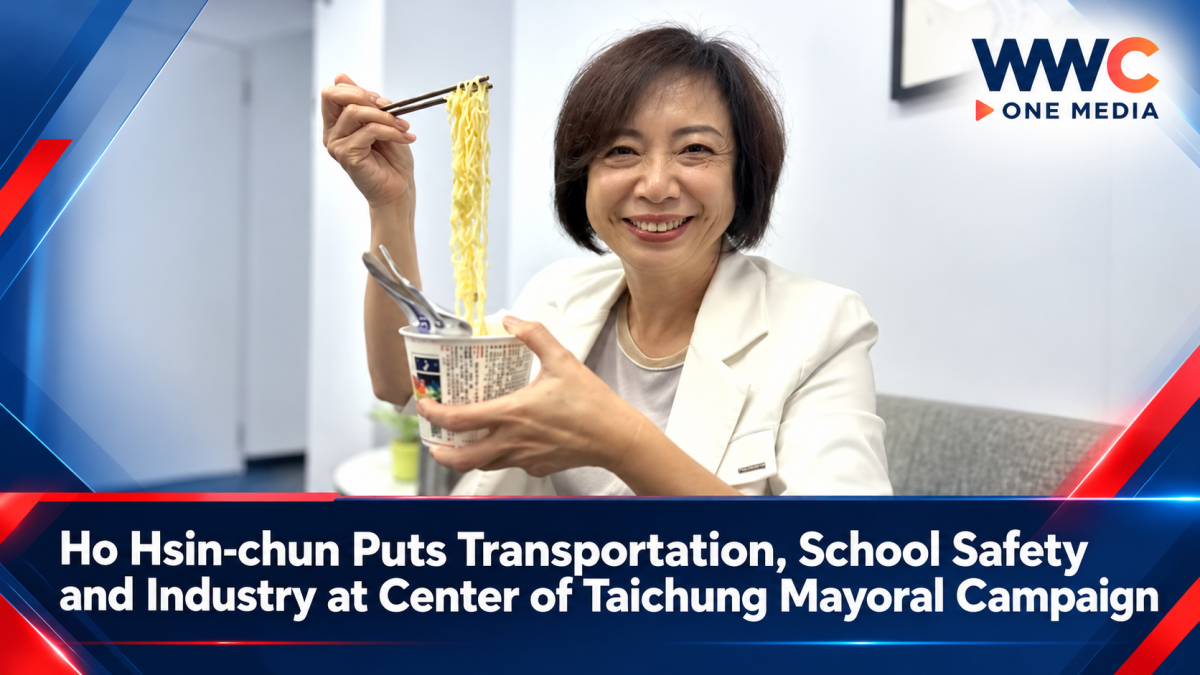
Democratic Progressive Party (DPP) Taichung mayoral candidate Ho Hsin-chun is placing transportation, school safety, economic development and support for Taichung’s industrial base at the center of her campaign ahead of Taiwan’s 2026 local elections.
Ho, a longtime Taichung legislator, is challenging Kuomintang (KMT) candidate Johnny Chiang, Taiwan’s deputy legislative speaker, in the November mayoral election. The contest is taking shape around competing proposals for the city’s transportation network, urban development and industrial growth.
Transportation emerges as a major campaign issue
Ho has made Taichung’s transportation system one of her principal campaign themes. She has criticized the city government over the pace of MRT expansion and argued that shortcomings involving public buses, parking and connectivity could affect both residents’ daily lives and the city’s economic development.
Her transportation platform includes efforts to strengthen public transit and improve connections between different parts of Taichung.
The MRT issue has also become a prominent point of political debate. CNA reported in August that the DPP’s campaign platform emphasized an integrated public transportation network, while President and DPP Chairman Lai Ching-te criticized delays involving the Taichung MRT Blue Line. The city government has defended its approach to the project.
School safety and food traceability
Education and public safety are another part of Ho’s platform.
According to Taiwan News, Ho has proposed additional funding for school security personnel and improvements to traffic conditions around school zones. Her stated goal is to improve safety for students traveling between home and school.
She has also advocated stronger food traceability measures, linking the proposal to consumer confidence and public health.
Industrial development and the Taichung exhibition center
Ho is also seeking to connect Taichung’s industrial strength with broader local economic development.
She has argued that the Taichung International Exhibition Center should generate benefits beyond hosting exhibitions and attracting investors. Her proposal includes improving surrounding infrastructure such as parking, restaurants and hotels so that visitors attending business events can also contribute to nearby commercial activity.
The emphasis reflects Taichung’s role as one of Taiwan’s major manufacturing centers, with advanced manufacturing and emerging technologies increasingly forming part of the city’s economic policy debate.
Drones become another campaign battleground
The city’s potential role in Taiwan’s drone industry has also emerged as a point of difference between the candidates.
Ho has criticized Chiang over the KMT’s approach to financing drone-industry development. She has argued that a special budget would provide more sustained investment for the sector, while saying that the DPP has a broader strategy for drones and advanced manufacturing.
The issue has significance beyond local economic policy because Taiwan has been placing greater emphasis on unmanned systems and related industries as part of its broader technology and security strategy.
A contest shaped by different visions for Taichung
Chiang has meanwhile promoted his own development agenda, including a proposed “20-minute living circle” aimed at improving access to transportation, education, healthcare, shopping and other services. UDN reported that Chiang has also highlighted railway improvements and an expanded transportation hub in Wuri.
CNA reported on September 20 that Chiang was campaigning in Xitun and emphasizing continuity with the administration of incumbent Mayor Lu Shiow-yen, while Ho was promoting her “Six-Star Governance” platform through local campaign activities.
The two candidates have also been increasing their presence in neighborhoods and traditional markets as the campaign moves toward the November election.
Ho’s political career stretches back more than two decades. Taiwan News reported that she entered Taichung County politics after an unsuccessful independent campaign and was later elected as a county councilor in 2002. She subsequently became a legislator representing Taichung.
The Taichung race therefore goes beyond a contest between two individual candidates: transportation, urban infrastructure, industrial policy, school safety and the city’s future economic direction are becoming central issues for voters as the November election approaches.
WWC ONE MEDIA G,A