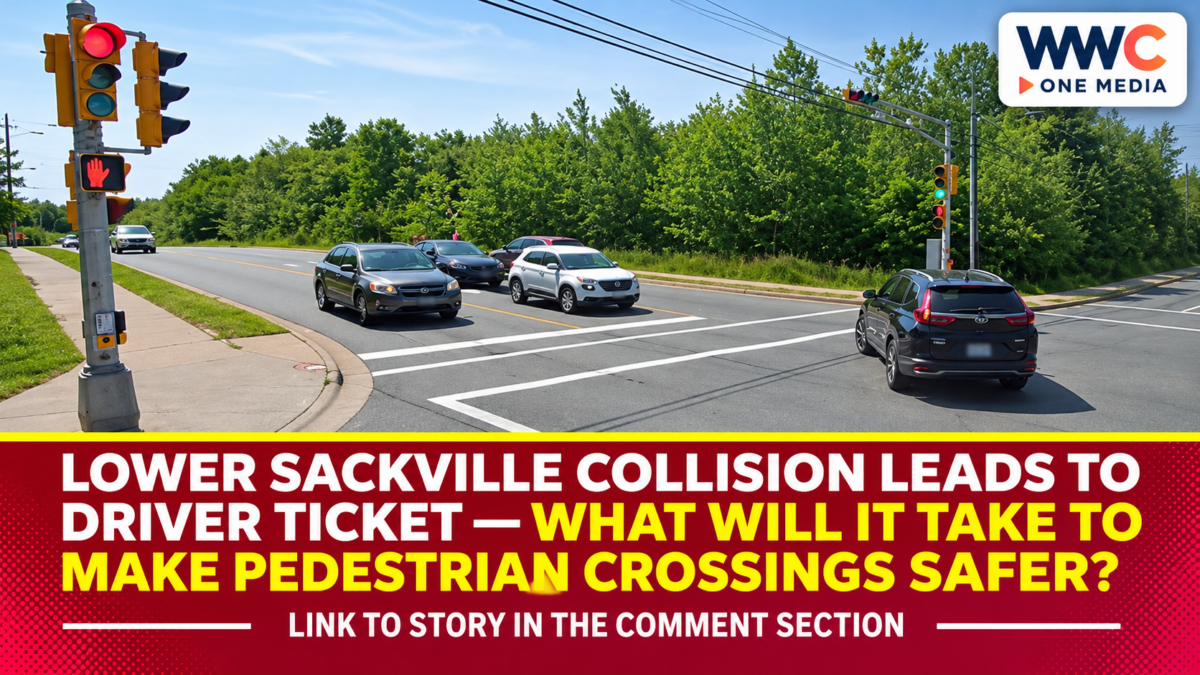
LOWER SACKVILLE, Canada — The Royal Canadian Mounted Police (RCMP) confirmed in a Nov. 23, 2026, public news listing that a driver was issued a traffic ticket following a vehicle–pedestrian collision in Lower Sackville, Nova Scotia.
The Lower Sackville collision draws attention to pedestrian protection and the continuing challenge of reducing traffic-related injuries in Canadian communities.
While the police announcement establishes that enforcement action was taken, the complete circumstances of the collision require further confirmation through the original incident report.
The case also provides an opportunity to examine Halifax’s existing road-safety strategy and Canada’s broader efforts to protect vulnerable road users.
Lower Sackville Collision Highlights Pedestrian Safety
The Halifax Regional Detachment’s public news listing identifies the incident as a collision involving a motor vehicle and a pedestrian.
The listing confirms that a driver received a ticket but does not provide sufficient information to establish the precise traffic violation, the complete sequence of events or the medical condition of those involved.
These distinctions are important because an enforcement action does not necessarily establish every factor that contributed to a collision.
A traffic incident may involve several considerations, including vehicle movement, visibility, intersection design and compliance with applicable traffic regulations.
The circumstances of the Lower Sackville case should be assessed through the complete police record rather than assumptions based on incomplete information.
WWC’s earlier coverage of a road collision involving a dirt-bike rider in Surrey, British Columbia examines similar questions surrounding the evidence required to establish responsibility.
Halifax Has a Long-Term Road Safety Target
The Halifax Regional Municipality’s Road Safety Strategy 2024 establishes a long-term vision of eliminating traffic-related deaths and serious injuries by 2038.
The strategy incorporates the Vision Zero and Safe System approaches, which emphasise prevention through coordinated improvements in road design, traffic management, education and enforcement.
Its objective is to maintain a declining rate of fatal and serious-injury collisions relative to the municipality’s population.
Rather than relying exclusively on individual road users to prevent collisions, the approach recognises the importance of creating transportation systems that provide multiple layers of protection.
For pedestrians, this could involve better crossing facilities, improved visibility and road designs that encourage safer vehicle movements.
For motorists, effective infrastructure can make traffic expectations clearer and provide additional opportunities to recognise potential hazards.
The existence of the strategy does not establish that the location involved in the Lower Sackville incident was inadequately designed.
Determining whether infrastructure improvements are warranted would require an assessment of the specific location and its collision history.
Canada’s Road Collision Statistics Reveal a Wider Challenge
Transport Canada’s national collision statistics recorded 2,050 motor vehicle-related deaths in 2024, representing a 2.5% increase from the previous year.
The national number of serious injuries reached 9,357, while total recorded injuries increased to 130,551.
Pedestrians accounted for 16.3% of traffic-related deaths and 15% of serious injuries during the reporting year.
These figures cover reportable motor vehicle collisions across Canada and should not be interpreted as statistics specific to Lower Sackville.
Nevertheless, they demonstrate why pedestrian protection remains an important component of national transportation policy.
The economic and social consequences of traffic injuries can extend beyond the immediate incident. Injured individuals may require medical treatment, rehabilitation or time away from employment, while families may face additional responsibilities and expenses.
From a public-policy perspective, preventing collisions could reduce these burdens while improving confidence in walking as an everyday mode of transportation.
Why Crosswalk Infrastructure and Enforcement Matter
Halifax’s road-safety strategy identifies improved pedestrian crossings, lighting, sidewalks and other infrastructure as potential measures for protecting vulnerable road users.
The municipality also identifies the importance of collecting and analysing collision information to determine where safety improvements should receive priority.
This evidence-based approach could help authorities distinguish locations with recurring safety concerns from those experiencing isolated incidents.
A marked crossing, for example, may benefit from additional improvements when evidence identifies visibility problems or recurring conflicts between pedestrians and turning vehicles.
However, each location should be assessed according to its particular conditions.
WWC’s examination of pedestrian-safety infrastructure and traffic management in Winnipeg provides another example of why road conditions and official collision findings should be considered separately before conclusions are reached.
Infrastructure improvements and traffic enforcement can complement one another. Neither should be regarded as a complete substitute for the other.
Protecting Families Requires Responsible Road Use
The broader lesson from pedestrian-related incidents is that road users should remain attentive whenever their movements could conflict with others.
Drivers approaching intersections should allow sufficient time to observe pedestrians and comply with applicable right-of-way requirements.
People travelling on foot should use designated crossing facilities where available and remain aware of surrounding traffic.
These general safety considerations should not be interpreted as suggestions that any pedestrian involved in the Lower Sackville incident contributed to the collision.
Establishing individual responsibility requires reliable evidence.
WWC’s previous examination of pedestrian collision reporting and official verification in Christchurch also highlights the importance of separating confirmed police findings from speculation about the individuals involved.
Responsible public discussion should protect the privacy of affected people, particularly children, and avoid circulating unsupported claims about their medical condition or personal circumstances.
What Happens Next?
Further details about the Lower Sackville collision will depend on the availability of the complete police statement and any subsequent official updates.
The public news listing establishes that a ticket was issued, but it does not establish whether the matter has been resolved through payment, a challenge to the ticket or another legal process.
Any additional reporting should distinguish the original enforcement action from a subsequent legal determination.
For the Halifax Regional Municipality, the wider challenge remains implementing its long-term road-safety strategy and evaluating whether infrastructure and enforcement measures are reducing injuries.
The ultimate objective should be to create streets where families can travel safely, motorists understand their responsibilities and vulnerable road users receive appropriate protection.
Frequently Asked Questions
Where did the Lower Sackville collision happen?
The RCMP’s public news listing identifies Lower Sackville, Nova Scotia, Canada, as the location.
Did police issue a ticket following the collision?
Yes. The Halifax Regional Detachment confirmed that a driver received a ticket in connection with the incident.
When did police announce the enforcement action?
The official RCMP news listing dates the announcement Nov. 23, 2026.
What is Halifax’s long-term road-safety objective?
The municipality’s Road Safety Strategy establishes a vision of eliminating traffic-related deaths and serious injuries by 2038.
Have all details of the collision been independently verified?
No. The complete original police statement was unavailable for direct inspection, leaving several incident-specific details unconfirmed.