
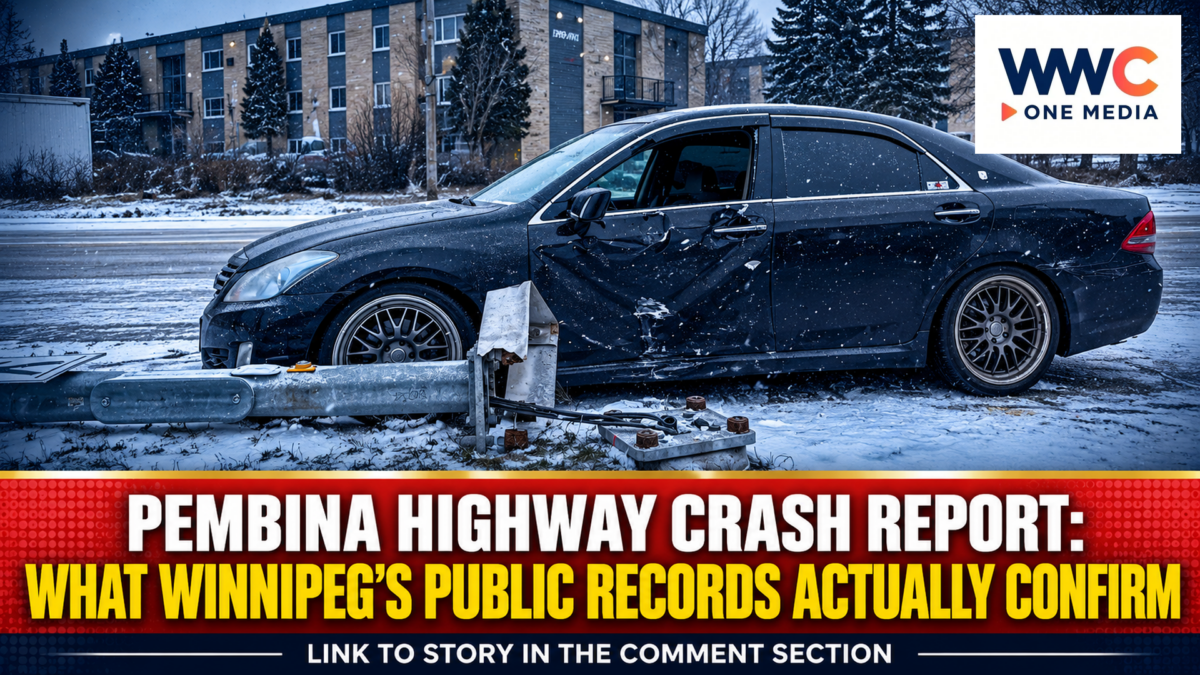
WINNIPEG, Manitoba — A reported traffic incident on Pembina Highway has drawn attention to road access and pedestrian-safety infrastructure in Winnipeg, but the public records available for review do not yet establish the specific circumstances of the reported collision. Official documents do, however, provide important context about road closures, traffic management and the city’s wider response to pedestrian-related incidents.
The distinction matters because a report of a collision, the damage visible afterwards and the eventual findings of an investigation are three different things. Without an incident-specific police or municipal record, the vehicle involved, the precise location, the condition of any signal equipment and the cause must remain unconfirmed.
Pembina Highway crash: what the official records establish
The Winnipeg Police Service’s published news-release index lists several incidents reported on Nov. 22, 2026, including two separate collisions involving pedestrians. It does not show a matching release identifying a single-vehicle collision on Pembina Highway or documenting damage to a crosswalk signal.
That absence should be interpreted carefully. Not every traffic incident necessarily receives a detailed public police release. A missing entry does not prove that an incident did not happen; it means the specific event cannot be confirmed from the police releases reviewed.
The City of Winnipeg’s Public Works lane-closure record provides another piece of context. Its published list, last updated on Nov. 21, records a southbound Pembina Highway curb-lane, painted bike-lane and west-side sidewalk closure between Manahan Avenue and Adamar Road, scheduled from Nov. 19 to Dec. 14 for street construction and maintenance.
The same municipal list records a separate full closure of Pembina Highway between Warsaw Avenue and Corydon Avenue from the evening of Nov. 20 until the morning of Nov. 21 for building construction and maintenance.
These are scheduled work notices. They do not establish that either closure was caused by a vehicle collision, nor do they identify the location of the reported signal damage.
Why a damaged crossing signal matters
Traffic signals and pedestrian crossing equipment help organise the movement of vehicles and people walking through intersections. When equipment becomes unavailable, the normal sequence of movements may be affected, making clear temporary traffic management important.
However, the actual response depends on the location and the type of equipment affected. A damaged pedestrian signal does not automatically mean that every traffic light at an intersection has stopped working. Nor does it establish that pedestrians were placed in immediate danger.
The city’s public-works records show that electrical, lighting and signal-related work is included in its wider road-maintenance programme. That is useful background, but it is not evidence that the reported Pembina incident involved a particular repair crew, maintenance project or equipment failure.
The appropriate questions for a case-specific update are whether the signal was inspected, whether a temporary control measure was installed, whether pedestrians were given an alternative crossing arrangement and when the equipment returned to service.
Winnipeg’s wider pedestrian-safety record
A Winnipeg Police Service release dated Oct. 19 described numerous pedestrian-related collisions over the preceding month. The service said those incidents included locations such as parking lots, marked crosswalks and controlled intersections, with victims ranging from children to adults in their 80s.
The release also described investigations that resulted in Highway Traffic Act charges, Manitoba Public Insurance Serious Offence Notices and criminal charges related to impaired driving.
The police notice is relevant as broader road-safety context, not as evidence about the Pembina report. It demonstrates that pedestrian collisions have been an identified enforcement and safety concern in Winnipeg, but it does not establish a connection between those earlier incidents and the reported single-vehicle event.
The same distinction applies to incidents elsewhere. WWC’s coverage of a vehicle allegedly crossing several lanes on Singapore’s Commonwealth Avenue examined why the sequence of a collision must be separated from conclusions about responsibility.
Likewise, a pedestrian collision investigated in Hilbert, Western Australia showed why an initial incident description should not be treated as a completed investigation. Both cases are separate from Winnipeg.
What traffic records can — and cannot — tell motorists
The City of Winnipeg’s lane-closure list is designed to provide information about scheduled restrictions, affected streets, expected durations and the types of work taking place. It can help motorists understand planned disruptions and identify alternative routes.
It is not a complete record of every short-term obstruction, emergency response or collision-related traffic delay. A temporary closure caused by an unexpected event may be communicated through a separate traffic advisory rather than appearing as a scheduled construction entry.
That difference is important when interpreting the Pembina report. The city’s published roadwork information confirms that some Pembina Highway restrictions were scheduled during the relevant period. It does not prove that those restrictions caused, contributed to or were extended by the reported collision.
For motorists, the practical lesson is to check current municipal traffic information before travelling rather than relying on an earlier closure notice. Conditions can change after a scheduled update, particularly when emergency crews or road-maintenance teams are involved.
WWC has also examined a truck collision involving roadside businesses in Southern Leyte. That separate Philippine incident illustrates why visible damage alone cannot establish the mechanical or human factors behind a crash.
What happens next
A reliable update on the Pembina incident requires an incident-specific record from the Winnipeg Police Service, a City of Winnipeg traffic advisory or a municipal maintenance notice identifying the affected crossing equipment.
The most useful confirmation would establish the exact location, when the incident was reported, whether anyone was injured, the condition of the signal and whether traffic restrictions were imposed. A later update could also clarify whether the equipment was repaired or replaced.
Until those details are available in an authoritative record, it would be premature to identify a driver, assign fault, describe the cause or claim that the crossing signal remained out of service for a particular period.
The public interest is straightforward: residents need accurate information about road conditions and pedestrian access. But accuracy also requires separating a reported event from details that authorities have formally established.
Frequently Asked Questions
Was there a single-vehicle crash on Pembina Highway?
A collision has been reported, but the official Winnipeg records reviewed do not provide an incident-specific confirmation of the reported event.
Was a pedestrian crosswalk signal damaged?
The specific damage has not been confirmed in an official police or municipal incident record available for this review.
Were there road closures on Pembina Highway?
Yes. The City of Winnipeg’s published roadwork list records scheduled restrictions on sections of Pembina Highway during November and December 2026. Those notices concern construction and maintenance, not a confirmed collision response.
Did anyone suffer injuries?
The records reviewed do not establish whether anyone was injured in the reported Pembina Highway incident.
Where can motorists check Winnipeg road closures?
Motorists can consult the City of Winnipeg’s official lane-closure list for published road restrictions and scheduled work.










