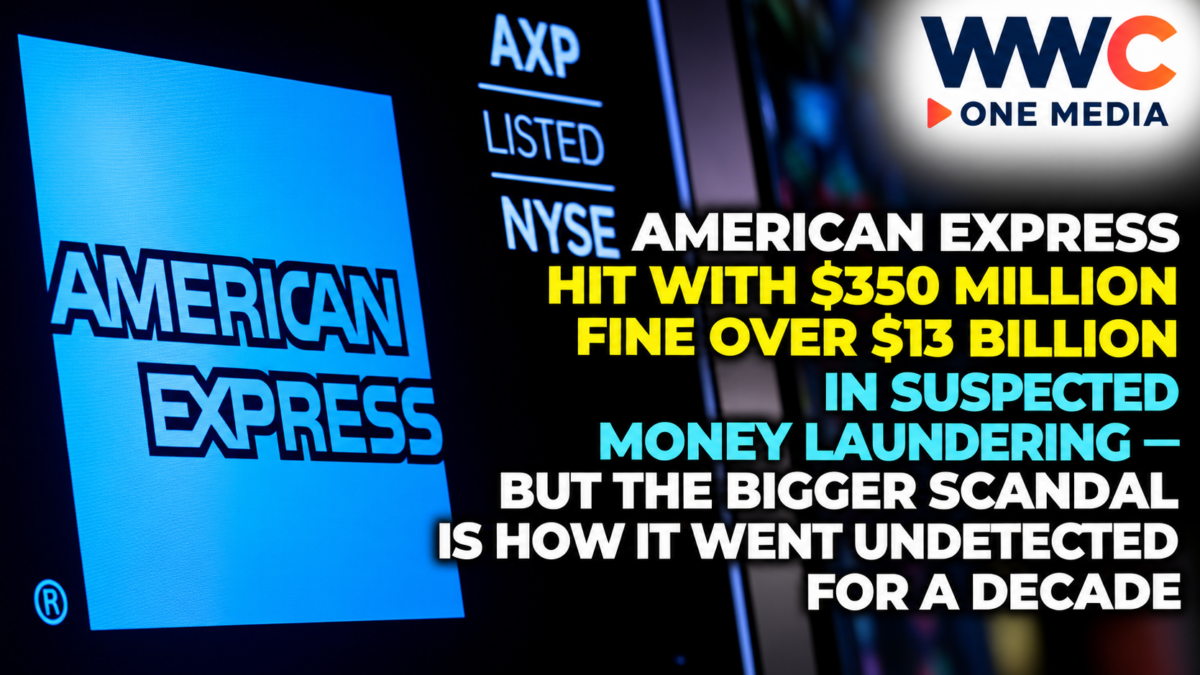
WASHINGTON — American Express, one of the world’s most recognizable financial services companies, has been ordered to pay a staggering $350 million penalty after US regulators uncovered years of serious failures in systems designed to detect money laundering and suspicious financial transactions.
But the fine is only part of the story.
Federal investigators found that approximately $13 billion in suspected trade-based money laundering activity was not properly identified, evaluated or reported over roughly a decade — raising troubling questions about how suspicious payments could move through a major American financial institution without adequate scrutiny.
The enforcement action, announced October 8 by the Office of the Comptroller of the Currency (OCC), targets American Express National Bank, the company’s banking subsidiary.
The Federal Reserve simultaneously issued a separate enforcement order against American Express Company and American Express Travel Related Services Company.
The Financial Times, Reuters, Bloomberg, Barron’s and other financial news organizations reported that regulators identified systemic weaknesses involving poorly resourced compliance teams, inadequate training, ineffective controls and failures to monitor risks across the company’s extensive credit card operations.
The central question is no longer simply how much American Express must pay. It is how billions of dollars in potentially illicit financial activity could escape adequate reporting for so long.
$13 billion in suspicious transactions: What regulators discovered
AMERICAN EXPRESS ENFORCEMENT ACTION | OCTOBER 8, 2026
$350M
Civil monetary penalty imposed by OCC
~$13B
Suspected laundering activity inadequately monitored or reported
2014–25
Approximate period examined by regulators
2
Federal regulators issuing enforcement actions
Sources: US Office of the Comptroller of the Currency, Federal Reserve and Reuters. The $13 billion represents suspected activity, not an independently established amount of criminal proceeds.
The OCC concluded that American Express National Bank failed to maintain an anti-money laundering program properly matched to the risks of its business.
The problems were not confined to a single system or isolated employee error.
According to the regulator, the failures included:
- Insufficient resources and employees lacking appropriate expertise.
- Weak internal controls and inadequate independent testing.
- Deficient anti-money laundering training for employees and directors.
- Problems identifying customers and conducting appropriate due diligence.
- Inadequate monitoring and reporting of potentially suspicious transactions.
These weaknesses caused the bank to miss or inadequately report significant suspicious activity, depriving law enforcement of important financial intelligence.
The regulator emphasized that money laundering controls play an essential role in both economic security and national security.
The surprising weakness: American Express focused on the wrong risks
One of the most revealing findings concerns how the company assessed the potential for criminal activity.
American Express is widely known for its credit and charge cards, including premium products used by consumers and businesses worldwide.
Yet regulators found that the bank focused too heavily on risks involving its smaller deposit-taking business while giving insufficient attention to the far larger credit and charge card operations.
That imbalance left important vulnerabilities inadequately addressed.
The OCC said that weak risk assessments, combined with shortcomings in customer identification and due diligence, contributed to failures in transaction monitoring.
The findings illustrate how a financial institution can have formal compliance procedures and still miss substantial risks if those procedures are not designed around how the business actually operates.
In American Express’s case, regulators concluded that these weaknesses persisted long enough to affect approximately $13 billion in suspected activity.
Were American Express employees involved?
Another concerning element emerged from the regulatory reporting.
According to Yahoo Finance’s coverage of the enforcement action, some suspicious transactions involved accounts associated with bank insiders.
The regulatory findings did not publicly identify those individuals or establish that all such transactions represented criminal misconduct by employees.
Nevertheless, potential insider connections are particularly sensitive for financial institutions because employees may have access to customer information, payment systems and internal procedures.
The case reinforces the importance of compliance systems capable of identifying suspicious activity even when transactions involve employees or related parties.
The existence of insider-related transactions should not be interpreted as proof of an organized employee money laundering conspiracy. Further investigation would be necessary to establish individual wrongdoing.
Federal Reserve launches separate enforcement action
The $350 million OCC penalty was accompanied by a separate Federal Reserve order.
The central bank identified serious deficiencies in American Express’s company-wide anti-money laundering program, especially at its national banking subsidiary.
Its order applies to American Express Company and American Express Travel Related Services Company.
The OCC’s monetary penalty and the Federal Reserve’s enforcement requirements are separate actions addressing related compliance weaknesses.
The distinction matters: reports of two regulators taking action do not mean two separate $350 million fines were imposed.
The Federal Reserve’s intervention increases pressure on American Express to demonstrate that its compliance failures have been addressed across the broader organization.
American Express responds: Company promises to strengthen controls
American Express Chairman and CEO Stephen J. Squeri acknowledged that the company’s compliance systems required improvements.
In an official statement released October 8, Squeri said American Express had identified shortcomings through internal and external reviews and was strengthening its financial crime compliance program.
The company also disclosed that it had investigated transactions involving people who allegedly misused its products to purchase goods and services, reported relevant information to law enforcement and taken other appropriate action.
American Express accepted the regulatory consent orders without admitting or denying the regulators’ findings.
That distinction is important: the company is subject to enforcement penalties and mandatory corrective measures, but the orders are not equivalent to a criminal conviction for laundering $13 billion.
Will the $350 million fine hurt American Express financially?
Despite the size of the penalty, the company maintains that its earnings outlook remains unchanged.
American Express said a portion of the fine had already been reserved in earlier financial periods, reducing the expected impact on its current financial results.
| 2026 financial guidance | Unchanged |
| 2027 financial guidance | No anticipated impact from remediation costs |
| Asset cap imposed | No |
| Immediate share reaction | Nearly 2% lower in after-hours trading |
American Express statement and Bloomberg reporting, October 8–9, 2026. Future financial effects remain subject to uncertainty.
Shares fell nearly 2% in after-hours trading following the announcement, according to Bloomberg’s report carried by The Business Times.
While the market reaction was relatively contained, the longer-term costs may include more compliance spending, increased regulatory scrutiny and potential reputational damage.
The company’s financial guidance also does not eliminate the possibility of further legal or regulatory developments.
What happens next? Regulators demand sweeping reforms
American Express must now demonstrate that it can identify suspicious financial activity more effectively.
The enforcement orders require corrective measures, including stronger oversight of financial crime risks, improved monitoring systems and more effective compliance procedures.
The company is also expected to establish structures for monitoring its remediation efforts and arrange an independent review of certain historical suspicious transactions.
Barron’s reported that regulators require a corrective action plan within 90 days.
The immediate challenge is not simply to fix deficiencies uncovered during the investigation. It is to show that the institution can consistently identify and report new suspicious activity before the same failures recur.
Why the Bank Secrecy Act matters
The controversy centers on the US Bank Secrecy Act, a major foundation of America’s anti-money laundering framework.
Under the law, covered financial institutions must maintain appropriate controls, monitor certain transactions and file Suspicious Activity Reports when applicable requirements are met.
Those reports provide information to authorities investigating potential money laundering, fraud, sanctions evasion and other financial crimes.
A bank is not necessarily expected to prove that a transaction is criminal before submitting a report.
Instead, reporting requirements are designed to help law enforcement examine potentially suspicious patterns.
American Express’s case highlights the difference between having compliance rules on paper and having systems that actually detect transactions requiring scrutiny.
Why the case matters to the Philippines and Asia
Although the enforcement action concerns a US financial institution, the implications extend to banks, payment companies and fintech providers worldwide.
Cross-border payments increasingly involve multiple institutions, international merchants and digital payment systems.
For financial centers such as Singapore and Hong Kong, as well as growing fintech markets such as the Philippines, the case reinforces the importance of customer due diligence, transaction monitoring and compliance oversight.
Philippine banks and payment providers operate under local anti-money laundering requirements administered through the country’s regulatory framework, including the Anti-Money Laundering Council and Bangko Sentral ng Pilipinas.
The American Express penalty does not establish that similar failures occurred at Philippine institutions.
Rather, it illustrates a broader industry risk: when compliance systems do not adequately reflect how financial products are used, potentially suspicious activity may escape detection even at major financial companies.
The bigger picture: A $350 million fine may be only the beginning
The enforcement action arrives amid a broader debate over how aggressively US regulators should supervise large financial institutions.
Bloomberg noted that the penalty contrasts with the Trump administration’s wider deregulatory efforts involving certain banking rules.
That makes the American Express case especially significant.
It demonstrates that even as some financial regulations are being relaxed, federal authorities remain willing to impose major penalties for serious failures to meet anti-money laundering obligations.
For American Express, the financial consequences appear manageable based on its current guidance.
The reputational challenge may be more difficult.
Customers, business partners and regulators now have reason to examine whether the company’s monitoring systems are capable of identifying suspicious activity across its extensive financial operations.
And the most important distinction remains unresolved in the public record: while regulators identified approximately $13 billion in suspected activity that was inadequately handled, that does not mean the entire amount has been established as criminally laundered funds.
The real warning is that a financial giant can invest heavily in compliance yet still fail to recognize major risks within its own business.
The next test for American Express is whether its promised reforms can prevent the same problems from happening again.