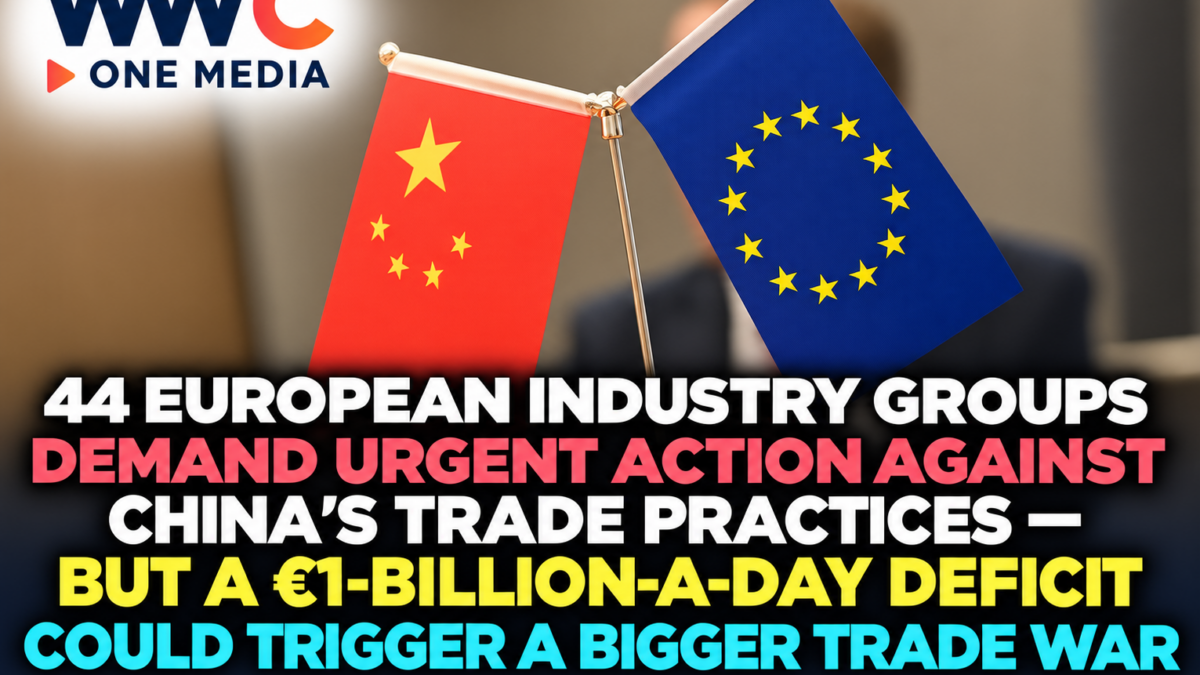
BRUSSELS — Europe’s industrial sector is sounding the alarm over China’s growing economic influence, with 44 major industry associations demanding immediate action from European Union leaders to protect factories, workers and manufacturers from what they describe as unfair Chinese competition.
But the warning comes with a much bigger problem.
The European Union is running a trade deficit with China exceeding €1 billion a day, raising fears that the continent’s industrial base could face another wave of factory closures, job losses and economic disruption.
The unprecedented collective appeal, reported by Reuters on October 8 and published by Bilyonaryo on October 9, represents industries including metals, chemicals and automotive components.
The associations are pressing Brussels to strengthen trade defense measures, accelerate investigations and develop new tools to respond to market distortions associated with Chinese state support and industrial overcapacity.
Their intervention comes just days before EU leaders gather for a crucial summit, where Europe’s increasingly difficult economic relationship with China will be high on the agenda.
Meanwhile, France and Germany are proposing stronger European powers to combat unfair trading practices, while EU Trade Commissioner Maroš Šefčovič is in Beijing for negotiations aimed at preventing further escalation.
The stakes extend far beyond Europe. A confrontation between two of the world’s largest trading partners could disrupt global manufacturing, supply chains, electric vehicle markets and international investment.
Europe’s €1-billion-a-day trade problem
EU–CHINA TRADE TENSIONS | OCTOBER 2026
44
European industry associations demanding action
€360B
Approximate EU trade deficit with China in 2025
€1B+
Average daily trade imbalance
46
New EU strategic raw-material projects selected October 9
Sources: Reuters and Associated Press, October 8–9, 2026. The daily trade figure describes the average imbalance, not money literally transferred each day.
The trade imbalance has become one of the most politically sensitive issues in Brussels.
According to the Associated Press, China’s trade surplus with the European Union reached approximately €360 billion in 2025.
European officials argue that heavily supported Chinese industries, combined with excess production capacity, have allowed Chinese manufacturers to export large volumes of competitively priced goods.
China, however, disputes accusations of unfair competition and argues that its products reflect manufacturing efficiency, investment and technological progress.
Beijing has also urged Europe to avoid protectionist measures that could damage bilateral trade.
The disagreement has become particularly significant as Chinese companies expand their global presence in electric vehicles, batteries, chemicals and industrial equipment.
What the 44 European industry groups want
The business associations are calling for a stronger and faster response from the European Commission.
Their demands focus on making trade defense more effective rather than relying solely on lengthy investigations into individual imported products.
| Industry demand | Intended outcome |
|---|---|
| Faster trade investigations | Respond more quickly to alleged dumping and unfair subsidies |
| Stronger enforcement of existing rules | Improve protection against documented market distortions |
| Examination of entire value chains | Address risks extending beyond a single product or component |
| Additional Commission staff | Reduce delays in handling industry complaints |
| New trade defense instruments | Counter broader state-driven market distortions |
| Protection for close European partners | Avoid unnecessary harm to Britain, Norway and Switzerland |
Based on the joint industry appeal reported by Reuters on October 8.
A central concern is the pace of European enforcement.
Industry representatives argue that manufacturers can experience serious commercial damage while authorities are still examining whether imported goods are benefiting from unfair subsidies or are being sold below appropriate market benchmarks.
They also warn that measures directed at one product can be undermined when market distortions shift to another part of the supply chain.
The associations want the EU to respond to industrial risks before financial losses and factory closures become irreversible.
However, their appeal is a policy demand, not a finding that every Chinese exporter or product has violated trade rules.
France and Germany push a powerful new EU trade weapon
The industrial groups’ appeal follows an initiative by France and Germany, Europe’s two largest economies.
French President Emmanuel Macron and German Chancellor Friedrich Merz have jointly called for a rapid-response mechanism that would give the European Union stronger powers against market distortions.
According to Reuters, their proposal would address practices involving subsidies, dumping and other systemic competitive imbalances.
The plan includes mechanisms for reducing dependence on concentrated suppliers and potentially limiting market access for countries whose policies are deemed unfair.
One particularly significant proposal would allow the European Commission to introduce countermeasures unless a qualified majority of EU governments voted against them.
That could make European trade enforcement faster by reducing the ability of political disagreement to delay action.
The proposal has not yet become law, and its final design remains subject to negotiations among EU institutions and member states.
China rejects Europe’s proposed limits on hybrid car exports
One of the most important disputes involves Chinese hybrid vehicles.
European officials are concerned that Chinese manufacturers are rapidly expanding sales of lower-priced electric and plug-in hybrid vehicles across the continent.
The EU has already imposed additional tariffs on certain Chinese battery-electric vehicles following an anti-subsidy investigation.
But Chinese manufacturers have increasingly expanded hybrid exports, which are not covered in the same way by those battery-electric vehicle duties.
According to the Financial Times, Brussels proposed that China voluntarily limit hybrid vehicle exports to approximately 15% of the European market, down from a share reported at more than one-third.
Beijing rejected the proposal.
The refusal has increased pressure on the EU to consider other protective measures, potentially including safeguard tariffs or quotas, although no such new broad hybrid restrictions had been finalized as of October 9.
Beijing and Brussels struggle to reach a trade breakthrough
EU Trade Commissioner Maroš Šefčovič held two days of discussions in Beijing on October 8–9, seeking progress on the trade imbalance and access to Chinese markets.
The Associated Press reported on October 9 that the talks had concluded, with European officials continuing to push for measurable progress.
China urged Brussels to avoid protectionist measures and raised concerns about European restrictions on exports of advanced chipmaking equipment.
Beijing has also initiated an anti-dumping investigation into certain chemical imports from the EU.
For Europe, the central concerns are Chinese industrial subsidies, export surges and limited access to the Chinese market.
For Beijing, the issues include European tariffs, technology restrictions and what China regards as discriminatory trade measures.
Neither side can easily disengage: European companies depend on Chinese suppliers and consumers, while Chinese manufacturers rely on European demand
A second threat: Europe’s dependence on Chinese critical minerals
The trade dispute is not confined to cars, steel and chemicals.
China dominates significant parts of the supply chain for rare earths and other critical minerals needed in electric vehicles, renewable energy systems, electronics and defense equipment.
European policymakers fear that escalating trade restrictions could leave domestic manufacturers vulnerable to supply disruptions.
In a separate announcement on October 9, the European Commission selected 46 new strategic raw-material projects for priority permitting and assistance with financing.
EU CRITICAL RAW MATERIALS PLAN
46
New strategic projects
€21.1B
Estimated project investments
EU targets for 2030
| EU domestic extraction | 10% |
| EU processing capacity | 40% |
| EU recycling capacity | 25% |
Targets under the EU Critical Raw Materials Act, referring to EU annual strategic raw-material needs, subject to the legislation’s specifications. Selection as a strategic project does not guarantee funding.
The program demonstrates that Europe is seeking two responses to its dependence on China: stronger trade defenses and more diversified sources of strategic supplies.
However, Reuters reported in September that several previously selected critical-mineral projects were struggling to secure financing, demonstrating that announcements do not automatically translate into operating mines or factories.
Could tougher EU trade rules backfire?
European manufacturers are demanding greater protection, but a more confrontational trade strategy carries substantial risks.
Stronger tariffs could make some imports more expensive for consumers and companies that rely on Chinese components.
Chinese retaliation could affect European exporters, including automotive manufacturers, luxury brands and agricultural producers.
A further concern is that restrictions affecting entire product categories could unintentionally harm trusted trading partners.
That is why the 44 industry associations specifically called for measures that avoid unnecessary consequences for countries such as Britain, Norway and Switzerland.
European leaders must therefore decide whether to prioritize fast intervention, negotiated solutions or a combination of both.
The trade dispute is not simply a contest between European and Chinese manufacturers. It also affects the businesses and households that purchase their products.
Why the dispute matters to the Philippines and Southeast Asia
The Philippines may not be directly involved in the EU-China confrontation, but major changes in European trade policy could have consequences for Southeast Asian economies.
Possible regional implications include:
- Manufacturing and investment: Companies may reconsider where to locate production facilities if EU tariffs or supply-chain rules change.
- Exports: Suppliers in ASEAN could gain opportunities if European companies diversify purchases, although rules of origin and customs checks would become increasingly important.
- Electric vehicles and electronics: Changes in Chinese and European automotive supply chains could affect component sourcing and investment across Asia.
- Trade negotiations: The Philippines’ ongoing efforts to strengthen commercial ties with Europe could become more valuable as the EU looks to diversify its partnerships.
These are potential effects, not confirmed consequences of the October 8 industry appeal.
For Philippine businesses, the most important developments to monitor are the EU’s final trade measures, China’s response and any changes in product-specific tariffs or import requirements.
October 15–16 summit could determine Europe’s next move
European Union leaders are scheduled to meet in Brussels on October 15–16, with relations with China expected to feature prominently.
The discussions will follow the Franco-German proposal, the industry’s joint appeal and Šefčovič’s negotiations in Beijing.
The summit could indicate whether European governments are moving closer to a unified response.
However, there is no guarantee that leaders will approve new trade restrictions at the meeting.
Much will depend on political agreement among member states, the legal basis for proposed measures and whether negotiations with China produce further concessions.
The bigger picture: Europe wants to protect its factories without losing China
The collective intervention by 44 European industry associations signals growing frustration over the continent’s economic relationship with China.
European manufacturers argue that slow enforcement and state-supported competition are putting domestic production under pressure.
France and Germany are seeking greater powers to respond quickly. The European Commission is negotiating with Beijing while developing alternative sources of strategic materials.
China, meanwhile, rejects accusations that its competitive position is inherently unfair and warns against protectionism.
Both economies have powerful reasons to avoid a full-scale trade war, but their competing industrial priorities are becoming increasingly difficult to reconcile.
Europe wants to protect its factories, jobs and industrial independence — but the biggest risk is that aggressive trade defenses could trigger retaliation from the same country on which many European supply chains still depend.
The approaching EU summit will help determine whether Brussels can pursue a tougher approach without allowing the dispute to escalate into a wider economic confrontation.