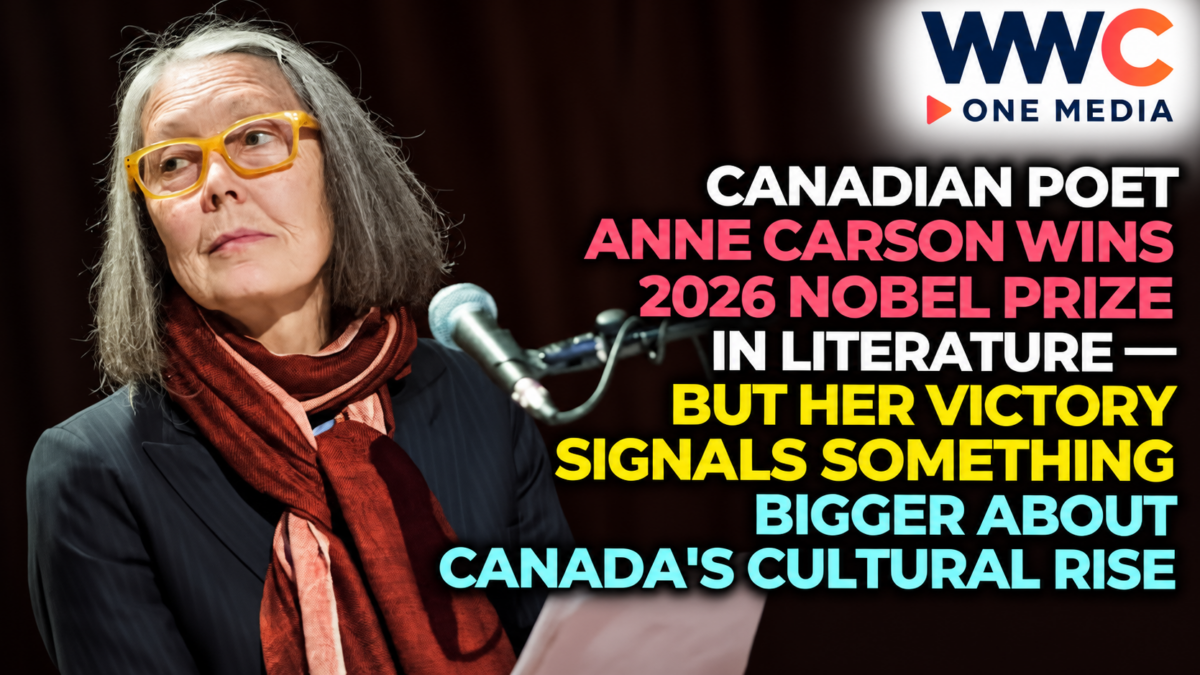
TORONTO, CANADA — Canada is celebrating a historic literary triumph after internationally acclaimed poet, essayist and classical scholar Anne Carson won the 2026 Nobel Prize in Literature, bringing renewed global attention to a country increasingly asserting its distinct cultural identity.
The 76-year-old Toronto-born writer received the prestigious honor on Thursday, October 8, for her groundbreaking approach to storytelling, poetry and classical literature.
The Swedish Academy recognized Carson for her inventive body of work, which draws on ancient Greek and Roman traditions while challenging the boundaries of contemporary literature.
Her victory makes her the third Canada-born writer to receive the literature Nobel, following Saul Bellow in 1976 and Alice Munro in 2013.
But the announcement carries significance beyond the literary community.
At a time when Canada is seeking to distinguish itself more clearly from the United States politically, economically and culturally, Carson’s Nobel victory has become a powerful symbol of Canadian creative achievement.
Canadian Prime Minister Mark Carney, university scholars, students and booksellers welcomed the announcement as a moment of national pride.
The achievement was reported by Reuters, The Canadian Press, The Guardian and other international publications, with Canada’s government and the University of Toronto also issuing statements celebrating Carson’s work.
Anne Carson joins Canada’s exclusive Nobel literary circle
CANADA-BORN NOBEL LITERATURE LAUREATES
Saul Bellow
1976
Born in Quebec; later an American citizen
Alice Munro
2013
Canadian short-story writer
Anne Carson
2026
Canadian poet, translator and classicist
Reuters identifies Carson as the third Canada-born literature laureate. Bellow’s later American citizenship is important to the historical distinction.
Carson’s achievement ends a 13-year gap since a Canada-born writer last won the Nobel Prize in Literature.
Unlike conventional novelists, she has built her international reputation by combining poetry, prose, essays, translations and academic scholarship into highly experimental works.
Her writing frequently draws on classical mythology, ancient Greek texts, desire, grief and human relationships.
The Nobel committee praised her ability to engage with classical traditions while creating new forms for contemporary readers.
The award recognizes a literary career that has consistently resisted familiar categories.
Who is Anne Carson, and why is her writing so influential?
Born in Toronto in 1950, Carson studied at the University of Toronto, where she earned bachelor’s, master’s and doctoral degrees.
Her academic foundation in classical studies became central to her creative identity.
Instead of treating ancient literature solely as historical material, Carson has reinterpreted classical figures and stories through modern forms of expression.
Her work has been celebrated for intellectual ambition, emotional intensity and a willingness to experiment with structure.
The University of Toronto described her career as spanning more than 20 books across poetry, prose, translations, essays and scholarship.
Carson has also taught at universities in Canada and the United States, influencing generations of writers and students.
The books that helped Anne Carson win the Nobel Prize
Autobiography of Red (1998)
A novel in verse that reimagines the Greek mythological figure Geryon through a contemporary story involving love, identity and emotional vulnerability. One of Carson’s most recognized works.
The Beauty of the Husband (2001)
A poetic exploration of marriage, betrayal and desire that won the T. S. Eliot Prize, further establishing Carson’s international literary standing.
Nox (2010)
An experimental work of mourning created in memory of her brother, blending personal documents, translation, visual material and classical poetry.
Wrong Norma (2024)
A collection of experimental prose pieces that demonstrates Carson’s continuing interest in unconventional storytelling and literary form.
Her influence reaches beyond poetry into visual art, theatre, translation and interdisciplinary performance.
The Indian Express described her work as challenging established literary forms while exploring profound human experiences such as loneliness, desire and loss.
Mark Carney calls Carson’s Nobel a proud moment for Canada
Prime Minister Mark Carney welcomed the award in an official statement issued October 8.
He praised Carson’s ability to make classical literature relevant to modern audiences through her distinctive imagination and writing.
Carney described the Nobel as a remarkable accomplishment for both the author and her country.
The prime minister also highlighted Carson’s previous distinctions, including two Griffin Poetry Prizes and her appointment as a Member of the Order of Canada.
The government’s response underscored the importance Canada places on international recognition of its writers, artists and cultural institutions.
Canada celebrates a “serendipitous” cultural moment
One of the most revealing reactions came from Michael Cobb, an English professor at the University of Toronto who has taught Carson’s work for nearly 25 years.
Cobb told Reuters that the Nobel announcement coincided with growing international interest in Canada as a country with a cultural identity distinct from the United States.
He called the timing “wonderfully serendipitous.”
The observation reflects a wider change in Canadian public life.
Canada has historically shared close economic, cultural and political relationships with the United States. American film, music, publishing and media have also had enormous international influence.
But the trade tensions and diplomatic disagreements involving US President Donald Trump’s administration have intensified conversations about Canadian sovereignty and national identity.
Carney’s response to American tariffs has contributed to that atmosphere, with many Canadians increasingly emphasizing the importance of protecting their own institutions and cultural traditions.
Carson’s Nobel recognition offers a different kind of international visibility — one built on intellectual achievement rather than political confrontation.
Her award was not a response to US politics; it was a decision by the Swedish Academy based on her literary work. Its timing, however, has given Canadians another reason to celebrate their country’s international contributions.
Toronto universities and bookstores celebrate
Celebrations extended beyond government officials to the institutions and communities that helped shape Carson’s career.
The University of Toronto described her achievement as a milestone for its academic and literary community.
University president Melanie Woodin congratulated Carson, recognizing her exceptional contributions to contemporary literature and scholarship.
Toronto independent bookstores also welcomed the announcement.
At Type Books, manager Claire Foster told The Canadian Press that Carson’s books had remained a regular part of the store’s poetry collection for approximately two decades.
The victory could bring a new wave of readers to Carson’s work, particularly those discovering her books for the first time through the Nobel announcement.
However, any eventual increase in book sales remains to be measured.
Carson’s unexpected Nobel phone call in Iceland
One of the most memorable details of the announcement came from Carson herself.
The writer was at her home in Reykjavík, Iceland, sweeping her kitchen floor when she received the call informing her that she had won the Nobel Prize.
In her first conversation with Nobel Prize representatives, Carson reacted with surprise and humor.
She described the news as almost unbelievable, saying:
“It seems a little insane.”
Carson also discussed how she might distribute the prize money and offered an unconventional suggestion for readers approaching her work: begin in the middle rather than necessarily at the start.
Her response reflected the unpredictable and playful attitude that has become a defining feature of her writing
2026 NOBEL PRIZE IN LITERATURE
76
Carson’s age at announcement
SEK 12M
Prize money, approximately US$1.2M
2026
Year of Nobel recognition
3rd
Canada-born literature laureate
Sources: Reuters and Nobel Foundation. The 2026 prize amount was raised from SEK 11 million to SEK 12 million.
Why her Nobel victory matters for literature worldwide
Carson’s recognition also represents an important moment for unconventional literary forms.
The Nobel Prize in Literature is often associated with novels, poetry collections and plays. Carson’s work challenges those divisions by combining scholarly interpretation, visual composition, dialogue, translation and poetic storytelling.
Her writing has demonstrated that classical literature does not need to remain confined to academic study.
Ancient stories can be reinvented through modern language, unconventional structures and contemporary human experiences.
Her influence also extends to collaborative performance and experimental theatre.
The Associated Press reported that Carson’s career has included creative collaborations with musicians and artists, including Laurie Anderson and Lou Reed.
The Nobel committee’s decision could encourage greater international interest in experimental poetry and genre-defying literature, although that longer-term effect remains to be seen.
The bigger picture: A literary victory with national significance
For Carson, the Nobel Prize is the culmination of decades of literary experimentation and international recognition.
For Canada, it is a high-profile cultural achievement arriving during an unusually intense period of national reflection.
The country is asserting its economic interests, defending its sovereignty and increasingly emphasizing what distinguishes Canadian institutions and creativity from those of its larger southern neighbor.
Carson’s victory demonstrates that Canadian cultural influence extends far beyond entertainment and commercial success.
It includes poetry, scholarship, translation and creative forms that have transformed how literature can be written and understood.
Canada has gained another Nobel literary laureate — but the bigger story is how Anne Carson’s achievement has become part of a broader moment of cultural confidence for the country.
Her writing may not be conventional, but that originality is precisely why the world’s most prestigious literary award has recognized her.