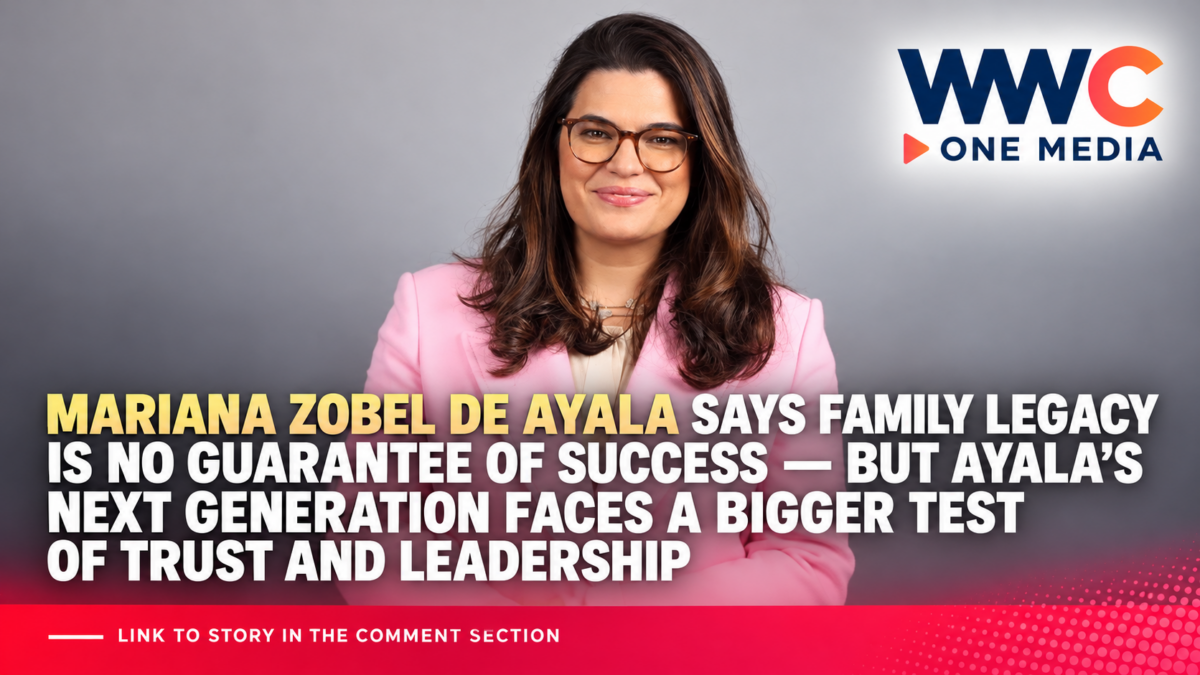
MANILA, PHILIPPINES — Being born into one of the Philippines’ most influential business dynasties may open doors, but Mariana Zobel de Ayala believes the next generation must prove that it deserves the trust and reputation built by nearly two centuries of family leadership.
In a striking message delivered during the Forbes Global CEO Conference in Singapore, the 37-year-old Ayala Corporation managing director emphasized that a powerful surname is not enough to guarantee respect, credibility or long-term business success.
“As a new generation of management, we have to re-earn that history and reputation.”
Mariana, an eighth-generation member of the Zobel de Ayala family, said the responsibility involves building a corporate culture characterized by transparency, discipline and a willingness to confront difficult truths.
Her remarks, highlighted by Forbes on social media and reported by Bilyonaryo, come as the Philippine conglomerate prepares its next generation of leaders to assume greater responsibilities across its sprawling business empire.
But the bigger question is whether Ayala’s younger leaders can preserve the family’s reputation while transforming a 192-year-old business for a rapidly changing economy.
The Zobel name carries nearly two centuries of business history
Ayala Corporation traces its origins to 1834, when the business that evolved into today’s conglomerate began operating in Manila.
Over the generations, the group expanded from its early commercial roots into major Philippine industries.
Today, its interests span real estate, banking, telecommunications, renewable energy, healthcare, education, infrastructure and technology-related ventures.
Its extensive business interests place the group in the daily lives of millions of Filipinos through residential communities, shopping malls, financial services and other essential activities.
That history gives the Zobel family considerable commercial credibility.
But Mariana’s message suggests that history also creates responsibility: every generation must demonstrate that it can manage the business with the same long-term focus expected of its predecessors.
Her remarks were made during the 24th Forbes Global CEO Conference, held in Singapore on October 7–8 under the theme Speed of Change.
Who is Mariana Zobel de Ayala?
Mariana Beatriz Zobel de Ayala
Eighth-generation Ayala family executive
- Managing Director, Ayala Corporation
- Senior Vice President, Ayala Land
- Head of Ayala Land’s Leasing and Hospitality Group
- Director across several Ayala businesses, including BPI-related and property interests
Mariana oversees significant portions of Ayala Land’s commercial property operations, including Ayala Malls, office properties, hospitality and leisure estates.
Her responsibilities extend beyond representing the family’s business interests.
She helps guide decisions on how shopping centers evolve, how office developments respond to changing demand and how hospitality properties compete for customers.
Ayala’s official leadership disclosures confirm that she was promoted to managing director in March 2025, along with another senior executive, Mark Uy.
The company’s announcement credited the promoted executives with demonstrating their ability to develop businesses, attract talent and drive corporate transformation.
That is consistent with Mariana’s message: next-generation leadership must be demonstrated through performance rather than assumed through family ties.
A new generation takes on Ayala’s biggest responsibilities
Ayala has increasingly assigned leadership positions to younger family members while retaining professional managers across its businesses.
Mariana Zobel de AyalaOversees Ayala Land’s leasing and hospitality operations and helps shape the future of the group’s malls, offices and leisure properties.
Jaime Alfonso Zobel de Ayala
Mariana’s brother has been involved in Ayala’s automotive and mobility businesses, including initiatives supporting electric and hybrid vehicles.
Jaime Z. Urquijo
A member of the next generation who holds leadership responsibilities involving urban estates, sustainability and enterprise risk.
Ayala’s March 2025 leadership announcement formally elevated Mariana and Mark Uy to managing directors, while Jaime Alfonso Zobel de Ayala and Jaime Urquijo became executive directors.
The appointments reflected a deliberate effort to strengthen leadership succession while recognizing executives’ individual contributions.
Crucially, Ayala’s senior management structure also includes professionals outside the founding family.
Cezar P. Consing serves as president and chief executive officer, while Jaime Augusto Zobel de Ayala is chairman.
Why Mariana believes transparency matters more than inherited prestige
Mariana’s emphasis on honest leadership reflects a broader challenge confronting large family-controlled businesses.
Established conglomerates benefit from brand recognition, longstanding commercial relationships and accumulated expertise. But those advantages do not automatically guarantee that customers, shareholders and employees will continue trusting their leadership.
For publicly listed companies, credibility is closely tied to financial reporting, corporate governance, accountability and the ability to deliver sustainable results.
Ayala’s challenge is particularly significant because its businesses operate in industries where consumers and investors have long-term commitments.
Property buyers depend on developers to deliver projects. Banking customers expect financial stability. Telecommunications subscribers expect reliable services.
For the next generation, maintaining confidence requires consistent performance across these different businesses.
Mariana’s remarks should not be interpreted as an admission of misconduct within Ayala. Rather, they represent her stated philosophy that reputation must be earned through leadership and organizational culture.
Ayala’s succession strategy is not simply about keeping power within the family
In a 2021 interview reported by BusinessWorld, Mariana acknowledged the importance of recruiting capable executives from outside the family.
She argued that the group’s diversified operations required expertise that could not reasonably be supplied by one family alone.
The observation is significant because Ayala has increasingly combined family leadership with professional management.
Chairman Jaime Augusto Zobel de Ayala has similarly discussed the importance of adapting the conglomerate while maintaining its long-term relevance.
In a May 2026 McKinsey interview, he described Ayala’s development over generations, its expansion into new industries and its efforts to generate a positive impact on Philippine society.
Together, the interviews suggest a continuing emphasis on professional capability, adaptability and the responsible stewardship of family-controlled businesses.
Mariana’s leadership philosophy is being tested in Ayala Land’s commercial businesses.
Shopping malls face changing customer habits, competition from online retail, evolving entertainment preferences and growing expectations for public spaces that offer more than traditional shopping.
Ayala Land has responded through its mall transformation and development initiatives.
In 2025, Mariana spearheaded a reported ₱17.5-billion mall development program expected to introduce more than 700,000 square meters of leasable space by 2028.
The company’s strategy increasingly emphasizes experience-driven destinations combining dining, retail, entertainment, culture and community activity.
For Mariana, the challenge is to make Ayala’s established properties relevant to younger consumers while supporting the financial performance of the business.
The success of those initiatives will ultimately be determined by demand, tenant performance, project returns and customer satisfaction — not by the family name behind the developments.
From business dynasty to modern conglomerate: The next big challenge
AYALA’S LONG-TERM TRANSFORMATION
1834
Origins of Ayala’s business history
192
Years since the group’s founding
8th
Generation of family leadership
2025
Mariana promoted to managing director
Ayala Corporation’s company history and March 2025 leadership announcement.
The pressures facing today’s Ayala executives differ significantly from those encountered by earlier generations.
Digital transformation is changing how Filipinos work, shop and manage their money.
Renewable energy and sustainability are reshaping corporate investment priorities.
Real estate developers must respond to changing office requirements, affordability pressures and new expectations for urban development.
At the same time, shareholders expect financial discipline and responsible use of capital.
For a conglomerate with roots stretching back nearly two centuries, maintaining relevance requires a balance between preserving established strengths and making difficult changes.
This is where Mariana’s message about discipline and transparency takes on practical importance.
It establishes a standard against which the next generation’s decisions can be judged.
Why this matters to Filipino investors and employees
Ayala’s leadership transition is not just a family matter.
The conglomerate’s businesses have extensive connections to the Philippine economy, so its strategic decisions affect shareholders, employees, customers, suppliers and communities.
For investors, leadership succession raises questions about corporate governance, management capability and long-term investment priorities.
For employees, it raises expectations about leadership culture and opportunities for professional advancement.
For consumers, the more practical concern is whether Ayala’s businesses can continue offering competitive and dependable products and services.
A respected corporate heritage can create confidence, but sustainable trust must ultimately be supported by performance.
That is the central significance of Mariana’s remarks.
The bigger picture: A 192-year legacy must be earned again
Mariana Zobel de Ayala’s statement offers a revealing perspective on the future of one of the Philippines’ most recognizable business families.
She is not rejecting Ayala’s history.
Instead, she is acknowledging that the achievements of earlier generations create responsibilities rather than guarantees.
Ayala’s younger leaders have inherited an established business platform, an influential brand and a reputation built over decades of growth.
But they also face changing consumer demands, technological disruption, competitive pressures and increasing expectations for corporate accountability.
Their challenge is to preserve what made the group successful while making it relevant to the next generation of Filipino customers and investors.
The Zobel surname may have helped build one of the Philippines’ most powerful business institutions — but Mariana’s message is that the next generation must prove, through its own decisions and results, that the name still deserves the public’s trust.
That could be the most important test of Ayala’s next chapter.