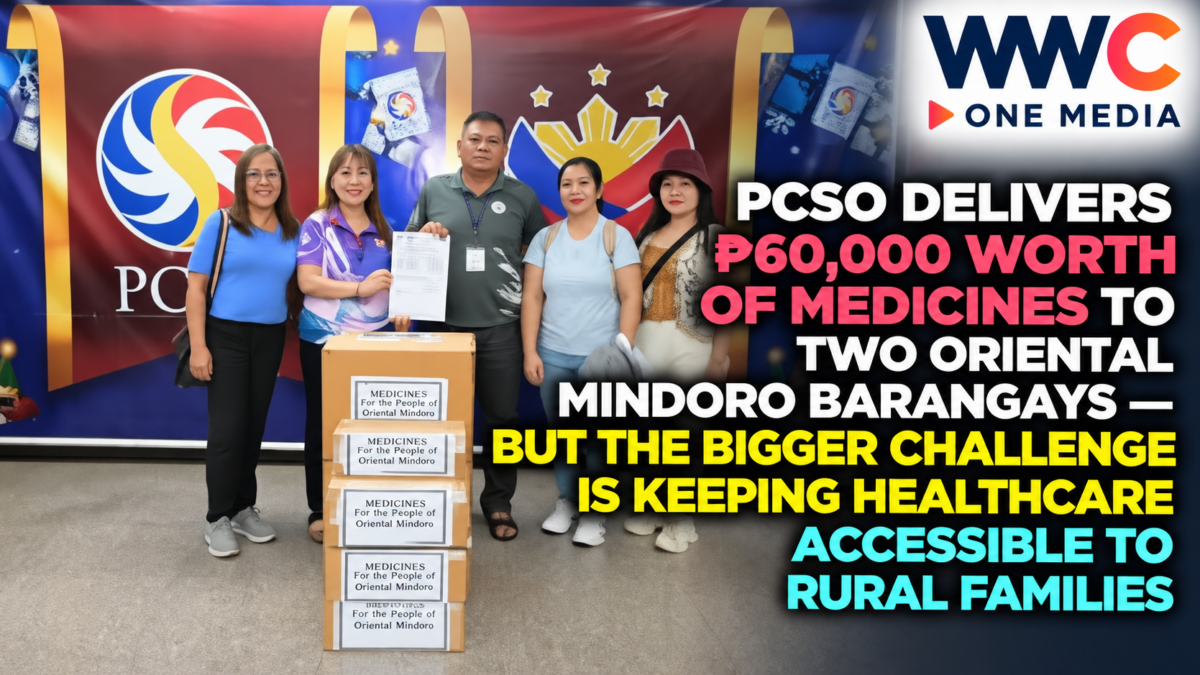
POLA, ORIENTAL MINDORO — Two barangays in the municipality of Pola have received a new supply of essential medicines from the Philippine Charity Sweepstakes Office (PCSO), providing additional support for community healthcare services and residents who may struggle to afford treatment.
But while the assistance brings immediate benefits to local communities, it also highlights a much larger issue confronting Philippine healthcare: ensuring that basic medicines remain available long after individual donation programs end.
Under its Medicine Donation Program, PCSO provided ₱30,000 worth of medicines each to Barangay Zone II and Barangay Banayan, for a combined reported value of ₱60,000.
The assistance was formally turned over during a ceremony on August 12, 2026, at the PCSO Conservatory Building in Mandaluyong City.
Barangay Zone II Chairperson Joseph Allain Pantilanan and Barangay Banayan Chairperson Godfrey Martinez personally received the donations on behalf of their communities.
The initiative is part of PCSO’s continuing effort to support local government units and improve access to medicines at the grassroots level, particularly in communities where public health resources may be limited.
Two barangays receive ₱30,000 each in medicine assistance
PCSO MEDICINE DONATION | POLA, ORIENTAL MINDORO
₱30K
Barangay Zone II
₱30K
Barangay Banayan
₱60,000
Combined value of donated medicines
Turnover held August 12, 2026. Source: Bitag Multimedia Network’s reporting on PCSO’s Medicine Donation Program.
The donations were intended to supplement medical resources available to the two communities.
Nurse IV Emojean Gogola of PCSO’s Medical Services Department facilitated the turnover, underscoring cooperation between the national government agency and barangay officials.
The recipients expressed appreciation to PCSO General Manager Melquiades Robles and the agency’s management for continuing to extend healthcare assistance to communities outside Metro Manila.
Although the reported donation represents a relatively modest amount compared with major hospital investments, barangay-level medicine assistance can help support primary care and reduce immediate supply pressures.
The actual number of patients who will benefit, the medicines supplied and the length of time the stocks will last were not specified in the available reporting. Those outcomes will depend on local distribution and healthcare needs.
PCSO expands its healthcare role beyond lottery funding
PCSO’s mandate extends beyond administering lottery and sweepstakes operations.
The agency also supports medical assistance, patient transportation, equipment donations and medicine distribution through its charitable programs.
Its Medicine Donation Program provides supplies to eligible local government units and other qualified recipients, helping supplement local healthcare services.
The agency’s separate Medical Assistance Program also provides financial support for eligible patients with medical expenses, subject to documentation and program requirements.
These programs serve different purposes. A barangay medicine donation is a supply contribution to a community, while patient medical assistance generally supports eligible individuals with specific healthcare needs.
Oriental Mindoro also received ₱18.2 million in medical equipment
The Pola donation comes amid wider government efforts to improve healthcare in Oriental Mindoro.
In April 2026, PCSO turned over a package of medical equipment and financial assistance valued at approximately ₱18.2 million to the provincial government, according to the Philippine News Agency and the Philippine Daily Inquirer.
The equipment component, valued at about ₱17.96 million, included:
- One digital X-ray machine to improve diagnostic imaging.
- Five ventilators to support patients requiring respiratory assistance.
- Eight electrocardiogram machines to monitor heart activity.
The assistance was intended to strengthen services at Oriental Mindoro Provincial Hospital in Calapan City.
PCSO General Manager Robles linked the donation to the government’s efforts to improve provincial healthcare, while Oriental Mindoro Governor Humerlito “Bonz” Dolor welcomed the additional hospital resources.
Unlike the ₱60,000 medicine assistance to Pola, the larger package was directed toward provincial-level healthcare infrastructure and financial support. These were separate initiatives.
DOH delivers another ₱1.87 million in health services
The Department of Health has also been increasing its presence in Oriental Mindoro.
During a government service activity in Calapan City on September 14, the DOH provided approximately ₱1.88 million worth of services, supplies and operational support.
The Philippine Information Agency reported that the assistance covered community-based, facility-based and school-based healthcare services, including medicines and other health commodities.
Dr. Ramon Bombais, head of the Provincial Department of Health Office, emphasized the importance of bringing services directly to residents who face difficulties accessing healthcare facilities.
Philippine Information Agency
Meanwhile, Oriental Mindoro’s provincial government distributed health kits containing first-aid medicines and basic medical supplies to barangays in the province’s second district during a September health summit in Mansala
Together, these programs reflect ongoing national and provincial efforts to expand healthcare access. However, their reported financial values do not measure actual patient outcomes.
The next healthcare challenge: Keeping medicines available
The Pola donation also raises a practical question about the sustainability of barangay healthcare.
A medicine donation can help replenish supplies, but its lasting value depends on appropriate distribution, inventory monitoring and follow-up funding.
Communities need dependable access to medicines, particularly for residents who have difficulty traveling to larger health facilities.
For local governments, the challenge is ensuring that donated medicines are properly stored, distributed according to medical need and replaced when stocks run low.
A continuing supply system is especially important for patients requiring regular medical treatment.
Those concerns are relevant nationwide. On September 30, Bilyonaryo News Channel reported a warning from health reform advocate Dr. Anthony Leachon that approximately ₱475 million worth of government-procured medicines were at risk of expiration.
That report concerned wider government medicine inventories, not PCSO’s donation in Pola. It nevertheless illustrates why effective inventory management and timely distribution are crucial to public healthcare spending.
PCSO’s donation program: How other LGUs can benefit
PCSO’s official 2025 Citizen’s Charter identifies local government units, government agencies, institutions and nongovernment organizations among the intended recipients of its Medicine Donation Program.
Applicants are generally required to submit a formal request and supporting information, such as a project proposal, organizational profile, target beneficiary details and implementation schedule.
The agency evaluates requests through its Medical Services Department. Approval is subject to its requirements and assessment procedures.
For local officials hoping to secure similar assistance, the program offers another potential source of essential medicines to complement regular health budgets.
Information on available assistance can be found through the
The bigger picture: Small donations, larger expectations
For Barangay Zone II and Barangay Banayan, the combined ₱60,000 in medicines represents additional support for local healthcare delivery.
For PCSO, it forms part of a broader effort to extend medical assistance beyond major cities and hospitals.
But the value of such programs should ultimately be measured by their impact on the people they are intended to help.
How many patients receive medicines? Are the supplies distributed promptly? Can barangays maintain stocks after the initial donations are exhausted?
Those questions remain unanswered in the publicly available account of the Pola turnover.
PCSO has delivered new medicines to two Oriental Mindoro barangays — but the bigger test is whether local healthcare systems can keep essential treatment accessible after the donated supplies run out.
That is where a one-time donation must connect with a much larger effort to improve community healthcare across the Philippines.