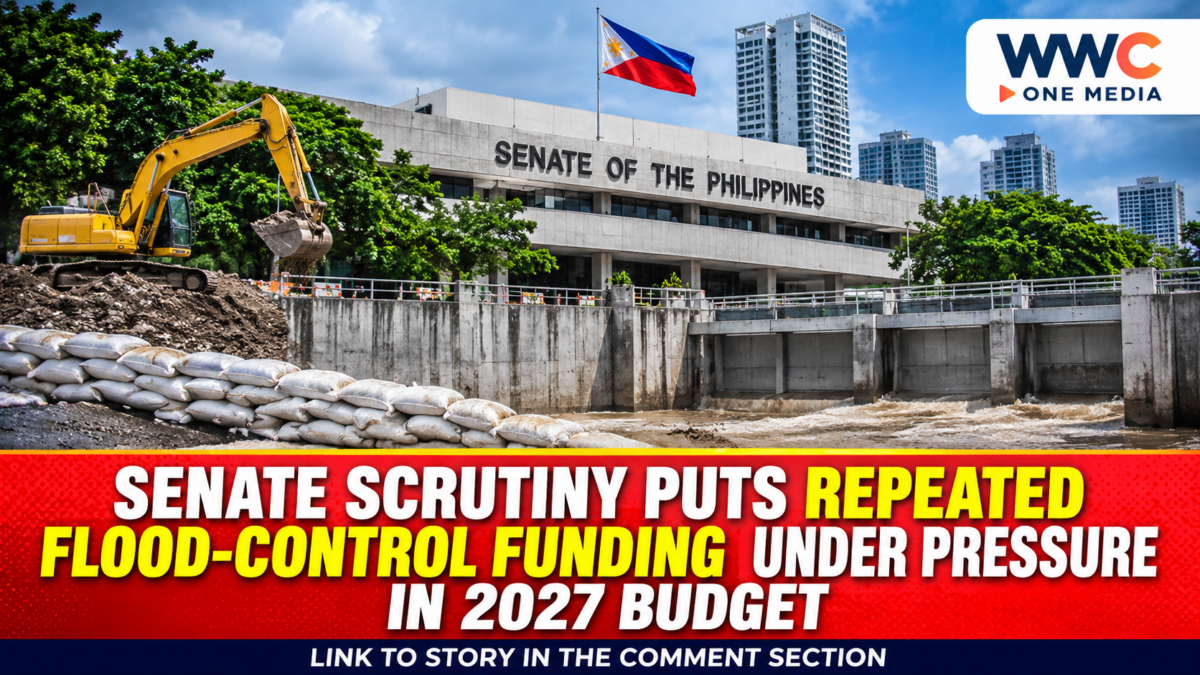
The Senate has begun reviewing the proposed 2027 national budget with possible duplicate appropriations for flood-control projects among the issues raised by Sen. Panfilo “Ping” Lacson. In a statement published on November 22, 2026, the Senate reported that Lacson intended to seek the removal of allocations he considered repeated or unnecessary during the chamber’s budget deliberations and, if needed, the bicameral conference committee process.
The concern goes beyond the amount assigned to a particular construction project. If the same public work appears in several budget years or under multiple entries, lawmakers and auditors need to establish whether the entries cover separate construction phases, additional work, or the same scope being funded again. That distinction matters because an appropriation authorizes spending; it does not, by itself, prove that money has already been released or paid.
Duplicate appropriations put project identification under the microscope
The Senate’s account of Lacson’s findings focused on flood-control items appearing in the proposed 2027 budget despite having received allocations in earlier years. Lacson said some projects had been funded in 2024, 2025 and 2026 but were still included in the new spending proposal.
The senator also said his team had identified at least 30 questionable projects in different parts of the country. These are allegations and preliminary findings that require examination against the underlying project records. The public information available in the Senate statement does not provide a complete project-by-project schedule that would allow readers to independently verify every suspected overlap.
This limitation is important. Two budget entries with similar descriptions are not necessarily the same project. A flood-control programme may cover different river sections, construction stages or additional protective works. A proper comparison needs more than a matching title: it should include the precise location, coordinates, engineering scope, implementing office, contract number, funding year and amount.
The Department of Budget and Management’s 2027 National Expenditure Program provides the official proposed spending documents, including Volume II-B, which contains the Department of Public Works and Highways budget and detailed project listings. Those documents form part of the record lawmakers can use to check whether project entries are distinct or potentially overlapping.
Why an appropriation is not the same as a payment
The difference between budget authority and actual expenditure is central to the issue.
An appropriation is legislative authority for government to spend public funds for a stated purpose, subject to applicable conditions. It does not automatically mean that the full amount has been released to an implementing agency, awarded to a contractor, or paid for completed work.
A project may receive funding in one year and require another allocation in a later year because it is being implemented in stages. Additional funds may also be proposed because of changes in design, cost, scope or implementation requirements. Those explanations should be supported by documents, not assumed.
The more serious concern arises when two entries appear to cover the same physical work and the same scope without a clear explanation. If that happens, lawmakers need to establish which allocation is necessary and whether the proposed additional funding should remain in the bill.
That is why project-level disclosure matters. Publishing the location, scope, funding history and implementation status of each project would make it easier for legislators, auditors and the public to distinguish legitimate continuation funding from possible duplication.
The 2027 budget process provides an opportunity to remove overlaps
The DBM published the FY 2027 National Expenditure Program on August 11, 2026. It includes the proposed allocations of national government agencies and a separate volume for DPWH projects.
The Senate Budget Transparency Portal lists the Finance Committee’s November 23–27 schedule for deliberations on the proposed General Appropriations Bill. Its November 24 calendar also identifies agency-level interpellations, showing that the review was continuing through the legislative process.
Lacson’s proposed approach is to raise the questioned items during the Senate’s amendment period and, if necessary, during bicameral proceedings. The bicameral conference committee reconciles differences between the Senate and House versions of the spending bill before final approval.
The process gives lawmakers an opportunity to remove or revise allocations before the budget becomes law. But meaningful review depends on having enough detail to identify the exact projects under question. A broad label such as “flood control” is not sufficient to determine whether two entries refer to the same construction site or separate works within a larger programme.
Earlier flood-control investigations show why records must match the ground
The current budget debate comes amid continuing scrutiny of government infrastructure spending. Previous investigations have highlighted the importance of comparing project documents with actual site conditions.
In Davao City, the National Bureau of Investigation has examined flood-control projects flagged for further investigation. WWC previously reported on the NBI’s review of 51 Davao flood-control projects, including a reported case involving repeated allocations associated with the same coordinates. Those findings remain subject to investigation and should not be treated as proof of criminal wrongdoing.
A separate Bulacan case illustrates why physical verification is essential. In a case involving a flood-control project declared complete but later alleged to be missing, the allegations became part of court proceedings. The case demonstrates the importance of checking accomplishment reports against what inspectors find at the project location.
Auditing capacity is another part of the accountability question. WWC has also examined the Commission on Audit’s proposal to restore a pre-audit system. The broader policy issue is whether government checks can identify documentation and implementation problems early enough to prevent questionable payments, rather than relying only on reviews after funds have been spent.
What happens next
The immediate question is whether the Senate can obtain and examine the detailed records behind the questioned flood-control entries before completing its version of the 2027 budget.
For each flagged item, a transparent review should establish the project’s exact location, engineering scope, previous appropriations, releases, contracts, disbursements and current physical status. DPWH and the relevant implementing offices should be able to explain why a project appears again and identify whether the new allocation covers additional work or repeats an existing obligation.
The Senate can then decide whether an entry should remain, be revised or be removed. Any final changes made during bicameral proceedings should also be traceable to the specific amendment and its justification.
For taxpayers, the standard should be straightforward: every allocation should have a distinct and documented purpose, and every payment should be supported by evidence that the contracted work was delivered. The budget debate is an opportunity to make that standard visible before the money is spent.
Frequently asked questions
What are duplicate appropriations?
Duplicate appropriations are budget entries that may allocate public funds more than once for the same project or scope of work. Similar descriptions alone do not prove duplication; project details must be compared.
Who raised concerns about repeated flood-control funding in the 2027 budget?
Sen. Panfilo “Ping” Lacson raised concerns about possible repeated allocations during the Senate’s review of the proposed 2027 national budget.
Does receiving an appropriation mean a contractor has already been paid?
No. An appropriation authorizes government spending for a purpose. Releases, contracts, obligations and actual payments are separate stages that require their own records.
Can the Senate remove questionable project allocations?
Senators can propose amendments to their version of the budget. Differences between the Senate and House versions are then reconciled through the bicameral conference committee before final approval.
How can the public check whether a flood-control project was funded more than once?
The public can compare official budget documents, project locations and coordinates, engineering plans, procurement notices, contract records, disbursement documents and audit findings. A reliable comparison must establish whether the entries cover the same physical work and scope.