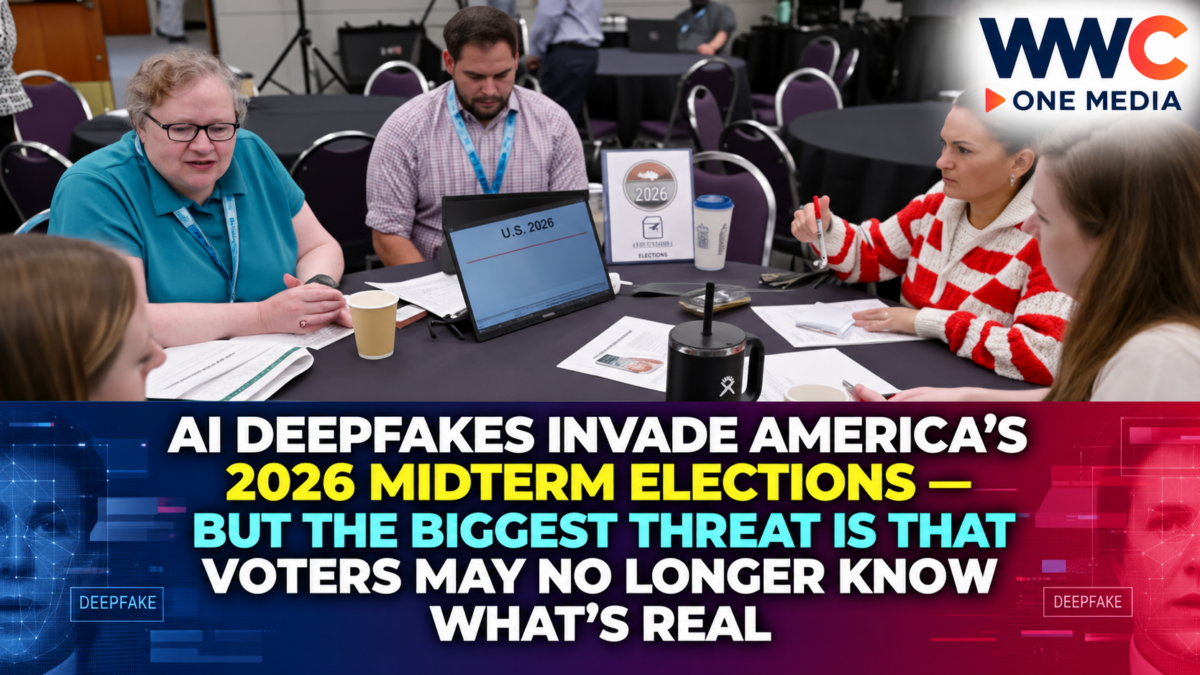
WASHINGTON — America’s political advertising war is entering a dangerous new era, where candidates can appear to say things they never said, participate in events that never happened and become the targets of digitally manufactured attacks — all thanks to artificial intelligence.
With the November 2026 U.S. midterm elections approaching, political campaigns and outside groups are increasingly turning to inexpensive AI-generated videos to influence voters, attack opponents and produce attention-grabbing advertisements.
What once required expensive production teams, professional actors and sophisticated visual effects can now be accomplished with generative AI tools capable of creating surprisingly realistic images, voices and video sequences.
But the controversy goes far beyond campaign costs.
The bigger question is whether American voters can still distinguish genuine political evidence from a convincing digital fabrication.
A Financial Times report published October 9 highlights how inexpensive AI deepfakes are transforming political attack advertising. The trend is also documented by The Washington Post, CNN, Axios and independent election-advertising researchers.
AI-generated attack ads are moving into mainstream politics
One of the most closely watched examples involves the Texas U.S. Senate contest between Republican Ken Paxton and Democrat James Talarico.
An AI-generated attack advertisement associated with Paxton’s campaign depicts Talarico in fabricated situations and attributes inflammatory conduct or statements to him.
The synthetic footage is not evidence that those events occurred. Rather, it illustrates how modern political attacks can manufacture imagery that supports an opponent’s negative portrayal.
Similar techniques have appeared in other races.
In Ohio, a Republican-aligned political group released an AI-generated advertisement portraying Democratic Senate candidate Sherrod Brown as an unwelcome party guest.
In Wisconsin, Republican Representative Derrick Van Orden faced a cease-and-desist demand after circulating an AI-generated portrayal of Democratic opponent Rebecca Cooke expressing positions her campaign said she did not hold.
These examples demonstrate how AI can shift political messaging from criticizing an opponent’s actual record to depicting an invented scene designed to influence voters.
Researchers trace approximately $80 million in AI political advertising
2026 U.S. MIDTERM CAMPAIGN RESEARCH
$80M
Tracked ad spending
~170
Unique AI-assisted ads
83%
Spending by Republican sponsors
Source: Wesleyan Media Project researchers, published October 5, 2026. Figures apply to the researchers’ tracked sample, not all U.S. political advertising.
Researchers studying election advertisements identified almost 170 unique ads incorporating artificial intelligence, representing approximately $80 million in spending.
Their analysis found that Republican candidates and aligned organizations accounted for roughly 80% of the advertisements tracked and 83% of the associated expenditure.
That is a finding about the observed sample, not proof that every AI-generated Republican advertisement was misleading or that Democrats have avoided the technology.
The research covered a broad range of AI uses, from subtle image modifications to realistic simulations of people and events.
The scale of spending shows that AI-generated political content is no longer simply an experimental campaign tool. It has become part of mainstream election advertising.
The legal battle: AI is moving faster than election safeguards
While artificial intelligence has transformed political advertising, the laws governing its use remain uneven.
According to the Financial Times, approximately 30 U.S. states have adopted legislation addressing AI-generated political content. However, the precise restrictions differ substantially between jurisdictions.
Some states require campaigns to disclose manipulated content. Others restrict certain deceptive deepfakes during periods leading up to elections.
The National Conference of State Legislatures documents these varying approaches, including disclosure obligations, legal remedies for affected candidates and restrictions on misleading synthetic media.
That creates several practical problems.
A video may be subject to specific disclosure requirements in one state but not another. A misleading advertisement might also circulate online long before regulators or courts can respond.
Meanwhile, the distinction between political satire and intentional deception creates additional legal challenges involving freedom of expression.
The Brennan Center for Justice has advocated stronger transparency requirements, particularly when manipulated media portrays candidates saying or doing things that never occurred.
Public distrust of AI is becoming a political issue itself
Americans are increasingly uneasy about the speed at which artificial intelligence is developing.
A recent Associated Press-NORC survey found that 64% of Americans believe AI is advancing too quickly, while 27% say its development is proceeding at an appropriate pace.
The survey also revealed substantial concern about keeping AI under human control and protecting people from its potential consequences.
Those findings do not measure opposition to political deepfakes specifically, but they provide an important backdrop to the growing controversy.
For political strategists, the technology presents a dilemma.
AI-generated content can make campaign advertising cheaper, faster and more visually engaging. But aggressive or misleading use may also damage a candidate’s credibility.
Candidates who emphasize their refusal to create deceptive AI portrayals may be able to turn authenticity into a political advantage.
Beyond deepfakes: AI is reshaping the entire election campaign
The technological shift comes amid enormous political advertising expenditure.
An October 8 Washington Post analysis examined more than 8,000 campaign advertisements representing approximately $1.6 billion in spending.
Economic concerns dominated competitive election advertising, while corruption, healthcare and immigration also featured prominently.
This suggests that artificial intelligence is transforming the presentation of political arguments even as campaigns continue fighting over familiar issues affecting American households.
Another regulatory controversy is emerging around automated political telephone calls.
The Associated Press reported that the Federal Communications Commission is considering a petition to ease restrictions on certain political robocalls, potentially including messages using AI-generated voices.
Supporters argue that expanded calling options could improve political communication. Critics warn that additional synthetic voices could increase the spread of misleading election messages.
Why this matters beyond the United States
The implications extend far beyond American politics.
AI-generated misinformation is a growing challenge for democracies worldwide, including countries across Asia where social media plays a central role in political communication.
The technology could allow political organizations, independent groups or malicious actors to produce synthetic speeches, fabricated interviews and misleading campaign videos at scale.
For the Philippines and other Southeast Asian countries, the American experience provides an important warning about the need for reliable verification, transparent political advertising and effective responses to manipulated media.
Although AI-generated material can serve legitimate purposes, including satire and accessible content production, undisclosed fabrications involving political figures risk misleading audiences.
The bigger picture: When seeing is no longer believing
The arrival of convincing, inexpensive deepfakes threatens to undermine a basic assumption of political communication: that recorded footage offers evidence of what someone actually said or did.
The danger is not confined to voters believing fabricated videos.
As synthetic media becomes increasingly common, authentic footage could also be dismissed as fake, allowing legitimate evidence to become the subject of unnecessary doubt.
This is sometimes described as the liar’s dividend — the advantage gained when widespread awareness of deepfakes makes genuine recordings easier to deny.
With the November 3, 2026, U.S. midterm elections approaching, political campaigns, technology companies, regulators and journalists face growing pressure to distinguish legitimate campaigning from deliberately deceptive digital content.
The next major election battle may not simply be about which political message persuades the most voters. It may be about whether voters can trust the images and voices used to deliver those messages.