MANILA, Philippines — The Philippines is preparing to place Manila at the center of international diplomacy as Southeast Asian leaders and representatives of major global powers gather for the 49th Association of Southeast Asian Nations (ASEAN) Summit and Related Summits this November.
The high-level meetings will mark a major moment in the Philippines’ 2026 ASEAN chairmanship, bringing together regional leaders and dialogue partners to discuss security, economic cooperation, political stability and challenges affecting Southeast Asia.
Among the most closely watched participants is United States President Donald Trump, whose attendance at the ASEAN–United States Special Summit on November 17 has been confirmed by the Department of Foreign Affairs (DFA).
The gathering is expected to draw attention not only because of the international figures attending, but also because of the difficult issues on the agenda — particularly tensions in the South China Sea, the continuing political crisis in Myanmar and the future of regional economic cooperation.
But as Manila prepares to welcome international delegations, the government faces another major challenge: ensuring security and smooth transportation while keeping the capital functioning for residents, workers and businesses.
Trump’s Expected Attendance Puts Manila in the International Spotlight
Trump is scheduled to attend the ASEAN–U.S. Special Summit on November 17 at the Philippine International Convention Center (PICC) in Pasay City, according to the DFA.
His visit would be his first trip to the Philippines since attending the ASEAN Summit in Manila in 2017 during his first presidential term.
The U.S. president is also expected to travel to China afterward for the Asia-Pacific Economic Cooperation (APEC) Summit in Shenzhen.
China’s representation is another important part of the diplomatic picture. Chinese President Xi Jinping is not expected to attend, while Chinese Premier Li Qiang has been identified as the customary leader of China’s delegation to ASEAN-related meetings in recent years. The DFA had not confirmed his attendance as of the latest report.
The meetings will also involve other ASEAN dialogue partners, including Australia, China, India, Japan, New Zealand, South Korea, Russia and the United Nations.
Brazilian President Luiz Inácio Lula da Silva, Canadian Prime Minister Mark Carney and representatives of the International Monetary Fund are also expected to participate as guests of the Philippine chair.
The presence of these international figures gives the Philippines an opportunity to strengthen diplomatic relationships and demonstrate its role in regional affairs.
South China Sea Code of Conduct Faces a Critical Test
One of the most consequential issues surrounding the summit is the long-running effort to establish a Code of Conduct (COC) for the South China Sea.
The proposed agreement is intended to establish rules and guidelines to help prevent maritime incidents and disputes from escalating into serious confrontations.
ASEAN and China first committed to working toward a code through a non-binding declaration in 2002. Negotiations have continued for years, with disagreements over the document’s scope, enforcement and legal force remaining major obstacles.
The issue is particularly important to the Philippines because of repeated maritime confrontations involving Philippine and Chinese vessels in disputed waters.
The Philippines had hoped to advance negotiations during its 2026 ASEAN chairmanship, with an earlier target to complete the process before the end of the year.
However, the outlook remains uncertain. The Associated Press reported on November 12 that ASEAN and China were expected to miss the 2026 deadline, despite provisional agreement on about 80% of the draft text. Major disagreements reportedly remain over geographic coverage, sensitive terminology and whether the final agreement should be legally binding.
If the negotiations remain unfinished, work will continue under Singapore when it assumes the ASEAN chairmanship in 2027.
For Manila, the summit is therefore a significant diplomatic opportunity — but it is not a guarantee of a breakthrough.
Myanmar Crisis Remains on ASEAN’s Agenda
The political situation in Myanmar is another major concern expected to be discussed by regional leaders.
ASEAN has continued to restrict the participation of Myanmar’s military leadership in its high-level summits following the military takeover that removed the elected government in 2021.
For the Manila gathering, Myanmar is expected to be represented by the director-general of its Foreign Ministry’s ASEAN affairs department rather than its top military leadership.
The situation highlights one of ASEAN’s most persistent challenges: how to maintain regional unity while responding to political instability and continuing violence within a member country.
The Philippines’ chairmanship has placed regional stability and cooperation among its major priorities, making Myanmar an important issue during the leaders’ discussions.
ASEAN Digital Economy Agreement Could Shape Regional Business
Beyond security and political issues, the summit could also produce an important development for businesses and consumers across Southeast Asia.
The Philippines expects to present the ASEAN Digital Economy Framework Agreement (DEFA), a regional initiative designed to strengthen digital trade and cooperation among member countries.
The agreement is intended to establish common frameworks for digital transactions, cross-border data flows, electronic payments, online consumer protection and other areas of the digital economy.
It also covers emerging areas such as artificial intelligence and financial technology.
If signed and implemented, DEFA could make it easier for businesses — including small and medium-sized enterprises — to reach customers across Southeast Asia and participate in regional digital markets.
However, signing the agreement should not be confused with its immediate implementation. Member countries will still need to complete the applicable domestic processes before its provisions take effect.
The agreement is one of the most closely watched economic outcomes of the Philippine chairmanship.
More Than 23,000 Personnel to Support Summit Security
Hosting world leaders requires extensive security preparations, and Philippine authorities are preparing a major deployment across Metro Manila.
The ASEAN 2026 Security Task Force announced that 23,154 personnel would be deployed to protect designated routes, summit venues, hotels and surrounding areas.
Of that total, 20,079 personnel are from the National Capital Region, while 3,075 come from multi-agency support units.
The Philippine National Police has separately reported that it will deploy 19,869 police personnel for the summit. These figures refer to different components of the security operation and should not be added together as though they represent separate, non-overlapping deployments.
Authorities have also intensified intelligence monitoring and coordination among the police, military, Presidential Security Command, government agencies and local governments.
The objective is to protect foreign leaders, delegates and the public throughout the meetings.
Will Metro Manila Traffic Be Affected?
The arrival of international delegations is expected to bring changes to traffic management, particularly around the PICC and other designated areas.
The Metropolitan Manila Development Authority has said that the plan will rely on security exclusion zones rather than widespread road closures.
Only accredited delegates and authorized vehicles with valid credentials will be allowed into restricted areas. Alternative routes have also been identified for motorists traveling near the summit venues.
The MMDA has emphasized that the public should not assume that every major road will be closed. However, security restrictions, temporary traffic controls and official motorcade movements may still affect travel times.
The government has also declared November 16 to 18, 2026, as special non-working days in the National Capital Region to help reduce congestion and support security preparations.
Commuters, employees and businesses should monitor official advisories, especially if they regularly travel through Pasay, the PICC area and nearby roads.
For more updates on security deployments and transportation adjustments, read WWC One Media’s related reports:
- Nearly 20,000 Police to Secure the ASEAN Summit as Metro Manila Faces Traffic Restrictions
- Philippines Deploys Nearly 17,000 Security Personnel for ASEAN Summit as Clark and Subic Become Backup Gateways
- More Than 300 Flights to Be Cancelled or Rescheduled as ASEAN Summit Disrupts Philippine Air Travel
Philippines’ ASEAN Chairmanship Nears Its Final Chapter
The 49th ASEAN Summit is also an opportunity for the Philippines to present the results of its year as chair of the regional bloc.
The Philippines will lead the plenary and retreat sessions, where leaders are expected to review the country’s chairmanship, discuss regional developments and address shared challenges.
The program includes the 29th ASEAN Plus Three Summit, involving China, Japan and South Korea, as well as the 21st East Asia Summit.
The Philippines is also expected to hand over the rotating ASEAN chairmanship to Singapore after its term.
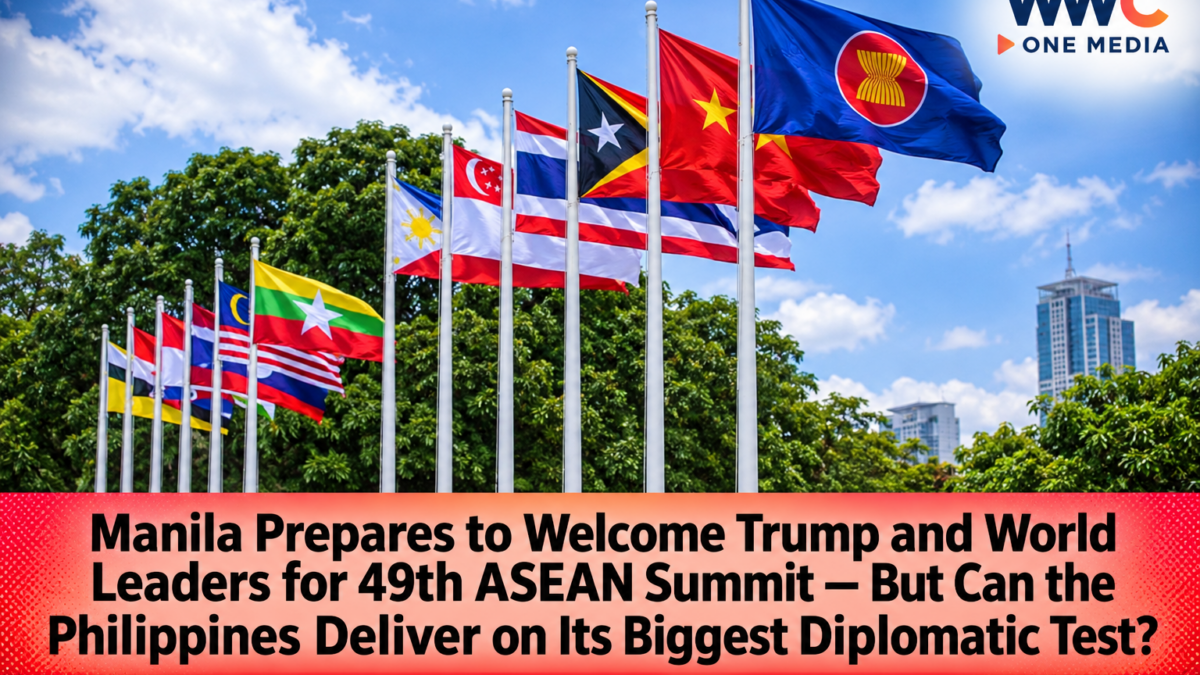
The ASEAN Secretariat has identified the summit’s theme as “Navigating Our Future, Together.” Its program includes the ceremonial unveiling of an updated ASEAN emblem and the raising of an updated ASEAN flag, along with other regional activities.
The Bigger Question: Can Manila Turn Diplomacy Into Results?
The Philippines’ hosting of the 49th ASEAN Summit is more than a ceremonial gathering of international leaders.
It is a test of the country’s ability to manage sensitive diplomatic discussions, strengthen regional partnerships, support economic integration and provide a secure environment for high-level international meetings.
The South China Sea Code of Conduct remains unresolved. Myanmar’s political crisis continues to challenge ASEAN unity. Meanwhile, the proposed digital economy agreement could become a major achievement if member countries move forward with its adoption and implementation.
For ordinary Filipinos, the summit will also be measured by how well authorities manage traffic, public safety and disruptions to daily activities.
Manila is preparing to welcome the world. But the bigger question is whether the Philippines can turn the international attention into meaningful diplomatic and economic results — and demonstrate that it can host a major regional gathering without leaving its own people struggling with the consequences.