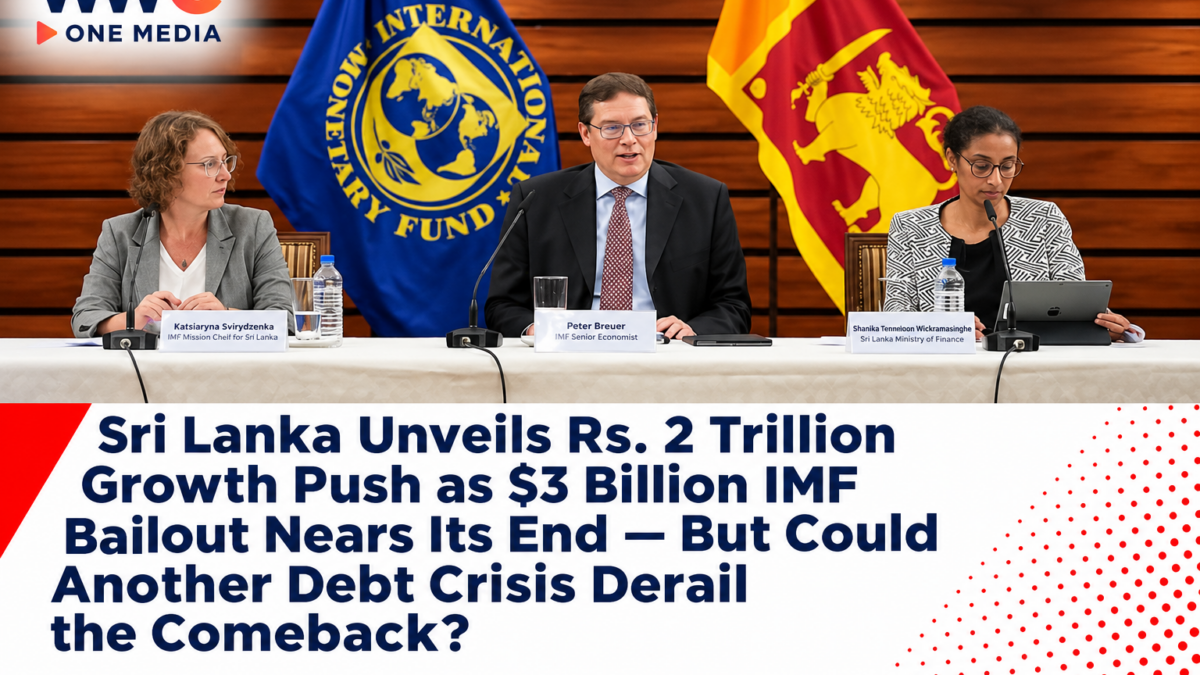
COLOMBO, Sri Lanka / MANILA, Philippines — November 12, 2026 — Sri Lanka is preparing one of its most consequential national budgets since its historic 2022 economic collapse, with President Anura Kumara Dissanayake seeking to shift the country from emergency financial stabilization toward economic growth as its nearly US$3-billion International Monetary Fund rescue program approaches completion.
The government’s 2027 budget framework includes approximately 2 trillion Sri Lankan rupees in capital allocations, intended to support infrastructure, investment and economic development.
But the ambitious spending strategy comes with significant risks.
The country is still recovering from a sovereign debt default, inflation has accelerated, energy costs have strained household finances, and investors remain cautious about its ability to return to international capital markets.
The budget is also closely linked to the IMF’s next scheduled disbursement.
The international lender has reached a staff-level agreement on its seventh program review, potentially unlocking another US$345 million in financing.
However, final approval depends partly on the government presenting a budget consistent with the rescue program’s fiscal requirements.
For a country that ran out of foreign currency in 2022 and struggled to import essential goods, the stakes could hardly be higher.
Sri Lanka has made substantial progress in restoring financial stability. The difficult question is whether that stability can now deliver better jobs, stronger investment and lasting improvements in living standards without recreating the debt problems that triggered its earlier crisis.
Sri Lanka’s 2027 Budget Marks a Critical Economic Turning Point
President Dissanayake, who also serves as finance minister, is scheduled to present the 2027 budget to Parliament on November 12.
The proposals represent the government’s attempt to move beyond the emergency measures introduced after the country’s economic collapse.
Those measures included restructuring debt, increasing revenue, reducing financial imbalances and rebuilding foreign-exchange reserves.
The new challenge is generating sustainable growth.
According to Sri Lanka’s official government communications, the budget includes approximately Rs. 2 trillion in capital allocations aimed at expanding economic activity.
The President reviewed the final proposals on November 11 alongside Treasury Secretary Harshana Suriyapperuma.
The government’s stated objective is to support investment and development while maintaining the fiscal discipline achieved under the IMF program.
However, a budget allocation is not the same as actual spending.
Infrastructure projects require procurement, planning, approvals and effective implementation before the allocated money translates into construction and economic activity.
For Sri Lanka, that distinction has become especially important.
Rs. 2 Trillion Investment Push Targets Infrastructure and Development
The budget’s planned capital expenditure is intended to strengthen the productive capacity of Sri Lanka’s economy.
Local financial reporting indicates that priorities include roads, railways, logistics networks, rural connectivity and related infrastructure.
These investments could improve transportation, help businesses reach customers and support long-term economic growth.
Better infrastructure can also encourage private investment by lowering the cost of moving goods and providing services.
But public investment creates meaningful benefits only when projects are selected carefully and completed efficiently.
Sri Lanka has previously experienced difficulties executing planned development spending.
In the first half of 2026, capital expenditure and net lending reached approximately Rs. 276.6 billion, equivalent to only 16.1% of the full-year target at that stage.
The figures, reported by EconomyNext from official midyear fiscal data, illustrate the challenge.
Allocating substantial money is one task.
Ensuring that projects proceed on schedule, avoid waste and deliver economic benefits is another.
The proposed Rs. 2 trillion program will therefore be judged partly by its implementation.
IMF’s $345 Million Installment Depends on the Budget
One of the budget’s most immediate financial consequences involves the International Monetary Fund.
Sri Lanka entered a four-year Extended Fund Facility arrangement in March 2023 following its sovereign debt default.
The program was approved at approximately US$3 billion.
Its objectives include restoring debt sustainability, rebuilding reserves, improving fiscal management and strengthening governance.
On October 4, 2026, the IMF announced a staff-level agreement to complete the program’s seventh review.
The agreement could unlock approximately US$345 million.
If approved, total disbursements under the arrangement would rise to approximately US$2.7 billion.
But the money has not yet been authorized for release.
The IMF Executive Board must approve the review, and the lender has identified conditions involving the 2027 budget and financing assurances.
The budget is therefore more than a domestic spending document.
It is also a test of whether Sri Lanka can maintain international lender confidence while introducing measures intended to support economic growth.
IMF Rescue Program Nears Its March 2027 Conclusion
The current IMF arrangement is scheduled to conclude in March 2027.
That creates pressure on policymakers to demonstrate that the country can maintain financial stability after the four-year program ends.
Sri Lanka has already achieved significant progress.
Economic activity has expanded for several consecutive quarters.
Foreign-exchange reserves have recovered.
Public finances have improved.
Debt restructuring is largely completed, although remaining obligations and risks continue to require attention.
But the end of an IMF program does not mean the country’s financial difficulties disappear.
Sri Lanka will still need to meet its debt obligations, manage budget deficits and attract investment.
It may also need to return to international bond markets.
That prospect raises questions about borrowing costs.
Investors will want evidence that the country can maintain financial discipline without depending on repeated emergency assistance.
Sri Lanka’s 2022 Financial Collapse Still Shapes Its Future
The budget cannot be understood without examining the crisis that preceded it.
In 2022, Sri Lanka experienced its worst economic collapse in decades.
Foreign-currency shortages severely disrupted imports of fuel, food and medicine.
Long queues formed outside fuel stations.
Electricity shortages affected businesses and households.
The government suspended foreign debt payments, leading to a sovereign default.
The crisis was accompanied by political upheaval and widespread public frustration.
Sri Lanka subsequently turned to the IMF for assistance and began a restructuring of its debt.
The recovery has involved difficult economic adjustments.
Tax increases and energy-pricing reforms helped improve government finances, but they also placed pressure on many households.
The new budget is intended to demonstrate that these painful measures can eventually produce a more productive and resilient economy.
For the government, restoring financial stability is only part of the challenge.
The more important political and economic test is ensuring that ordinary citizens benefit from the recovery.
Inflation Reaches 8.3% as Energy Costs Pressure Households
Sri Lanka’s progress is being threatened by renewed inflation.
According to Reuters, inflation in Colombo accelerated to 8.3% in October 2026.
The increase reflects pressure from energy prices and broader economic conditions.
The Middle East conflict has been particularly important because Sri Lanka depends on imported petroleum.
Higher oil prices can increase transportation costs, electricity-related expenses and the cost of producing and distributing goods.
Those effects can eventually reach household budgets through more expensive food, transport and essential services.
The government has previously introduced targeted support, including fuel and electricity assistance and cash transfers for vulnerable families.
However, the IMF has emphasized that relief must remain affordable, transparent and carefully targeted.
Broad subsidies can create substantial fiscal costs.
If poorly designed, they may undermine government finances and reverse progress in reducing debt-related risks.
Sri Lanka’s challenge is protecting vulnerable households without allowing emergency relief to become a permanent source of fiscal instability.
Tax Relief Could Become a Politically Important Budget Issue
The government’s budget preparations have included discussions about providing relief to households affected by the cost of living.
Sri Lankan financial newspaper Daily FT reported that the administration was considering a further adjustment to the Pay As You Earn income-tax threshold.
The threshold had previously been increased from Rs. 100,000 to Rs. 150,000.
Officials have also discussed longer-term changes to indirect taxation.
However, the final design and timing of additional tax measures depend on the detailed budget proposals and legislative process.
Expected changes should not be reported as laws already in force.
Tax relief presents an economic trade-off.
Reducing the burden on households can support disposable income and consumption.
But lower revenue can complicate efforts to maintain budget targets.
The IMF has therefore emphasized improving tax compliance, broadening the tax base and making the revenue system more efficient.
The government must determine how to provide relief without weakening its ability to finance public services and debt obligations.
Can Sri Lanka Maintain Its Hard-Won Fiscal Discipline?
The budget will be closely examined for its fiscal targets.
Reuters reported that Sri Lanka is targeting a primary surplus of approximately 2.6% of gross domestic product for 2027, alongside an overall budget deficit of around 4.5%.
A primary surplus means government revenue exceeds expenditure before interest payments.
An overall deficit includes interest and other applicable budget costs.
Both indicators matter because Sri Lanka continues carrying substantial public debt.
The IMF’s earlier program framework identified a medium-term primary surplus benchmark of 2.3% of GDP.
Differences between figures appearing in program documents and current budget reporting can reflect updated policy assumptions or different reporting stages.
The final enacted budget and IMF assessment will determine which targets govern subsequent implementation.
For creditors, the larger issue is whether Sri Lanka can consistently generate sufficient government revenue while funding necessary development.
A strong primary balance helps demonstrate fiscal discipline.
But debt sustainability also depends on economic growth, borrowing costs, exchange rates and the maturity profile of outstanding obligations.
A $6.9 Billion Reserve Buffer Offers Some Protection
Sri Lanka’s foreign-exchange reserves have improved substantially since the 2022 crisis.
The IMF reported gross official reserves of approximately US$6.9 billion during its 2026 review discussions.
Reuters also reported that reserves reached roughly that level in October.
The rebuilding of reserves is important because Sri Lanka needs foreign currency to pay for imports and meet external obligations.
A stronger reserve position can help cushion temporary disruptions in capital flows or export income.
But not all gross reserves are necessarily available without restrictions.
Their adequacy must be assessed in relation to imports, debt payments and other liabilities.
The recovery in reserves is therefore encouraging, but it does not eliminate the country’s external financing risks.
Debt Restructuring Is Nearly Complete — But Borrowing Remains Expensive
Sri Lanka’s debt restructuring has been one of the most important components of its recovery.
The government negotiated changes to its debt obligations after defaulting in 2022.
These arrangements were intended to restore a more manageable repayment schedule and support long-term financial sustainability.
The IMF has said that restructuring is largely completed.
However, the government still faces significant borrowing requirements.
Economist and former central bank Deputy Governor W.A. Wijewardena told Reuters that Sri Lanka could face borrowing costs of 11% to 12% if it returned to international bond markets under current conditions.
That estimate is not a confirmed price for a new bond issue.
It illustrates the potential cost of borrowing from private investors.
Such rates could make new debt expensive to service.
As WWC ONE MEDIA reported in its coverage of Indonesia’s plan to raise up to US$1.5 billion through Chinese panda bonds, emerging-market governments are exploring different funding channels while managing investor confidence and financing costs.
Indonesia’s circumstances are distinct from Sri Lanka’s debt restructuring and IMF program.
Nevertheless, both stories illustrate why access to international capital is only useful when financing remains sustainable.
Sri Lanka’s next challenge will be demonstrating that it can borrow responsibly without returning to the conditions that contributed to its earlier crisis.
International Ratings Upgrade Offers Encouragement
Investor confidence in Sri Lanka has improved.
In September 2026, Fitch Ratings upgraded the country’s long-term foreign-currency issuer rating to B-minus from CCC-plus.
The upgrade reflected progress in fiscal performance, external balances and debt restructuring.
However, a B-minus rating remains below investment grade.
It indicates that substantial credit risks persist despite improvements.
Investors will continue monitoring Sri Lanka’s government finances, political stability and economic performance.
The ratings improvement may support the country’s longer-term effort to regain access to global bond markets.
But it does not guarantee that the government will obtain financing at affordable interest rates.
Growth Must Reach Ordinary Sri Lankan Families
The government’s economic strategy faces a major social challenge.
According to the World Bank, Sri Lanka’s recovery remains incomplete and uneven.
The institution estimated that poverty affected approximately 16.9% of the population in 2025, remaining above pre-crisis levels.
That means macroeconomic improvements have not yet translated into a full recovery in household living standards.
Government revenue can improve while many families continue struggling with food, transport and housing expenses.
Similarly, rising GDP does not automatically mean all workers are receiving higher wages or gaining access to better employment.
The World Bank has urged Sri Lanka to strengthen private-sector investment, productivity and exports.
Those reforms are intended to generate more sustainable employment and income growth.
The success of the 2027 budget will therefore depend not only on meeting fiscal targets but also on improving economic opportunities.
Tourism, Exports and Investment Are Crucial to the Recovery
Sri Lanka needs stronger sources of foreign currency and sustainable growth.
Tourism remains an important industry.
The country attracts visitors through its beaches, cultural heritage, national parks and natural landscapes.
Tourism revenue can support employment, local businesses and foreign-exchange earnings.
However, the industry is vulnerable to external shocks.
Geopolitical uncertainty, travel costs and environmental conditions can affect demand.
As WWC ONE MEDIA reported in its coverage of drought-related tourism restrictions at Sri Lanka’s Yala National Park, environmental pressures have already affected travel activity at important wildlife destinations.
The government must also strengthen exports and encourage productive private investment.
A more diversified economy would be better able to withstand fluctuations in tourism demand and imported fuel costs.
Investment in logistics, transport and public services could contribute to that process if projects are well managed.
Renewable Energy Could Reduce Sri Lanka’s Exposure to Imported Fuel
Energy security is another important part of Sri Lanka’s development strategy.
The country has been working to expand renewable electricity generation and reduce its exposure to imported fuel.
Such investments can potentially lower vulnerability to international oil-price shocks.
But energy development also creates difficult choices.
As WWC ONE MEDIA reported in its investigation into complaints from fishing communities near Sri Lanka’s Mannar wind farm, some residents have raised concerns about declining catches, flooding and the effects of construction.
Those complaints have not established that wind turbines caused the reported economic and environmental problems.
They nevertheless demonstrate the importance of community engagement, scientific assessment and effective safeguards.
Sri Lanka’s investment strategy must balance national energy needs with local economic and environmental concerns.
Sri Lankan Workers Could Find New Opportunities Abroad
Labor mobility may also influence the country’s economic recovery.
Workers employed overseas can send remittances home, supporting household income and providing foreign currency.
Thailand has been exploring new labor recruitment arrangements with Sri Lanka.
As WWC ONE MEDIA reported in its analysis of Thailand’s agricultural labor shortage, the two countries agreed on a framework covering up to 10,000 Sri Lankan workers in an initial recruitment phase.
The arrangement creates potential employment opportunities.
However, the target does not mean 10,000 workers have already been deployed.
Actual placements depend on employer demand, recruitment procedures and applicable labor protections.
Overseas employment can support remittance flows, but it is not a substitute for creating productive jobs within Sri Lanka.
The longer-term objective should be an economy capable of offering attractive opportunities at home.
Regional Trade Integration Could Support Long-Term Growth
Sri Lanka has also expressed interest in strengthening regional economic relationships.
Greater trade integration could help exporters reach additional markets and attract investment.
As WWC ONE MEDIA reported in its coverage of Regional Comprehensive Economic Partnership members renewing their commitment to World Trade Organization reforms, Sri Lanka is among the economies seeking accession to RCEP.
An accession working group has been established to consider interested economies.
However, Sri Lanka is not yet a member of the agreement.
Any future benefits would depend on negotiations, market access, domestic reforms and implementation.
For an economy seeking more export-led growth, trade relationships could become an important part of the post-IMF strategy.
Why the Philippines Should Watch Sri Lanka’s Recovery
Sri Lanka’s experience offers lessons for other developing economies, including the Philippines.
Both countries are exposed to imported energy prices, global financial conditions and the cost of public borrowing.
Both also need infrastructure investment, sustainable fiscal management and stronger employment opportunities.
Sri Lanka’s 2022 collapse demonstrated how quickly economic vulnerabilities can become a national emergency when foreign-currency reserves are depleted and debt obligations become difficult to meet.
The country’s subsequent IMF-supported recovery highlights the importance of rebuilding financial buffers and restoring market confidence.
But its continuing challenges also show that stabilization alone is insufficient.
Public debt must remain manageable.
Investment should deliver measurable benefits.
And fiscal policy must balance long-term development with support for households facing immediate economic pressure.
The two economies have different financial structures and circumstances, so Sri Lanka’s past crisis should not be treated as a prediction of events in the Philippines.
The relevant lesson is the importance of maintaining resilience before external shocks become overwhelming.
What Happens Next for Sri Lanka’s 2027 Budget?
The first major milestone is the presentation of the detailed budget proposals to Parliament.
According to the official parliamentary timetable, debate begins on November 13.
The second-reading vote is scheduled for November 20.
Committee-stage discussions are planned through December 14, when the final vote is scheduled.
The IMF will also assess whether the budget meets the conditions necessary to complete its seventh review.
Beyond those immediate steps, investors will watch economic growth, inflation, reserves and public finances.
They will also examine whether Sri Lanka successfully implements its capital investment plans.
The government’s ability to attract private investment and create productive employment will be critical.
The country is moving closer to the formal conclusion of its IMF rescue program.
But its longer-term recovery will depend on decisions made well beyond March 2027.
The Bottom Line: Sri Lanka Faces Its Biggest Test Since the 2022 Default
Sri Lanka has made substantial progress since its historic financial collapse.
Foreign-exchange reserves have recovered.
Economic activity is expanding.
Debt restructuring is largely complete.
And international confidence has improved.
The government’s proposed Rs. 2 trillion capital investment program signals an ambition to move from crisis management toward long-term growth.
But several major challenges remain.
Inflation has returned as a concern.
Energy prices continue exposing the economy to international shocks.
Poverty remains above pre-crisis levels.
And borrowing from international capital markets could still be expensive.
The next US$345 million in IMF financing also depends on completing the lender’s review requirements.
Sri Lanka has demonstrated that it can stabilize an economy devastated by debt default. The harder challenge is generating lasting prosperity without undermining the financial discipline that made recovery possible.
As President Dissanayake prepares the country for life after its IMF rescue program, could the 2027 budget finally launch a sustainable era of investment and growth—or will inflation, debt repayments and new global shocks threaten to pull Sri Lanka back toward another economic crisis?