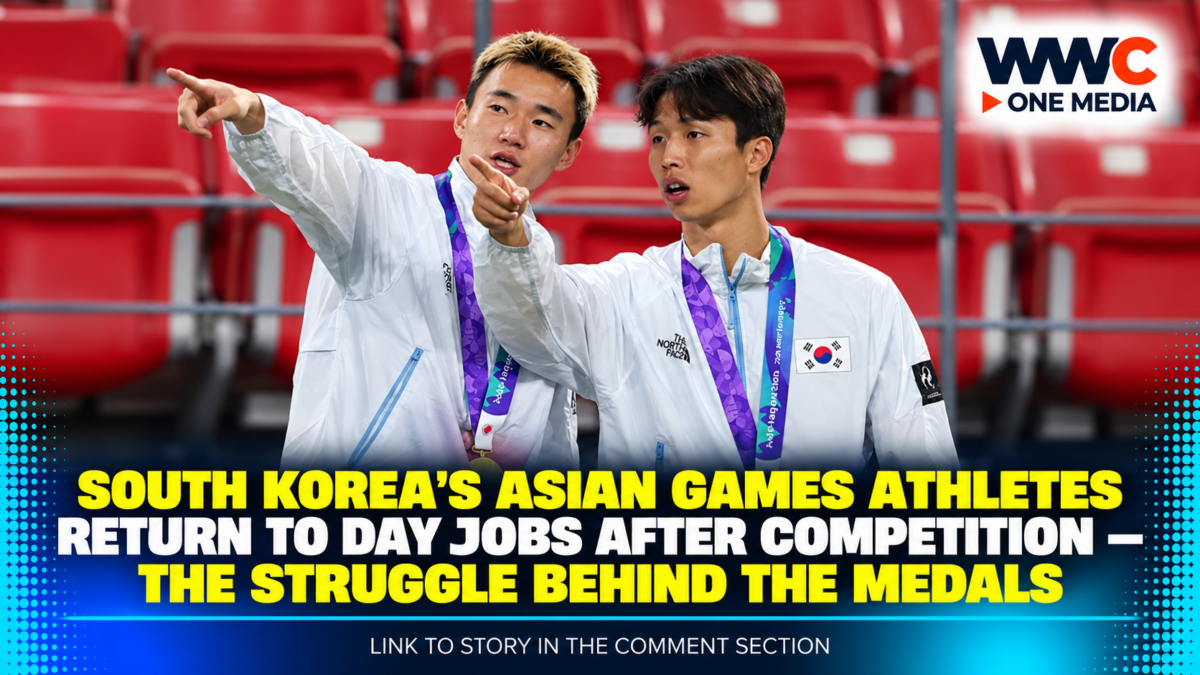
For some athletes, representing their country is only part of the battle. After the crowds leave and the medals are awarded, they must return to ordinary jobs to pay their bills and keep their sporting dreams alive.
That is the reality facing South Korean competitors in less popular sports following the 2026 Aichi-Nagoya Asian Games, where athletes in disciplines such as kabaddi and beach volleyball continue to struggle with limited financial support, inadequate training facilities and uncertain career prospects.
While South Korea finished third overall in the continental competition, the experiences of athletes such as kabaddi player Kim Geon-myeong and beach volleyball player Shin Ji-eun have exposed the difficulties facing competitors outside the country’s more commercially successful sports.
Their stories raise an important question: How can athletes compete at the international level when making a living can be as challenging as preparing for the next tournament?
Kabaddi Player Works as a Sanitation Worker While Training for South Korea
At 32, Kim Geon-myeong has had to balance the demands of international competition with a full working life.
A member of South Korea’s national kabaddi team, Kim works as a sanitation worker for the Geumjeong District Office in Busan. His workday begins at 6 a.m., with responsibilities that include cleaning streets, collecting garbage, responding to public complaints and addressing illegal dumping.
Even after earning a place on the national team, Kim continued training before and after work.
His path into the sport began when university senior Lee Jang-gun, one of South Korea’s best-known kabaddi players, encouraged him to try it.
After failing to make the national team for the 2018 Asian Games in Jakarta and Palembang, Kim reconsidered his career options before taking the sanitation job.
His experience reflects a structural problem for Korean kabaddi: the country has no professional kabaddi teams.
National team members work in different occupations, making it difficult to coordinate training schedules and maintain the consistent preparation required for international competition.
Although the sport gained attention after South Korea won silver at the 2018 Asian Games, its domestic infrastructure remains limited.
For athletes such as Kim, representing the country does not eliminate the need to earn a living. Instead, it adds another demanding responsibility to an already crowded schedule.
Beach Volleyball Player Takes on Part-Time Jobs to Fund Her Dream
Shin Ji-eun, 25, faces a similar challenge in beach volleyball.
Shin helped South Korea secure its first-ever victory in beach volleyball at the 2026 Asian Games, giving the sport a valuable moment of visibility.
Yet behind that achievement lies a financial struggle familiar to many athletes competing in less commercially developed disciplines.
To raise approximately 7 million won, or about $4,800, for overseas competition expenses, Shin took on various temporary jobs. Her work included shifts at a hamburger restaurant and helping people move.
South Korea has no professional beach volleyball teams, while dedicated training facilities remain scarce.
These limitations make it difficult for athletes to concentrate exclusively on training, even when they reach the national team.
Shin and teammate Kim Jeong-a advanced to the women’s round of 16 after defeating Malaysia in the group stage. Their Asian Games campaign ended against China’s highly rated defending champion pair.
Despite the elimination, their participation highlighted the effort required to compete internationally in a sport with limited domestic support.
Shin also spoke candidly about the uncertainty facing athletes in her position.
“Honestly, our future is uncertain,” she said, describing a system in which personal determination alone cannot guarantee a sustainable sporting career.
Her concern goes beyond whether she can train harder or perform better. It is whether the financial and institutional support needed to continue training will be available at all.
Why Lesser-Known Sports Struggle to Attract Support
South Korea has developed a strong international sporting reputation, but the resources available to athletes can vary considerably between disciplines.
Popular sports generally have greater opportunities to attract sponsorship, media coverage and professional contracts. Athletes in smaller sports may have fewer ways to earn money from competition, even when they represent their country.
The absence of professional teams in kabaddi and beach volleyball illustrates the problem.
Without stable employment through a sports club, athletes may need to rely on temporary work, personal savings or other sources of financial assistance.
This can make training schedules harder to maintain and participation in overseas competitions more expensive.
Limited facilities add another obstacle, while inconsistent access to funding can make long-term planning difficult.
The result is a system in which athletes are expected to compete internationally while managing financial responsibilities that can interfere with preparation and recovery.
The experiences of Kim and Shin suggest that sporting talent alone is not enough. Athletes also need an environment that allows them to develop their skills without constantly worrying about whether they can afford to continue.
South Korea Finishes Third, but Its Medal Total Raises Questions
South Korea finished third overall at the 2026 Aichi-Nagoya Asian Games, maintaining its position among Asia’s leading sporting nations.
However, the country’s medal tally was its lowest in 44 years, according to the report.
That result adds urgency to discussions about the country’s sporting priorities.
South Korea faces the dual challenge of sustaining performance in sports that have traditionally delivered medals while developing newer or less established disciplines.
Providing better support for athletes outside the most prominent sports could help widen the country’s competitive base, although funding decisions must account for the different needs and development timelines of individual disciplines.
The experiences of lesser-known athletes also raise questions about how success should be measured.
Medal counts provide one measure of performance, but a sustainable sporting system also depends on athlete development, training access, coaching, financial stability and opportunities to compete internationally.
Without those foundations, promising athletes may struggle to remain in their sports long enough to reach their full potential.
The Road to Los Angeles 2028
With the Los Angeles 2028 Olympics approaching, South Korea faces a key period for evaluating its sports programs and deciding how best to support future competitors.
The challenge is not simply to produce more medals at the next major competition. It is also to build conditions in which athletes can train consistently, develop professionally and pursue long-term careers.
Potential areas for improvement include stronger support for sports federations, more accessible training facilities, better assistance with international competition expenses and partnerships that create sustainable employment opportunities for athletes.
For disciplines without professional leagues, targeted support could help national team members maintain their training schedules while earning a living.
Such measures would not guarantee future medals, but they could reduce some of the financial barriers that currently make international competition difficult.
The question for South Korea is whether the lessons from the Asian Games will lead to meaningful changes before the next Olympic cycle reaches its decisive stages.
Beyond the Medals: The Athletes Still Fighting to Continue
Kim Geon-myeong and Shin Ji-eun represent two different sports, but their experiences reveal a shared challenge.
Both have pursued the opportunity to represent South Korea while working to cover the costs of everyday life and international competition.
Their stories also demonstrate why the end of a major tournament does not necessarily mark the end of an athlete’s struggle.
For many competitors in less popular sports, the next challenge begins when they return home: finding enough time, money and support to prepare for the next opportunity.
South Korea’s performance at the Asian Games may be measured in medals, but the future of its sporting system will also depend on whether athletes can continue competing without carrying the burden alone.
WWC ONE MEDIA G,A