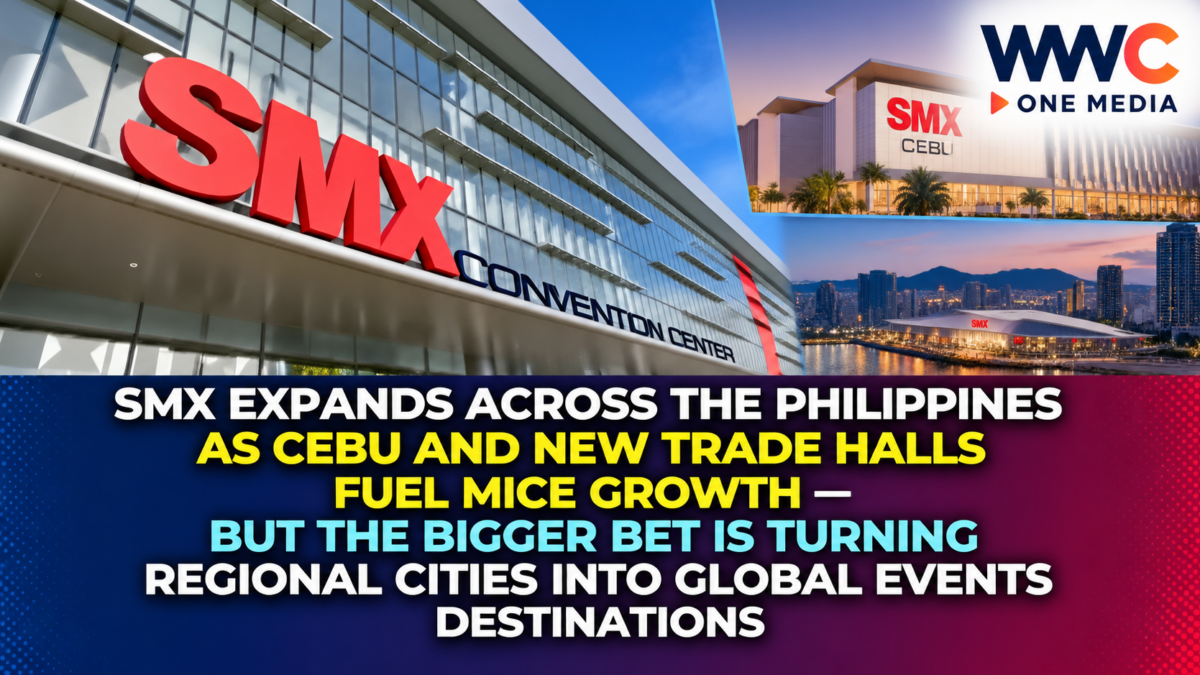
MANILA — SM Hotels and Conventions Corp. is accelerating one of the Philippines’ biggest convention-center expansions, betting that the next wave of business tourism will no longer be concentrated only in Metro Manila.
Through its:
SMX Convention Center
network, the SM group is adding new convention and trade facilities across:
Cebu
Nueva Ecija
Batangas
Laguna
and
Pasay.
The strategy is straightforward.
Bring world-class event infrastructure closer to:
regional business centers
industrial corridors
and
tourism destinations.
If it works, the result could reshape the country’s:
MICE industry — meetings, incentives, conferences and exhibitions.
Instead of international organizers automatically looking first to:
Manila
or
foreign regional hubs,
SM wants more Philippine cities to compete for:
trade fairs
corporate summits
international congresses
and
large exhibitions.
And the biggest project is rising in Cebu.
SMX SEASIDE CEBU IS THE CENTERPIECE
SMX Convention Center Seaside Cebu is being developed inside:
South Road Properties.
The facility has more than:
40,000 square meters of gross floor area
and approximately:
21,000 square meters of leasable event space.
That makes it the largest SMX facility in the company’s portfolio.
The venue includes:
4 trade halls
8 function rooms
and
19 meeting rooms.
It also connects directly with the wider SM Seaside development.
That gives organizers access to:
Hotels
Retail
Restaurants
and
Entertainment
within the same destination ecosystem.
CEBU COULD BECOME A MUCH BIGGER MICE HUB
Cebu already has several advantages.
It is one of the Philippines’ largest:
tourism destinations
and
business centers.
It has a major international airport.
It has a strong hotel market.
And it sits close to many of the country’s most important:
island destinations.
But large international events require more than beautiful beaches.
They need:
large halls
meeting rooms
transport connectivity
hotel inventory
and
professional event infrastructure.
That is the gap SMX Seaside Cebu is trying to fill.
THE PROJECT IS A ₱5.3-BILLION BET
SM Hotels and Conventions previously said the Cebu project represents approximately:
₱5.3 billion
in investment.
That is a substantial commitment.
Convention centers are expensive because operators need to build:
large column-free halls
high-capacity loading areas
specialized electrical systems
staging infrastructure
and
commercial kitchens.
But the economic return can extend far beyond the venue itself.
A major convention can fill:
Hotels
Restaurants
Airline seats
Taxis
and
Retail stores.
That means the economic impact spreads through the destination.
BUSINESS TOURISTS CAN BE MORE VALUABLE THAN ORDINARY TOURISTS
MICE travelers often spend more than leisure tourists.
They may pay for:
Business-class flights
Premium hotels
Corporate dinners
Private transport
and
Extended stays.
Some attendees also bring family members.
Others extend business trips into vacations.
That is why tourism agencies around the world compete aggressively for major international congresses.
One successful convention can bring:
thousands of high-spending visitors
into a city at once.
SMX IS NOT STOPPING WITH CEBU
Three new:
SMX Trade Halls
are scheduled for Luzon.
They are being developed in:
Cabanatuan, Nueva Ecija
Sto. Tomas, Batangas
and
Sta. Rosa, Laguna.
Together, these venues will contribute more than:
13,000 square meters
of leasable exhibition space.
These are smaller than the major SMX convention centers.
But that is deliberate.
The goal is to create:
regional event infrastructure.
CABANATUAN TARGETS CENTRAL LUZON
Cabanatuan sits inside one of the Philippines’ important:
agricultural
and
commercial
regions.
Businesses in Nueva Ecija and surrounding provinces often need to travel to:
Metro Manila
or
Clark
for large exhibitions.
A local SMX trade hall can change that.
Agricultural expos.
Construction fairs.
Corporate conferences.
Automotive shows.
Local government events.
All could be hosted much closer to regional participants.
That lowers travel costs.
It also keeps more event spending inside the local economy.
STO. TOMAS SITS INSIDE A MAJOR INDUSTRIAL CORRIDOR
Sto. Tomas, Batangas has another advantage.
It lies near one of the country’s most important manufacturing belts.
The surrounding area connects:
Batangas
Laguna
and
Cavite.
These provinces contain major factories producing:
Electronics
Automotive components
Food products
and
Industrial goods.
That creates demand for:
Trade shows
Supplier conferences
Corporate training
and
Business-to-business events.
A convention venue close to factories can be commercially attractive.
STA. ROSA HAS A SIMILAR ADVANTAGE
Sta. Rosa is already one of Southern Luzon’s biggest:
industrial
and
residential
centers.
It is home to major:
Automotive plants
Business parks
and
Commercial developments.
It is also connected directly to Metro Manila through:
SLEX.
An SMX Trade Hall there gives event organizers another alternative to venues inside the capital.
That could attract events serving:
CALABARZON businesses
without forcing participants into Metro Manila traffic.
SMX IS EFFECTIVELY FOLLOWING ECONOMIC GROWTH
The geographic pattern is not random.
SMX is expanding into areas where:
population
business activity
and
infrastructure investment
are rising.
This follows the same strategy used by SM’s:
Malls
Hotels
and
Residential developments.
As regional economies grow, demand for:
professional event space
also rises.
SMX is trying to enter those markets before competitors build comparable scale.
PASAY IS GETTING ANOTHER MAJOR PROJECT
Even while expanding regionally, SM is still increasing capacity in:
Metro Manila.
The new project is called:
SMXCITE — Center for International Trade and Exhibitions.
It will rise inside the:
Mall of Asia Complex.
The standalone exhibition center will add more than:
18,000 square meters
of leasable trade-hall space.
That effectively doubles the exhibition capacity available alongside:
SMX Convention Center Manila.
SMXCITE WILL HAVE FIVE EXHIBITION HALLS
The facility is designed with:
5 major exhibition halls
and
4 meeting rooms.
It can accommodate up to approximately:
803 standard 3-by-3-meter booths.
That is important for very large events.
Trade fairs often measure capacity in booth numbers because exhibitors require:
Display space
Storage
Electricity
and
Visitor circulation.
A venue capable of holding hundreds of booths can host much larger international exhibitions.
THE MALL OF ASIA COMPLEX IS ALREADY A MICE ECOSYSTEM
The MOA area has become one of the country’s most concentrated event districts.
It includes:
SMX Manila
Mall of Asia Arena
Hotels
Restaurants
Retail
and
Entertainment.
Large exhibitions at SMX already benefit nearby:
Hotels
and
Shopping centers.
Adding SMXCITE increases the number of events that can happen simultaneously.
That could turn the district into an even larger:
regional exhibition hub.
THE PHILIPPINES COMPETES WITH MUCH BIGGER MICE MARKETS
This expansion matters because the country faces formidable competition.
In Southeast Asia, major MICE destinations include:
Singapore
Bangkok
Kuala Lumpur
and
Jakarta.
These cities have invested heavily in:
Convention centers
Airports
Hotels
and
Public transport.
International organizers compare destinations carefully.
A city may have excellent tourism appeal.
But without sufficient:
meeting capacity
and
logistics,
it may lose the event.
SINGAPORE HAS SET A VERY HIGH STANDARD
Singapore is one of Asia’s strongest business-event hubs.
Its advantage includes:
World-class airports
Reliable transport
Premium hotels
and
Major venues.
The Philippines cannot simply compete by offering cheaper event halls.
It must offer a complete:
destination experience.
That includes:
Connectivity
Safety
Service
and
Professional event management.
THE PHILIPPINES HAS ONE NATURAL ADVANTAGE: DESTINATION APPEAL
Where the Philippines can compete strongly is:
tourism.
Business travelers attending an event in:
Cebu
can extend their trip to:
Bohol
Mactan
or
other islands.
That creates a powerful combination:
business plus leisure.
The industry calls this:
“bleisure.”
It is becoming increasingly important globally.
Employees attending conferences often add personal vacation days.
Destinations that offer both business infrastructure and leisure attractions can benefit.
CEBU IS PERFECTLY POSITIONED FOR BLEISURE
Cebu can offer:
International conferences
during the week
and
Beaches
Diving
Heritage tourism
and
Island trips
afterward.
That gives organizers another selling point.
A convention does not have to be simply:
a meeting.
It can become:
an experience.
That can improve attendance.
SMX ALREADY HOSTS SOME OF THE COUNTRY’S BIGGEST TRADE EVENTS
SMX Manila hosts major exhibitions including:
WORLDBEX
and
Manila International Auto Show.
The Tourism Promotions Board also lists a growing calendar of events across SMX facilities.
SMX Davao hosts major regional events.
Clark has also become an important:
Central Luzon event destination.
That existing network gives SMX a major advantage when opening new properties.
Organizers already know the brand.
ORGANIZERS CAN FOLLOW SMX ACROSS DIFFERENT CITIES
This is one of the strongest network effects.
Imagine an event organizer running exhibitions in:
Manila
Cebu
Davao
and
Clark.
Instead of negotiating with different venue operators in every city, the organizer can work with one:
SMX network.
That can simplify:
Contracts
Technical requirements
Catering
and
Event standards.
Consistency can be extremely valuable for national exhibitions.
SMX IS BECOMING A NATIONAL PLATFORM
The business therefore goes beyond renting halls.
SMX is effectively building:
a national event infrastructure network.
That could make it easier for major brands to launch:
Roadshows
Trade fairs
and
Corporate conferences
across the Philippines.
One event format could travel from:
Luzon
to
Visayas
to
Mindanao.
That creates scale.
SMX ALREADY OPERATES IN DAVAO
SMX Convention Center Davao at:
SM Lanang Premier
serves Mindanao.
This is important because Davao has grown into one of the country’s largest:
Business
and
Tourism
centers outside Luzon.
Events that previously required participants to fly to Manila can now be staged locally.
That improves accessibility for companies across Mindanao.
BACOLOD ALSO EXPANDS THE VISAYAS NETWORK
SMX has a presence in:
Bacolod.
That gives the company another regional foothold.
As Bacolod’s economy grows, demand increases for:
Corporate meetings
Social events
Trade gatherings
and
Professional conferences.
The strategy is the same:
Bring the event infrastructure closer to where businesses already operate.
CLARK IS BECOMING ANOTHER MAJOR MICE CENTER
Clark is particularly important.
Its advantages include:
Clark International Airport
Hotels
Casinos
Industrial parks
and
New transport infrastructure.
SMX Convention Center Clark opened in:
2022.
It has since hosted major:
Corporate events
Exhibitions
and
Conferences.
SMX is adding Cabanatuan to strengthen its wider Central Luzon network.
THE BRAND HAS ALSO BEEN WINNING AWARDS
SMX recently secured its third consecutive:
Philippines’ Best Convention & Exhibition Center
award at the:
2026 TTG Travel Awards.
The recognition was announced during the awards ceremony in:
Bangkok.
SMX Manila and SMX Clark have also received recognition in:
ASEAN tourism awards.
Awards do not automatically guarantee commercial success.
But they can strengthen a venue’s credibility with international organizers.
INTERNATIONAL EVENTS ARE SOLD YEARS IN ADVANCE
This is another important reason reputation matters.
Major conferences often select destinations:
two
three
or even
five years
ahead.
Organizers conduct:
site inspections
and evaluate:
capacity
hotel supply
airport access
and
service standards.
Winning international events therefore requires long-term destination marketing.
A strong venue brand can help.
THE TOURISM PROMOTIONS BOARD IS ALSO PUSHING MICE
The Philippine government increasingly treats MICE as a major tourism growth segment.
The Tourism Promotions Board promotes:
international congresses
trade fairs
and
regional business events.
Its calendar already includes major exhibitions hosted at SMX venues.
This matters because large conventions are rarely secured by one company alone.
They usually require coordination between:
Venue operators
Hotels
Airlines
Tourism agencies
and
Local governments.
THE ECONOMIC IMPACT CAN EXTEND FAR BEYOND TOURISM
MICE events also generate business activity.
A construction trade show can connect:
Developers
and
Suppliers.
An agricultural expo can connect:
Farmers
with
Technology providers.
A medical conference can connect:
Doctors
with
Pharmaceutical companies.
That means convention infrastructure can support:
commerce
as well as tourism.
THIS IS WHY REGIONAL TRADE HALLS MATTER
A smaller venue in Cabanatuan may not attract the same international congress as Cebu.
But it could host:
Agricultural expos
Regional government conferences
and
Business fairs.
Those events can create direct economic opportunities.
A local company that cannot afford to exhibit in Manila may be able to participate in a regional event.
That broadens access.
EVENTS CAN HELP DECENTRALIZE ECONOMIC ACTIVITY
The Philippines remains highly centralized around:
Metro Manila.
Businesses.
Corporate headquarters.
Conferences.
Government offices.
Many remain concentrated in the capital.
Regional convention centers encourage companies to hold more activities elsewhere.
That can distribute spending toward:
Cebu
Clark
Davao
Bacolod
and
CALABARZON.
This fits the broader goal of creating more economic centers outside Metro Manila.
INFRASTRUCTURE WILL DETERMINE HOW FAR THAT STRATEGY CAN GO
Building convention halls is only one part of the equation.
Cities also need:
Airports
Roads
Hotels
Reliable internet
and
Public transportation.
A beautiful venue surrounded by severe congestion can still struggle.
The strongest MICE destinations succeed because the entire visitor journey works.
That is the challenge Philippine cities still need to solve.
CEBU TRAFFIC REMAINS A REAL ISSUE
Cebu is a strong tourism destination.
But congestion can undermine the event experience.
South Road Properties provides:
large development space
and
better-planned infrastructure.
Still, connectivity to:
Mactan-Cebu International Airport
and
other parts of Metro Cebu
will remain important.
Large conventions can move thousands of delegates simultaneously.
Transportation capacity matters.
MANILA FACES THE SAME PROBLEM
Metro Manila has world-class venues.
But traffic can make travel between:
Airports
Hotels
and
Event centers
unpredictable.
The Mall of Asia Complex has advantages because:
Hotels
Retail
and
venues
are concentrated nearby.
That reduces the need for long-distance travel once delegates arrive.
Integrated development can therefore become a competitive advantage.
SM’S REAL ADVANTAGE MAY BE INTEGRATION
SM does not operate convention centers in isolation.
Its broader ecosystem includes:
Hotels
Malls
Entertainment venues
and
Commercial properties.
An event attendee may stay at an SM-linked hotel.
Attend a conference at SMX.
Eat inside an SM mall.
And shop afterward.
That allows different parts of the SM ecosystem to benefit from the same visitor.
This is a classic:
integrated destination strategy.
MORE EVENTS CAN ALSO BOOST HOTEL OCCUPANCY
SM Hotels and Conventions currently operates:
10 hotel properties
with more than:
2,600 rooms.
Convention demand can help fill those rooms during:
weekdays
and
off-peak periods.
That is valuable because leisure hotels often experience fluctuating occupancy.
Corporate events can create steadier demand.
EVENT CALENDARS CAN STABILIZE TOURISM
Leisure tourism is seasonal.
Beach destinations may experience peaks during:
summer
and
holidays.
MICE events can be scheduled throughout the year.
That makes tourism revenue more predictable.
Hotels.
Restaurants.
Airlines.
Transportation providers.
All benefit from more stable business travel.
THE PHILIPPINES COULD USE MORE INTERNATIONAL ASSOCIATION EVENTS
One of the highest-value segments is:
international association congresses.
These include conferences for:
Doctors
Engineers
Scientists
Technology professionals
and
Industry groups.
Delegates often stay several nights.
They frequently travel with:
colleagues
or
family.
Winning more of these events could generate substantial tourism revenue.
BUT BIGGER VENUES ALSO CREATE A CAPACITY RISK
There is another side to expansion.
Convention centers are expensive fixed assets.
A large hall makes money only when:
events actually use it.
If too many venues are built without enough demand, utilization can fall.
That creates pressure on:
Pricing
and
Profitability.
SMX therefore needs to do more than build facilities.
It needs to fill the calendar.
COMPETITION IS ALSO GROWING
Other developers and hotel groups are investing in convention infrastructure.
Cebu already has:
IEC Convention Center
and other large venues.
Megaworld is expanding event facilities.
Hotels are improving meeting capabilities.
That competition is healthy.
But it means SMX cannot rely solely on scale.
It needs:
Service quality
Technology
and
Strong organizer relationships.
TECHNOLOGY IS BECOMING MORE IMPORTANT IN EVENTS
Modern conventions require much more than:
chairs
and
projectors.
Organizers increasingly expect:
High-speed connectivity
Livestreaming
Hybrid-event systems
Digital registration
and
Data analytics.
International exhibitors also need:
Reliable power
and
Technical support.
The quality of those services can influence destination selection.
HYBRID EVENTS DID NOT DISAPPEAR AFTER THE PANDEMIC
Physical events have returned strongly.
But virtual participation remains useful.
A conference can have:
thousands in the venue
and
thousands more online.
That allows organizers to expand reach without increasing physical capacity indefinitely.
Convention centers that support hybrid formats therefore have an advantage.
SUSTAINABILITY IS BECOMING A COMPETITIVE FACTOR TOO
Corporate organizers increasingly ask venues about:
Energy efficiency
Waste management
Water use
and
Carbon emissions.
Companies have their own sustainability targets.
Holding an event at a resource-intensive venue can undermine those goals.
SMX and other venue operators will increasingly need to show measurable sustainability performance.
REGIONAL EVENTS CAN REDUCE TRAVEL TOO
There is a sustainability argument behind regional expansion.
If a company holds an event in:
Cabanatuan
instead of requiring hundreds of Central Luzon employees to travel to Manila,
it can reduce:
travel time
transportation costs
and
emissions.
Regional venues therefore offer both economic and operational advantages.
THE BIGGER STORY: SMX IS NOT JUST BUILDING CONVENTION HALLS — IT IS TRYING TO BUILD A NATIONAL BUSINESS-TOURISM NETWORK
The Cebu project gets attention because it will be:
SMX’s largest venue.
SMXCITE matters because it will dramatically increase Manila exhibition capacity.
But the smaller trade halls may reveal the broader strategy.
SM wants:
Cabanatuan
Sto. Tomas
Sta. Rosa
Clark
Bacolod
Davao
Cebu
and
Metro Manila
connected through one event platform.
That creates a network capable of serving:
Local business fairs
National roadshows
and
International conventions.
The economic impact goes far beyond ticket sales or venue rental.
Events bring:
Hotel bookings
Flights
Restaurant spending
Retail activity
and
Business deals.
They also create a reason for companies and professionals to travel to cities they might otherwise never visit.
That is why convention infrastructure can become part of:
regional economic development.
For the Philippines, the opportunity is substantial.
The country already has:
tourism appeal
English-speaking talent
and
strong hospitality culture.
What it has often lacked is enough:
large-scale modern event infrastructure
outside traditional hubs.
SMX is betting billions that closing that gap can bring more international events to the Philippines.
But the real test will not be how many convention halls the country builds.
It will be how many global organizers choose to fill them.
SMX is rapidly expanding the Philippines’ event infrastructure — but the bigger prize is whether Cebu, Clark, Davao and other regional cities can finally challenge Asia’s established MICE capitals for the billions generated by international business travel.