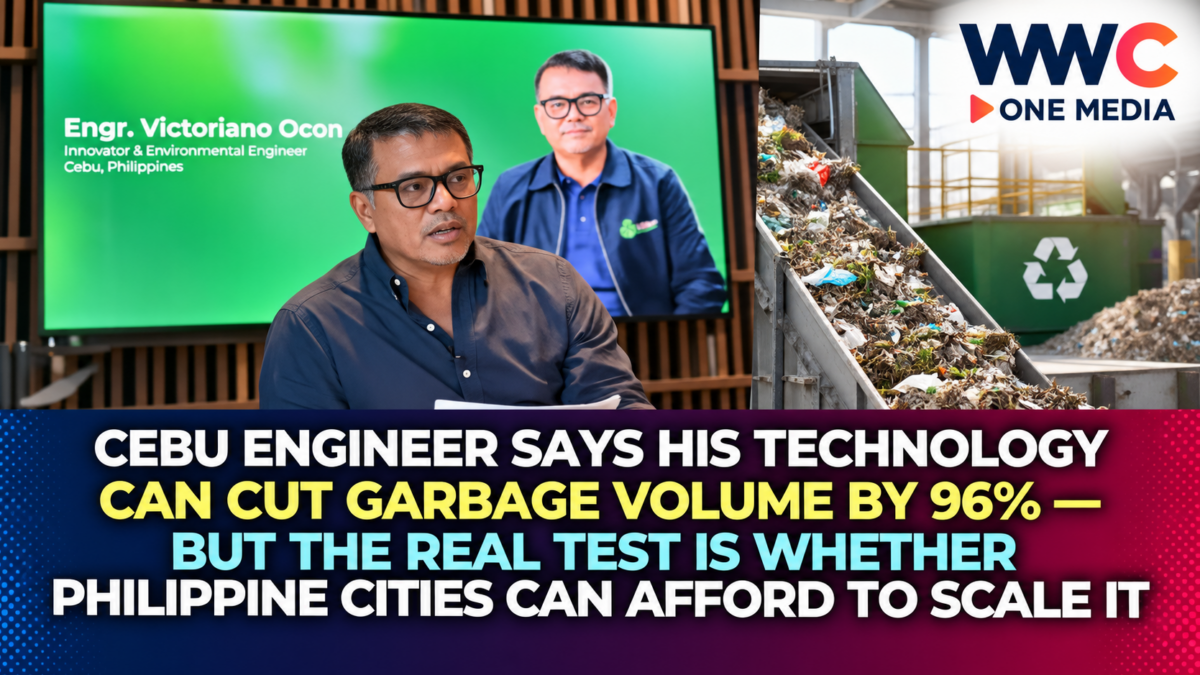
CEBU CITY — A Cebuano agricultural engineer says a locally developed waste-treatment system can shrink a ton of residual garbage into roughly 40 kilograms of ash, potentially giving Philippine cities a new weapon against overflowing landfills, soaring hauling costs and an increasingly urgent solid-waste crisis.
The technology was developed by:
Victoriano Ocon
president of:
Vic Metal Fabrication and Environmental Services Inc.
His system, called:
“Gasification Process for Waste Disposal: Advanced Waste Solution,”
uses controlled heat and limited oxygen to break down residual waste.
According to Ocon, the process can reduce the volume of material requiring final disposal by as much as:
96%.
That claim alone would be remarkable.
But its significance becomes much larger when viewed against what is happening across Cebu.
Earlier this year, the deadly collapse of the:
Binaliw sanitary landfill
exposed just how fragile the region’s waste-disposal infrastructure had become.
Cities suddenly had to find alternative locations.
Garbage accumulated.
Transportation costs surged.
And provincial and national officials began searching for technologies that could reduce the amount of waste that ever reaches a landfill in the first place.
Ocon believes his system can help provide that missing piece.
THE TECHNOLOGY JUST WON A NATIONAL INNOVATION AWARD
Ocon’s system was one of only:
five innovations
selected as winners of the:
2026 Presidential Filipinnovation Awards.
The national competition recognizes Filipino-developed technologies with commercial potential and measurable community benefits.
The Department of Science and Technology Central Visayas confirmed Vic Metal’s gasification technology was among this year’s awardees.
That gives the project more credibility than a typical experimental waste machine.
It has moved beyond a workshop prototype.
It has already entered commercial deployment.
OCON RECEIVED ₱3.5 MILLION TO DEVELOP IT FURTHER
The award includes approximately:
₱3.5 million
in support for continued development.
Ocon says he wants to use the funding to push the technology toward:
waste-to-energy.
The long-term concept is to capture more of the heat generated during gasification and convert it into:
electricity.
If that works commercially, the system would do more than reduce landfill volume.
It could potentially turn part of the waste stream into:
usable energy.
That is a far more ambitious proposition.
HOW DOES THE GASIFICATION SYSTEM WORK?
The basic principle is different from simply setting garbage on fire.
Conventional combustion typically uses a relatively unrestricted supply of:
oxygen.
Gasification operates with:
limited oxygen
and controlled temperatures.
The waste is heated inside a chamber.
Instead of completely burning everything immediately, thermal decomposition produces:
combustible gases
ash
and
other byproducts.
Those gases can then undergo further treatment or potentially be used as an energy source.
The goal is to recover useful value while dramatically reducing the amount of physical material left behind.
THE CLAIM: ONE TON OF WASTE BECOMES ABOUT 40 KILOGRAMS OF ASH
Ocon says treating:
1,000 kilograms of waste
can leave approximately:
40 kilograms
of ash.
That corresponds to the company’s claim of:
up to 96% volume reduction.
For cities that currently pay to transport hundreds of tons of garbage every day, that could dramatically change the economics.
Instead of hauling nearly all collected residual waste to a landfill, an LGU could theoretically treat much of it locally and transport only the remaining material.
That means fewer:
garbage trucks
landfill trips
and
tipping fees.
But real-world savings depend on operating costs, fuel, labor, maintenance and environmental compliance.
THE ASH DOES NOT NECESSARILY HAVE TO BECOME WASTE
Ocon says the residual ash can be used as a substitute for:
fine sand
in the manufacture of hollow blocks.
Some local governments using the technology have reportedly used blocks containing recovered ash for:
drainage projects
low-cost housing
and
burial vaults.
That moves the system closer to a:
circular-economy model.
Instead of treating ash entirely as waste, some of it becomes a construction input.
But this is an area where quality control matters.
Material reused in construction needs appropriate testing to ensure:
strength
durability
and
chemical safety.
Waste reduction is valuable only if environmental risk is not simply transferred somewhere else.
THE TECHNOLOGY CAN ALSO SPEED UP COMPOSTING
Ocon says waste heat from the treatment system can be used to accelerate the processing of:
biodegradable material.
Traditional composting can take:
around 15 days or longer
depending on the method.
He says heat-assisted processing can shorten part of that process dramatically, potentially to:
overnight treatment
under some operating conditions.
That could matter because biodegradable waste represents a huge share of Philippine municipal garbage.
Separating food and organic waste before thermal treatment can also reduce:
moisture
and
improve efficiency.
THE SMALLEST SYSTEM COSTS ABOUT ₱45 MILLION
The entry-level installation is not cheap.
Ocon says the smallest facility costs about:
₱45 million.
It can process approximately:
20 tons of waste per day.
That means local governments have to compare the upfront capital expense against years of:
hauling
landfill fees
fuel
and
disposal costs.
For some cities, the economics could become attractive quickly.
For smaller municipalities, financing may remain difficult.
That is why support from:
DOST
development banks
and
government financing programs
could become important.
THE SYSTEM NEEDS ONLY ABOUT 100 SQUARE METERS
One advantage is its relatively small physical footprint.
Ocon says a small facility can fit on approximately:
100 square meters.
That makes it possible to install the equipment inside or beside existing:
materials recovery facilities.
Land availability is one of the biggest problems in waste management.
Nobody wants a landfill beside their community.
Finding hundreds of hectares near urban areas can become politically and economically impossible.
A compact treatment system could reduce that problem.
OCON SAYS 20 LGUS HAVE ALREADY ADOPTED THE TECHNOLOGY
According to Ocon, around:
20 local government units
have already acquired or adopted versions of the technology.
Four are in Cebu:
Lapu-Lapu City
Alegria
Compostela
and
Tuburan.
Other reported users include:
Malolos City
and facilities outside Cebu.
That demonstrates the system is not simply theoretical.
However, the exact operational status and performance of every installation have not been independently documented in the same level of detail.
That will matter as the technology scales.
THE LARGEST INSTALLATION IS REPORTEDLY IN MALOLOS
Ocon says the largest deployed system is in:
Malolos City, Bulacan.
Its designed capacity is approximately:
30 cubic meters of waste per hour.
Capacity varies by location.
An LGU generating 50 tons of waste per day may purchase only a 20-ton system if that is all its budget allows.
That means gasification may not completely eliminate the need for:
landfills.
Instead, it can reduce how much material needs to reach them.
THAT MAY BE THE MORE REALISTIC GOAL
There is no single machine that solves an entire city’s garbage problem.
Effective solid-waste management requires several layers:
Waste reduction
Segregation
Recycling
Composting
Materials recovery
Residual treatment
and
Sanitary disposal.
Gasification addresses primarily the:
residual fraction.
That distinction matters.
Cities should not treat thermal technology as permission to stop recycling or segregation.
The cleaner the waste stream entering the plant, the more efficient and environmentally manageable the process can become.
CEBU NEEDS ALTERNATIVES URGENTLY
The technology is arriving at a critical moment.
On:
January 8, 2026,
the Binaliw sanitary landfill suffered a catastrophic trash slide.
Thirty-six people were ultimately reported killed.
The disaster forced authorities to reconsider Cebu’s waste infrastructure.
DENR ordered officials to develop:
long-term and resilient solutions
instead of relying on temporary disposal arrangements.
The incident transformed waste management from a routine municipal issue into a major regional crisis.
CEBU CITY’S GARBAGE COSTS LATER DOUBLED
The financial impact quickly became visible.
After Binaliw operations were disrupted, Cebu City had to transport large volumes of waste farther away.
Local reporting said the city was spending approximately:
₱4.2 million per day
to haul roughly:
700 tons of garbage
to Aloguinsan.
Previously, disposal involving Binaliw cost roughly:
₱2.1 million daily.
That means the waste crisis effectively doubled daily disposal expenses.
At ₱4.2 million every day, the annualized cost could exceed:
₱1.5 billion
if sustained for a full year.
That puts Ocon’s ₱45-million entry-level system into a very different financial perspective.
BUT CAPACITY HAS TO MATCH THE PROBLEM
There is also a mathematical reality.
If Cebu City generates around:
700 tons of garbage per day,
a single 20-ton-per-day system would handle less than:
3%
of that daily volume.
So solving a large city’s waste problem would require:
multiple units
or
much larger installations.
That raises capital requirements substantially.
Technology that works for a municipality generating 20 or 30 tons a day may require a very different configuration in a major urban center.
CEBU IS ALREADY STUDYING OTHER WASTE TECHNOLOGIES
The provincial government is not relying on one solution.
Cebu has begun work on a proposed:
Green Transformation Eco-Industrial Park
with Japanese waste-management company:
GUUN Co. Ltd.
That project aims to convert various waste streams into:
recycled products
and
alternative fuels.
Cebu has also proposed integrated solid-waste facilities for the:
north
and
south
of the province.
The larger strategy is becoming clear.
Cebu wants to move away from a system where most garbage simply ends up buried.
THAT IS EXACTLY WHAT REPUBLIC ACT 9003 ENVISIONED
The Philippines’ Ecological Solid Waste Management Act requires LGUs to prioritize:
segregation
recycling
composting
and
resource recovery.
Open dumping is prohibited.
Sanitary landfills should primarily receive:
residual waste.
Yet implementation remains uneven.
Many communities still depend heavily on landfill disposal.
As populations grow, the volume arriving at these facilities becomes increasingly difficult to manage.
THE NATIONAL GARBAGE PROBLEM IS GETTING BIGGER
The problem is not unique to Cebu.
In Metro Manila alone, DENR data show an estimated:
4.34 million tons
of solid waste were generated in:
2025.
Per-capita generation increased from:
0.71 kilogram per person per day in 2024
to:
0.75 kilogram in 2025.
At the same time, waste-diversion performance declined slightly.
That is the opposite direction cities need.
More garbage is being produced while the capacity to divert it from disposal struggles to keep pace.
THIS IS WHY 96% REDUCTION ATTRACTS SO MUCH ATTENTION
Imagine a city that sends:
100 tons
of residual waste to landfill every day.
A genuine 96% reduction could theoretically leave only a small fraction requiring final disposal.
That could:
extend landfill life
reduce truck traffic
cut fuel consumption
and
lower disposal fees.
It could also reduce pressure to continuously find new landfill sites.
For densely populated islands and urban areas, that is a compelling proposition.
But engineering claims need to be proven consistently under actual operating conditions.
EMISSIONS ARE THE CRITICAL ENVIRONMENTAL QUESTION
Every thermal waste technology eventually faces the same scrutiny:
What comes out of the stack?
Gasification can be technically different from conventional mass-burn incineration.
But heating mixed municipal waste can potentially create:
particulates
acid gases
heavy-metal emissions
and
other pollutants
if the system is poorly designed or operated.
That is why Ocon’s equipment includes pollution-control components.
THE SYSTEM USES A CYCLONE AND SCRUBBER
Ocon says gases from the process pass through:
a cyclone separator
and
a scrubber.
Cyclones can remove particulate matter from gas streams.
Scrubbers can help capture certain pollutants before exhaust reaches the atmosphere.
According to Ocon, third-party testing has shown the system complies with:
DENR environmental standards.
That is an important claim.
But environmental performance must remain consistent throughout the equipment’s operating life.
A machine that passes when new still needs:
maintenance
monitoring
and
proper operation
years later.
PHILIPPINE LAW MAKES THIS PARTICULARLY IMPORTANT
Republic Act 8749, the:
Philippine Clean Air Act,
contains a ban on incineration defined around the burning of municipal, biomedical and hazardous waste that emits poisonous and toxic fumes.
The law also establishes emission standards for stationary sources.
That means a technology cannot simply call itself:
gasification
and assume it is automatically environmentally acceptable.
Performance matters.
The actual:
process
emissions
and
regulatory approvals
matter.
LGUs considering any thermal-treatment system should therefore require comprehensive environmental documentation rather than relying solely on marketing claims.
TECHNOLOGY TRANSFER IS PART OF OCON’S BUSINESS MODEL
Vic Metal says it is not trying to operate every municipal waste facility itself.
Instead, it sells:
equipment
and
technical know-how.
The package can include:
facility construction
equipment installation
operator training
and
first-year maintenance support.
After that, an LGU can continue using Vic Metal’s maintenance service or use another qualified provider.
That approach is important because waste infrastructure lasts much longer than the politician who bought it.
THE EQUIPMENT IS EXPECTED TO LAST 10 TO 15 YEARS
Ocon estimates a typical facility’s operating life at approximately:
10 to 15 years
before substantial rehabilitation becomes necessary.
That means LGUs need to calculate:
lifetime cost
rather than simply purchase price.
A ₱45-million machine that needs expensive repairs, specialized fuel or imported parts could become costly.
One that runs reliably for 15 years and replaces millions of pesos in annual hauling charges could become extremely economical.
Procurement should focus on the entire lifecycle.
EARLIER DEPLOYMENTS SHOW WHY LONG-TERM PERFORMANCE MATTERS
Other gasification technologies have already operated in Cebu.
In 2023, the Development Bank of the Philippines financed a waste-treatment facility at the:
Mactan Economic Zone
using a thermal gasification and oxidation process.
That system was projected to reduce waste volume by:
97%.
DOST had issued an Environmental Technology Verification statement for the technology.
This shows the concept itself is not completely new to the Philippines.
The real challenge is scaling thermal-treatment systems reliably, economically and safely across many LGUs.
OCON’S ADVANTAGE IS THAT THE TECHNOLOGY IS HOMEGROWN
Local engineering matters.
Imported waste systems can be expensive.
Replacement parts may be difficult to obtain.
Foreign technicians can add maintenance costs.
A locally developed system can potentially offer:
cheaper fabrication
faster repairs
and
easier customization.
It can also be designed around Philippine waste composition rather than conditions in Europe or Japan.
That could be one of Vic Metal’s biggest advantages.
PHILIPPINE WASTE IS OFTEN WET
Municipal waste in the Philippines contains significant quantities of:
food
and
organic material.
Wet waste is difficult for thermal systems because water absorbs heat.
That lowers energy efficiency.
This is another reason:
segregation
and
composting
remain essential.
Removing biodegradable material first allows the thermal system to focus on dry residual waste.
That improves efficiency and reduces unnecessary energy consumption.
ZERO WASTE WILL REQUIRE MORE THAN GASIFICATION
Ocon’s stated goal is ambitious:
“Zero waste, going to electricity.”
It is a powerful vision.
But zero waste requires more than thermal destruction.
The hierarchy should still begin with:
Reduce.
Then:
Reuse.
Then:
Recycle.
Then:
Compost.
Only material that cannot reasonably be recovered should require final treatment.
Otherwise, valuable plastics, metals or other recyclable materials could be destroyed instead of recovered.
WASTE-TO-ENERGY IS THE NEXT BIG TEST
The next stage of Ocon’s development is potentially more transformative.
If waste heat can be converted into electricity efficiently, municipalities could offset part of their operating cost.
A facility could theoretically:
treat garbage
while also
generating power.
But power generation introduces another level of complexity.
The system would need to demonstrate:
consistent heat output
energy efficiency
grid compatibility
and
financial viability.
The amount of electricity produced will ultimately determine whether the waste-to-energy promise is commercially meaningful.
DOST SUPPORT COULD HELP BRIDGE THAT GAP
The Department of Science and Technology has supported Vic Metal’s development.
Government backing is valuable because innovative environmental technology often faces a difficult financing gap.
A prototype may work.
But moving from prototype to:
commercial-scale deployment
requires:
engineering
testing
certification
and
capital.
The Presidential Filipinnovation Award can help give the company credibility with:
banks
LGUs
and
private investors.
BUT GOVERNMENT AWARDS SHOULD NOT REPLACE INDEPENDENT PERFORMANCE TESTING
Recognition is important.
It is not a substitute for due diligence.
Every LGU considering the technology should still evaluate:
actual waste throughput
downtime
maintenance cost
fuel consumption
emissions
ash quality
and
total cost per ton.
Performance data from operating facilities will ultimately determine whether the system becomes:
a national solution
or
a niche technology.
THE MOST IMPORTANT NUMBER MAY NOT BE 96%
The 96% reduction claim gets attention.
But local governments should arguably focus on another figure:
cost per ton successfully treated.
Imagine two technologies.
One reduces waste by:
96%
but costs:
₱10,000 per ton.
Another reduces waste by:
85%
but costs:
₱2,000 per ton.
The second may make more economic sense.
Engineering performance and economics have to work together.
CEBU NOW HAS A CHANCE TO BECOME A NATIONAL TEST BED
Cebu’s waste crisis is painful.
But it also creates an opportunity.
The province is already evaluating:
Japanese recycling technology
integrated waste facilities
local gasification
and
resource-recovery projects.
If these systems are independently monitored and compared, Cebu could provide the Philippines with valuable evidence about what actually works.
That would benefit LGUs nationwide.
THE BIGGER STORY: THE PHILIPPINES DOES NOT NEED ANOTHER GARBAGE MACHINE — IT NEEDS A WASTE SYSTEM THAT ACTUALLY WORKS
Victoriano Ocon’s invention deserves attention.
It is:
Filipino-developed.
It has received national recognition.
It is already being used by local governments.
And according to its developer, it can reduce residual waste by as much as:
96%.
For cities spending millions every day hauling garbage to distant landfills, that is potentially transformative.
But the ultimate test is not the award.
It is not the headline percentage.
And it is not even whether the machine works once.
The real test is whether an LGU can run the system:
every day
for:
10 to 15 years
while maintaining:
safe emissions
manageable costs
and
reliable throughput.
Cebu knows what happens when waste infrastructure fails.
Thirty-six people died in the Binaliw landfill collapse.
Garbage disposal costs surged.
Temporary dumping arrangements ran into environmental problems.
And officials were forced to search urgently for alternatives.
That makes locally developed innovation more important than ever.
But it also makes rigorous testing more important than ever.
A Cebu engineer may have built a machine capable of shrinking garbage by 96% — but the real breakthrough will come only if Philippine cities can prove it is cleaner, cheaper and safer than simply moving mountains of trash from one landfill to another.