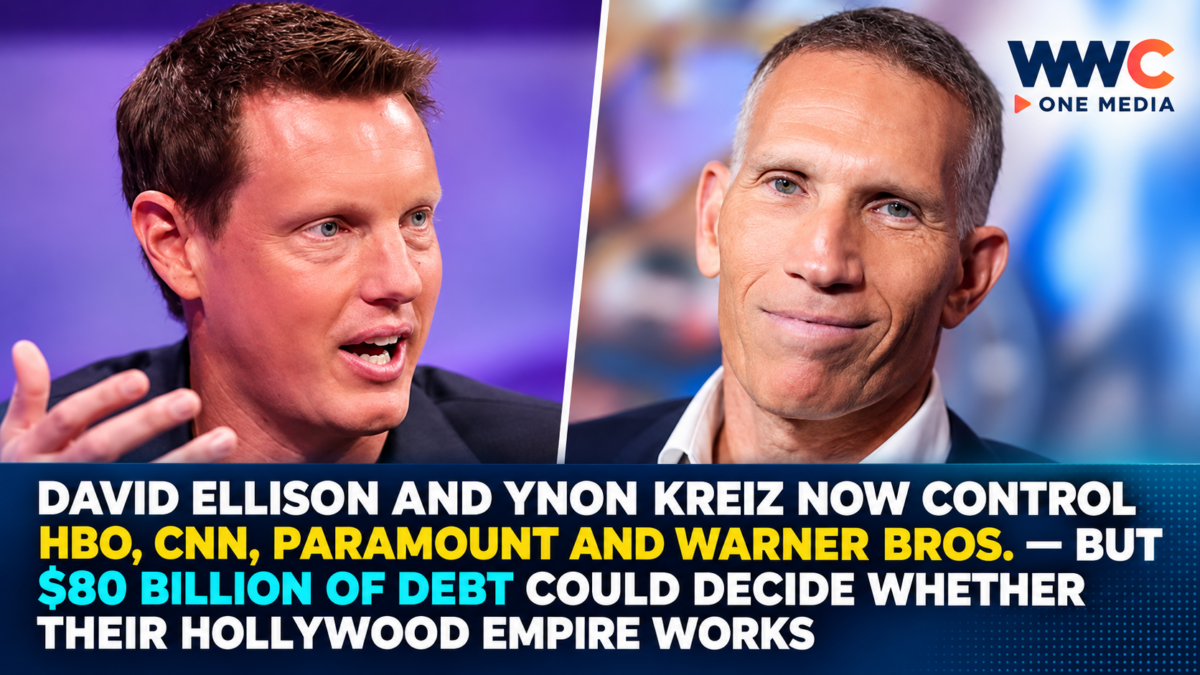
NEW YORK — David Ellison and Ynon Kreiz are taking control of one of the most powerful collections of entertainment assets ever assembled, promising to turn the newly created Skydance into a technology-driven Hollywood giant capable of competing directly with Netflix, Disney, Amazon and even Silicon Valley.
But they are beginning with an enormous problem:
roughly $80 billion of debt.
The new company was created after Paramount Skydance completed its blockbuster acquisition of Warner Bros. Discovery.
The transaction was valued at approximately:
$110 billion.
And the combined media empire now includes:
Paramount Pictures
Warner Bros. Pictures
CBS
CNN
HBO
HBO Max
Paramount+
Discovery
DC Studios
and
Pluto TV.
Its intellectual-property vault includes some of the most valuable franchises in entertainment:
Harry Potter
Superman
Batman
Lord of the Rings
Game of Thrones
Mission: Impossible
Top Gun
Transformers
and
Star Trek.
The scale is breathtaking.
Now Ellison and Kreiz have to prove that bigger actually means better.
THE DEAL IS DONE
This is no longer merger speculation.
The Paramount-Warner Bros. Discovery transaction officially closed on:
October 6, 2026.
The combined company is now called:
Skydance.
Shares moved to the:
New York Stock Exchange
under the ticker:
SKYD.
Ellison said the new corporate name was deliberately chosen so that:
Paramount
and
Warner Bros.
could continue operating as powerful studio brands rather than being buried inside a hyphenated corporate identity.
That is strategically important.
The studios have more consumer recognition than the parent company.
DAVID ELLISON REMAINS THE TOP EXECUTIVE
David Ellison is:
Chairman and Chief Executive Officer.
He remains the company’s principal executive officer.
His responsibilities center on:
Strategy
Creative direction
and
Technology.
Ellison is the son of Oracle co-founder:
Larry Ellison.
But he has spent years building his own entertainment company through Skydance Media.
His original studio produced and financed movies including entries in:
Mission: Impossible
Top Gun
and
Terminator.
Now he controls one of Hollywood’s largest conglomerates.
YNON KREIZ IS THE NEW CO-CEO
Ynon Kreiz officially became:
Co-Chief Executive Officer
in early October.
He joins after leading:
Mattel
since 2018.
Under the leadership structure, Kreiz will focus heavily on:
day-to-day operations
integration
efficiency
and
execution.
Ellison described the arrangement as a division of labor based on their complementary strengths.
The logic is straightforward.
Ellison wants to spend more time deciding:
what Skydance should become.
Kreiz is being asked to make sure the organization actually gets there.
KREIZ’S MOST IMPORTANT NUMBER IS $6 BILLION
Skydance says it expects more than:
$6 billion
in merger synergies over approximately:
three years.
Those savings are expected to come from areas including:
Technology consolidation
Marketing
Real estate
Corporate overhead
and
Some workforce reductions.
Kreiz told CNBC that employee cuts will be part of the plan.
But he argued that labor will not represent the majority of the savings.
The bigger goal is what he described as:
re-engineering how the company works.
THIS IS WHY KREIZ WAS HIRED
Kreiz has built a reputation as a restructuring executive.
When he became Mattel CEO in 2018, the toy company was struggling.
Kreiz pushed through significant cost reductions.
Reuters estimates Mattel ultimately generated more than:
$1.5 billion
of savings under his restructuring programs.
He simplified manufacturing.
Reduced costs.
And shifted the company toward treating brands as entertainment franchises rather than simply toy products.
That strategy produced one spectacular example:
Barbie.
BARBIE MAY HAVE HELPED KREIZ LAND THE BIGGEST JOB OF HIS CAREER
Kreiz spent years arguing that Mattel should monetize its intellectual property through:
Movies
Television
Games
Consumer products
and
Experiences.
The 2023 Barbie movie became the clearest validation of that strategy.
And ironically, it was distributed by:
Warner Bros.
The film became Warner Bros.’ highest-grossing global theatrical release.
Now Kreiz is running the company that owns Warner Bros.
That background matters because Skydance has exactly the kind of IP portfolio Kreiz likes.
SKYDANCE’S IP LIBRARY IS ENORMOUS
Consider the franchises now under one corporate roof.
From Warner Bros.:
Harry Potter
DC
Lord of the Rings
Game of Thrones
Mortal Kombat
and
Barbie-related film interests.
From Paramount:
Mission: Impossible
Transformers
Star Trek
Top Gun
Teenage Mutant Ninja Turtles
and
SpongeBob SquarePants.
Kreiz’s job is not simply to make movies from those properties.
It is to turn them into:
Games
Merchandise
Experiences
Consumer products
and
Long-term franchises.
WARNER BROS. HAS HISTORICALLY UNDERMONETIZED ITS IP
This is one of the more interesting arguments supporting the merger.
Reuters cited Raymond James analysts estimating that Warner Bros. earns only around:
30 cents
for every dollar Disney generates from comparable franchise ecosystems.
Disney has spent decades learning how to turn one piece of IP into:
Movies
Theme parks
Merchandise
Cruises
Streaming
and
Consumer products.
Warner Bros. has major franchises.
But it has historically extracted less economic value from many of them.
Kreiz has been hired partly to close that gap.
THE NEW COMPANY HAS MORE THAN 200 MILLION STREAMING SUBSCRIBERS
Scale is one of Ellison’s biggest arguments.
Combined:
HBO Max
and
Paramount+
have more than:
200 million global streaming subscribers.
Pluto TV adds approximately:
80 million monthly active users.
That immediately gives Skydance much greater streaming scale.
The company can now compete more directly with:
Netflix
Disney
Amazon Prime Video
and
YouTube.
But subscriber count alone does not guarantee profitability.
SKYDANCE STILL HAS TO DECIDE WHAT TO DO WITH HBO MAX AND PARAMOUNT+
One of the biggest strategic questions is whether the services remain:
separate
or
eventually become more integrated.
HBO Max has a premium identity built around:
HBO
Warner Bros.
and
prestige programming.
Paramount+ offers:
CBS
sports
movies
and
franchise entertainment.
Combining the services could reduce:
technology costs
and
customer churn.
But it could also create:
brand confusion
and
price increases.
Management has not yet announced a simple full-merger solution.
SPORTS MAY BE ONE OF THE NEW COMPANY’S MOST POWERFUL WEAPONS
Skydance now controls rights and relationships spanning:
NFL
MLB
NHL
PGA
UEFA
and other sports.
Sports remain one of the few categories capable of generating enormous:
live audiences.
That makes them especially valuable as traditional television declines.
CBS’s NFL rights are particularly important.
Live sports can keep customers subscribed to:
linear television
and
streaming services.
That gives Skydance another advantage over entertainment-only competitors.
THE COMPANY ALSO CONTROLS TWO MAJOR NEWS ORGANIZATIONS
The merger puts:
CNN
and
CBS News
inside the same corporate structure.
CNN chief:
Mark Thompson
will remain in charge of CNN.
CBS News editor-in-chief:
Bari Weiss
will also remain.
Both report into the senior Skydance leadership structure.
That arrangement has attracted political attention because news independence became a major issue during regulatory approval of the merger.
SKYDANCE AGREED TO AN EDITORIAL INDEPENDENCE BOARD
As part of settlements that helped clear legal opposition to the acquisition, Ellison agreed to establish an:
editorial independence board
covering CNN and CBS News.
Critics have questioned how much real authority that body will have.
But the commitment reflects the unusual power now concentrated inside Skydance.
This is not simply an entertainment company.
It owns major:
Film studios
TV networks
Sports rights
Streaming services
and
News organizations.
HOLLYWOOD HAS RARELY SEEN THIS MUCH CONTENT UNDER ONE ROOF
AP estimates Paramount and Warner Bros. properties accounted for roughly:
11.8% of total U.S. television viewing
in July.
Ellison told CNBC the figure is around:
12%.
He said that would put Skydance behind only:
YouTube
in overall television viewing share.
That illustrates why he fought so aggressively to buy Warner Bros. Discovery.
He believes scale is the only realistic way for traditional Hollywood companies to compete with:
technology platforms.
ELLISON SAYS HOLLYWOOD FAILED TO ADAPT
Ellison’s diagnosis of the old media industry’s problems is unusually harsh.
He argues traditional media companies allowed:
Netflix
and
Amazon
to disrupt them.
They clung too long to:
cable television
and
legacy distribution.
The new Skydance strategy is supposed to combine Hollywood’s creative assets with a:
Silicon Valley mindset.
Technology is central to that pitch.
AI WILL BE PART OF THE STRATEGY
Ellison has repeatedly emphasized:
artificial intelligence.
He believes AI will transform virtually every part of the entertainment business.
Potential applications include:
Production
Post-production
Advertising
Localization
Recommendation systems
and
Business operations.
That could reduce costs and accelerate workflows.
But this is also one of the most politically sensitive issues in Hollywood.
Writers and actors remain concerned about AI replacing creative labor.
SKYDANCE CANNOT SIMPLY USE AI TO ELIMINATE PEOPLE
The company is constrained by:
union agreements
and
legal settlements.
Hollywood labor organizations fought aggressively over AI during previous strikes.
Studios are expected to respect contractual protections involving:
Actors
Writers
and
Creative work.
That means Skydance’s use of AI will likely focus initially on:
productivity
and
operational efficiency
rather than openly replacing entire creative categories.
Still, the issue will remain contentious.
ELLISON ALSO PROMISED MORE MOVIES, NOT FEWER
As part of the settlement that cleared the merger, Ellison committed the combined studios to release:
30 films annually
during the first two years.
That rises to:
32 films per year
during the following three years.
That is important.
Media consolidation is often followed by:
fewer productions
and
fewer jobs.
Skydance is publicly promising the opposite in theatrical output.
Delivering both:
higher production
and
billions in cost savings
will be difficult.
THE COMPANY ALSO AGREED TO SPEND MORE ON U.S. FILM PRODUCTION
Reuters reports Skydance must spend at least an additional:
$300 million per year
on domestic film production.
It also agreed to maintain both legacy studio lots.
And it must respect existing Hollywood labor agreements.
Those commitments eliminate several easy merger savings.
The company cannot simply:
close a studio lot
or
slash production dramatically
to hit its targets.
Kreiz therefore needs to find efficiencies elsewhere.
THE $80 BILLION DEBT LOAD IS THE REAL PROBLEM
Skydance enters this new era with roughly:
$79 billion to $80 billion
of debt.
That number overshadows nearly every strategic discussion.
Debt itself is not automatically dangerous.
A business with stable cash flows can support large borrowings.
But media is undergoing enormous disruption.
Cable television is shrinking.
Streaming is expensive.
Advertising is volatile.
And content requires constant reinvestment.
That makes the leverage particularly important.
THE COMPANY STARTS NEAR SEVEN TIMES LEVERAGE
CNBC challenged Ellison on the fact that leverage begins near:
seven times.
Management’s goal is to reduce that to around:
three times
within roughly:
three years.
That would require a massive improvement.
There are only a few ways to reduce leverage.
Increase:
earnings.
Generate:
cash.
Sell:
assets.
Or reduce:
debt.
Ellison says the company can do all of that while continuing to invest heavily.
SKYDANCE SAYS IT WILL SAVE MORE THAN $6 BILLION
This is where the merger synergies become critical.
Kreiz says the company can generate more than:
$6 billion
in savings.
He identified major opportunities in:
technology
marketing
real estate
and
operations.
Management’s confidence partly comes from its experience at Paramount.
Skydance previously promised around:
$2 billion
in Paramount savings.
Ellison now says the company expects to deliver approximately:
$2.7 billion
by year-end.
That overperformance is being used as evidence that the much larger Warner target is achievable.
BUT $6 BILLION IN SAVINGS WILL NOT BE ENOUGH BY ITSELF
The company must grow too.
Ellison and Kreiz are targeting roughly:
mid-single-digit annual revenue growth
through 2030.
That may sound modest.
But on nearly:
$70 billion
of annual revenue, even 5% growth represents billions of dollars.
Management wants the combination of:
growth
and
cost savings
to dramatically expand cash flow.
FREE CASH FLOW IS SUPPOSED TO HIT $10 BILLION
Ellison says the business could generate roughly:
$4 billion
in free cash flow next year after adjusting for transaction costs.
By:
2030,
management is targeting:
$10 billion.
That number is crucial.
Debt ultimately gets paid with:
cash.
If Skydance can generate $10 billion annually, the $80 billion debt pile becomes much more manageable.
If free cash flow disappoints, the leverage could become a serious problem.
INTEREST ALONE COULD COST BILLIONS
CNBC noted annual interest expense could approach around:
$6 billion.
That is an extraordinary burden.
Every dollar spent servicing debt cannot be spent on:
Movies
Sports rights
Streaming technology
or
New franchises.
This is why management cannot simply rely on creative success.
It needs financial discipline.
SKYDANCE STILL PLANS TO PAY A DIVIDEND
The company also expects to pay roughly:
$800 million
in dividends.
CNBC questioned why a highly leveraged company would return money to shareholders instead of paying down debt faster.
Ellison’s answer was essentially that strong future cash generation will allow Skydance to do both.
That is a confident assumption.
It will be tested quickly.
THE BIGGEST STRUCTURAL PROBLEM IS CABLE
Traditional cable networks remain profitable.
But subscribers continue leaving.
That affects assets across:
Warner
Discovery
and
Paramount.
Cable networks can still produce substantial cash.
But long-term decline is difficult to reverse.
Ellison argues the decline is beginning to:
flatten.
He also believes combining two portfolios extends their economic life.
CBS IS DIFFERENT FROM MANY CABLE NETWORKS
Ellison remains particularly bullish on:
CBS.
Broadcast television still reaches enormous audiences.
CBS remains a major home for:
NFL football
primetime entertainment
and
news.
Ellison said recent primetime performance showed substantial year-over-year gains.
That cash-generating broadcast business could help finance the transition toward streaming.
HBO MAY BE THE MOST VALUABLE PREMIUM BRAND IN STREAMING
Warner Bros. brings another huge advantage:
HBO.
HBO has produced decades of premium programming.
Its catalog includes:
The Sopranos
Game of Thrones
Succession
The Last of Us
and many others.
That brand gives Skydance a premium streaming identity that Paramount never fully possessed.
The challenge is preserving that quality while extracting more financial value.
WARNER BROS. ALSO BRINGS DC
DC Studios gives Skydance access to:
Batman
Superman
Wonder Woman
and
other superheroes.
Disney demonstrated how valuable superhero franchises can become when properly coordinated.
But Warner’s DC strategy has historically suffered from:
inconsistent execution.
James Gunn remains in place leading DC Studios.
If Gunn can build a successful connected universe, DC could become one of Skydance’s most valuable growth engines.
HARRY POTTER MAY BE EVEN MORE IMPORTANT
Harry Potter remains one of the largest entertainment franchises in the world.
Warner is developing a major:
HBO television adaptation.
The franchise also generates revenue through:
Games
Consumer products
Theme-park licensing
and
Experiences.
Kreiz’s IP-focused strategy is likely to push even harder into those areas.
That could create substantial recurring revenue outside traditional film releases.
VIDEO GAMES ARE ANOTHER OPPORTUNITY
Skydance now controls or licenses enormous gaming potential.
Properties such as:
Harry Potter
DC
Mortal Kombat
Game of Thrones
and
Transformers
can generate billions through games.
Media companies increasingly view gaming as a way to keep fans engaged between film and television releases.
Disney has also been expanding gaming partnerships.
Skydance is likely to do the same.
THE COMPANY WANTS TO COMPETE WITH SILICON VALLEY, NOT JUST HOLLYWOOD
Ellison’s long-term ambition is particularly important.
He does not view:
Disney
as the only competitor.
He also sees:
Netflix
Amazon
Apple
Meta
and
YouTube
as rivals for consumer attention.
That changes how Skydance thinks about technology.
Traditional studios historically outsourced much of their consumer relationship to:
Cable operators
Movie theaters
and
distributors.
Technology companies own their platforms and their customer data.
Skydance wants more direct control.
THAT MAKES STREAMING TECHNOLOGY CRITICAL
HBO Max and Paramount+ currently operate on separate technical stacks.
Consolidating infrastructure could produce major cost savings.
But migrations can be dangerous.
Streaming consumers have little patience for:
crashes
poor video quality
or
billing problems.
Warner Bros. Discovery’s earlier Max migrations demonstrated how complicated platform integration can become.
Skydance needs to save money without degrading the customer experience.
ADVERTISING COULD BECOME ANOTHER BIGGER BUSINESS
The combined company has enormous reach across:
Broadcast television
Cable
Streaming
and
Free ad-supported television.
That gives advertisers multiple ways to reach consumers.
If Skydance successfully unifies:
data
and
ad technology,
it could improve targeting.
That could increase revenue per viewer.
It also gives the company a stronger alternative to digital advertising giants.
PLUTO TV IS AN IMPORTANT PIECE
Pluto TV has roughly:
80 million monthly active users.
It operates as a:
free, ad-supported streaming service.
That gives Skydance a presence across three pricing models:
Premium subscription
through HBO Max.
Mass subscription
through Paramount+.
And:
Free ad-supported streaming
through Pluto.
That flexibility could become strategically valuable as consumers resist paying for too many streaming subscriptions.
THE TWO-CEO MODEL IS ITSELF A BIG BET
Co-CEO structures often attract skepticism.
Decision-making can become confusing.
Employees may wonder:
Who is really in charge?
Investors may worry about internal conflict.
But the model can work when responsibilities are clearly divided.
Netflix famously operated successfully with co-CEOs.
Comcast has also used shared executive structures.
Ellison says the Skydance roles are clear.
He handles:
strategy, technology and creative.
Kreiz handles:
operations and integration.
BUT ELLISON STILL HOLDS ULTIMATE AUTHORITY
There is an important governance detail.
According to Skydance’s SEC filing, Ellison remains the company’s:
sole principal executive officer.
That indicates the co-CEO titles do not necessarily represent perfectly equal authority.
Ellison remains:
Chairman
and
CEO.
Kreiz is:
Co-CEO
and a board member.
That may help prevent stalemate if the two executives disagree.
KREIZ’S MATTEL RECORD IS NOT UNIFORMLY POSITIVE
Kreiz achieved significant operational improvements at Mattel.
But Reuters notes the stock’s long-term performance during his tenure was mixed.
Mattel shares were roughly flat to slightly lower across much of the period while the:
S&P 500
rose dramatically.
That does not mean the turnaround failed.
But it demonstrates that cost-cutting and franchise strategy do not automatically translate into superior shareholder returns.
He now faces a much larger challenge at Skydance.
THIS COMPANY IS MANY TIMES MORE COMPLEX THAN MATTEL
Mattel primarily manages:
Toy brands
and
licensed entertainment.
Skydance manages:
Movie studios
Streaming platforms
Newsrooms
Sports rights
Cable networks
Broadcast television
Advertising
and
Games.
It also has approximately:
$80 billion of debt.
Integrating all of those businesses simultaneously is an extraordinary management challenge.
That is why the next three years matter so much.
INVESTORS ARE ALREADY SKEPTICAL
The new Skydance has received cautious treatment from Wall Street.
Analysts worry about:
Leverage
Cable decline
Integration costs
and
Execution risk.
Those concerns are reasonable.
The intellectual property is valuable.
But valuable assets do not automatically produce high shareholder returns if too much debt sits on top of them.
The balance sheet may determine how much freedom management actually has.
ELLISON’S FAMILY PUT BILLIONS INTO THE DEAL
The Ellison family committed enormous capital to help finance the acquisition.
Larry Ellison’s wealth gave David Ellison unusual financing power during the bidding war.
Other investors included:
RedBird Capital
and
Middle Eastern sovereign wealth funds.
That capital allowed Skydance to outbid rivals.
But winning the auction is only the first step.
The new owners now need to earn a return on that investment.
THE PURCHASE PRICE ROSE DRAMATICALLY DURING THE BIDDING WAR
CNBC noted Ellison originally entered the Warner bidding around:
$18 per share.
The final deal reached approximately:
$31 per share.
Including costs such as the break fee associated with the rival Netflix arrangement, CNBC calculated that the total price effectively increased by as much as:
$47 billion
from the early proposal.
That is a huge escalation.
It raises the amount of value management must create simply to justify the acquisition.
THIS IS WHY THE $6 BILLION SYNERGY NUMBER MATTERS SO MUCH
Every extra dollar paid for Warner must ultimately be recovered through:
earnings
growth
or
asset value.
Management’s answer is:
$6 billion-plus in savings.
Mid-single-digit revenue growth.
More valuable franchises.
Streaming scale.
And $10 billion in future free cash flow.
If those targets are hit, the final purchase price may look reasonable.
If not, the bidding war could become an expensive mistake.
THE BIGGER STORY: HOLLYWOOD JUST CREATED ITS ANSWER TO BIG TECH — BUT NOW IT HAS TO PROVE SCALE CAN BEAT DEBT
For years, Hollywood complained that Silicon Valley companies had an unfair advantage.
Netflix had one global streaming platform.
Amazon could fund entertainment with cloud profits.
Apple could spend billions on shows while earning most of its money from hardware.
YouTube dominated television viewing without operating like a traditional studio.
Hollywood’s response has been:
consolidation.
Disney bought Fox.
Warner merged with Discovery.
Paramount merged with Skydance.
Now Skydance has gone one enormous step further by bringing Paramount and Warner Bros. together.
The result is a company with:
nearly $70 billion of annual revenue.
More than:
200 million streaming subscribers.
About:
12% of U.S. television viewing.
Some of the world’s most valuable franchises.
And a content catalog few competitors can match.
That is the bull case.
The bear case is just as simple:
roughly $80 billion of debt.
Billions in annual interest.
A shrinking cable business.
A difficult streaming market.
Thousands of employees who may face restructuring.
And management that must somehow cut more than $6 billion while simultaneously producing:
more movies
more television
and
more growth.
David Ellison and Ynon Kreiz say this is not a cost-cutting story.
They say it is a:
growth story.
The next three years will decide whether investors believe them.
Because Skydance now owns enough intellectual property to compete with almost anyone in entertainment.
But if Ellison and Kreiz cannot turn Harry Potter, DC, HBO, Paramount, CBS and CNN into enough cash to tame an $80 billion debt load, Hollywood’s newest empire could discover that owning everything is very different from making everything pay.